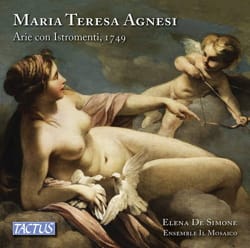
Maria Teresa AGNESI (1720-1795)
Arie con Istromenti, 1749
Elena De Simone (mezzo-soprano), Ensemble Il Mosaico
Recorded 2018 — Istituto Diocesano di Musica Sacra ‘Santa Cecilia’, Verona, Italy
TACTUS TC720101 [68:33]
Maria Teresa Agnesi Pinottini has been hiding in plain sight for two and a half centuries—sister to the mathematician Maria Gaetana Agnesi, Kapellmeisterin to the Milanese court, composer of operas that actually got performed. Yet here we are in 2022, still treating her as a footnote. This Tactus release, drawing from her 1749 collection of concert arias, makes a case that won’t be easily dismissed.
The collection itself is a curious thing. Nine arias with obligato instruments—not merely continuo-accompanied showpieces but genuine chamber works where violin — cello, or flute engage the voice in genuine dialogue. Agnesi knew what she was doing.
“Son confusa pastorella” opens with a shepherd’s conventional bewilderment, but listen to how the; violin commentary undercuts the pastoral simplicity, chromatic inflections suggesting something darker beneath the Arcadian surface. The writing has real theatrical intelligence. Elena De Simone brings a mezzo of considerable warmth and flexibility to this repertoire, though the timbre occasionally turns opaque in the lower register—a minor issue, really, when the interpretive intelligence is this keen.
She understands that these arias, composed for the concert hall rather than the stage, require a different kind of projection. More intimate. Less about filling space than inhabiting it.
“Ah non son io che parlo” shows Agnesi’s command of the affective vocabulary. The aria depicts a speaker possessed, words not their own, and — well — the composer responds with harmonic restlessness that keeps circling back without quite resolving. De Simone navigates the long-breathed phrases with admirable control, though I wish she’d; taken more risks with the text—there’s an edge here she doesn’t quite find.
The instrumental writing deserves special mention. Ensemble Il Mosaico, a period-instrument group I confess I hadn’t encountered before, plays with both precision and genuine expressivity. In “Scherza il pastor” the flute obbligato doesn’t merely decorate; it creates a second character, and the players understand this.
You can almost hear the rosin dust settling on the strings.
The ten-minute span never feels long. That’s compositional craft meeting interpretation insight. What strikes me most forcefully is Agnesi’s harmonic language—conservative by mid-century standards, perhaps, but deployed with real personality.
She’ll set up a conventional cadential progression, then delay it just long enough to make you notice. “Afflitta e misera,” the longest aria at nearly twelve minutes, sustains interest through — subtle variations in orchestral texture and unexpected melodic turns that avoid mere sequence. De Simone’s voice has a slightly plangent quality that suits the melancholic numbers particularly well.
“Non piangete amati rai” finds her at her most affecting, the plea to beloved eyes not to weep rendered with genuine pathos. The violins here create a halo of sound around the voice—Agnesi clearly understood sonority as an expressive tool. The disc venue, a sacred music institute in Verona, provides ample but not excessive resonance.
Engineer Matteo Costa has captured the instrumental timbres with pleasing clarity, though De Simone’s voice occasionally recedes into the texture when it should emerge from it. The balance isn’t quite right in “Lo seguitai felice —” where the cello obbligato sometimes overshadows the vocal line. One substantial frustration: no texts included.
For repertoire this unfamiliar, that’s a real oversight. We can make educated guesses about the dramatic situations—pastoral laments, declarations of constancy, the usual Metastasian themes—but Agnesi’s specific word-setting deserves closer attention than this presentation allows. The performances themselves vary somewhat in intensity.
“Non dirmi crudele” finds both singer and ensemble fully engaged, the plea against cruelty rendered with appropriate urgency. But “Alla prigione antica,” closing the program, feels a bit perfunctory—as if everyone was ready to go home. It’s a small thing, but audible.
Still, this is valuable work. Agnesi emerges not as a curiosity or a quota-filler but as a composer of genuine accomplishment, writing in established forms with individual voice. The arias won’t displace Handel or Hasse from anyone’s affections, but they deserve more than archival obscurity.
De Simone and Il Mosaico make a persuasive case for their revival, even if the advocacy isn’t quite flawless. The real question is whether this music can sustain repeated listening, and I find that it can. Agnesi’s melodic invention, while not inexhaustible, has sufficient variety and — well — her dramatic instincts are sound enough to reward return visits.
This is craftsmanship of a high order—which is, finally, what we should expect from a court Kapellmeisterin who held her position on merit. Worth hearing. Worth having.