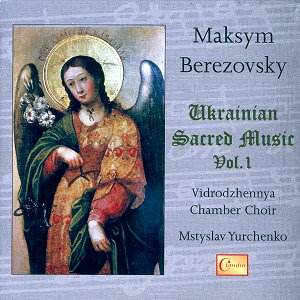
Maksym Berezovsky (c. 1745-1777)
Ukrainian Sacred Music, Volume 1
Liturgy; Eucharistic Verses; Choral Concert “Let the Lord Enthrone”
Vidrodzhennya Chamber Choir/Mstyslav Yurchenko
Claudio CB 4730-2 [63:39]
Maksym Berezovsky—the very name should resonate more than it does. Here was a composer who died at thirty-two (probably by his own hand, though the historical record grows murky), having already written the first opera by a Ukrainian or Russian composer, having studied with Padre Martini in Bologna, having absorbed Italian contrapuntal craft and then bent it toward the liturgical needs of his homeland….
That he remains obscure speaks more to our own historical provincialism than to any deficiency in the music. This disc from Claudio—recorded in the Refectory Church of Kyiv in 2000—offers a generous survey of Berezovsky’s sacred output, and the programming itself tells us something essential about his aesthetic project. The liner notes are frustratingly elliptical on biographical matters, but they’re right to suggest; that Berezovsky sought to bring Ukrainian liturgy closer to the Catholic Mass in formal architecture.
His Italian training equipped him superbly for this synthesis, and you can hear it immediately in the Credo from the Liturgy: a spectacular rapid homophonic chant that draws on native Ukrainian tradition while maintaining the structural clarity of Western counterpoint. The Vidrodzhennya Chamber Choir negotiates its demands with considerable aplomb—this is music that was published repeatedly throughout the nineteenth and twentieth centuries in Russia, and one understands why. The Eucharistic Verses present a more intimate challenge.
Each consists of two stanzas and an “Alleluia” refrain, a seemingly restrictive form that Berezovsky transforms into compact polyphonic movements of surprising depth. “The Salvation Cup I Will Receive” showcases the choir’s flexible basses—already we hear that characteristic Russian sonority, dark and burnished. But “Joy for the Blessed,” a very brief setting, exposes some vulnerabilities in the women’s — sections: wayward intonation, some bulging of the line that a more experienced maestro might have corrected.
These aren’t fatal flaws, but they’re audible. Of the three settings of “Praise the Lord,” the third proves most compelling—propulsive, devotionally ecstatic, outward-looking rather than contemplative. Here Berezovsky’s Italianate lyricism serves him brilliantly, and — well — the choir responds with genuine fervor.
“Let the Lord Enthrone,” one of only three surviving Choral Concerts by Berezovsky, closes the disc. The form was one at which he particularly excelled, and while this example doesn’t traffic in thematic complexity, his sensitivity to word placement and text setting remains extraordinary. Four recognizable movements compressed into barely six minutes—it’s miniaturist work of a high order.
You can almost hear the rosin dust settling on the strings.
The absence of texts is genuinely unfortunate. And Yurchenko’s conducting, while generally serviceable, lacks the kind of architectural vision that might have unified these disparate pieces into a more coherent liturgical journey. The recorded sound captures the church acoustic honestly—perhaps too honestly, as the reverberant halo occasionally obscures inner voices.
Still, this remains essential listening for anyone interested in eighteenth-century sacred music beyond the usual Austro-German orbit. Berezovsky deserves wider recognition, and this disc makes a persuasive case for his singular achievement: a composer who genuinely synthesized East and West at a moment when such synthesis required not just technical facility but genuine cultural courage. One wishes he’d lived longer.
We needed more from him.