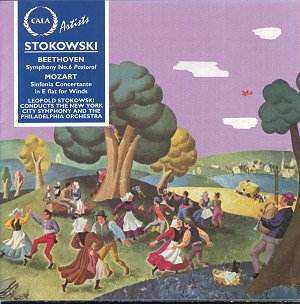
STOKOWSKI
Mozart: Sinfonia Concertante in E-flat major, K. 297b
Beethoven: Symphony No. 6 in F major, Op.
68 (“Pastoral”) Marcel Tabuteau, oboe; Bernard Portnoy, clarinet; Sol Schoenbach, bassoon; Mason Jones, horn Philadelphia Orchestra (Mozart); New York City Symphony Orchestra (Beethoven) Leopold Stokowski, conductor Recorded 1940 (Mozart), 1945 (Beethoven) CALA CACD 0523 [76:22]; — The received wisdom about Stokowski—that he was hopeless in the classics, a showman who belonged with Tchaikovsky and Wagner but had no business near Mozart or Beethoven—collapses rather spectacularly when confronted with actual evidence. This disc provides plenty of it. The Mozart dates from 1940, when Stokowski still commanded the Philadelphia Orchestra at its zenith.
More remarkable: it represents his only commercial Mozart production of the period, if we charitably overlook a 1919 Minuet extracted from the G minor Symphony. One wonders why he didn’t record more. The Sinfonia Concertante for winds receives a performance of such poise and collective understanding that it sounds less like four soloists with orchestra than a single organism breathing together.
Marcel Tabuteau—twenty-five years into his Philadelphia tenure by then—was the most famous oboist in America, — and his tone here possesses that reedy, slightly nasal quality that characterized the old French school. But listen to Bernard Portnoy’s clarinet work in the slow movement. The phrasing is limpid, yes, but also metrically flexible in ways that would give period-instrument purists apoplexy.
He stretches phrases, pulls back, surges forward—all with an inevitability that suggests Mozart himself might have approved, historical evidence be damned. The blending of timbres is what Stokowski did better than almost anyone. Textures here are pliant without being soft-focused, inflections subtle without becoming precious.
The horn (Mason Jones, another Philadelphia legend) emerges and recedes with perfect judgment. This is chamber music on a large scale, and it works. —
The Beethoven presents different challenges and different rewards.
This 1945 Carnegie Hall recording was released on a Camden LP in the 1950s under the preposterous fiction that it featured something called; the “Sutton Symphony Orchestra.” It was, of course, the New York City Symphony—Stokowski’s short-lived ensemble that produced only three complete recordings before disbanding. The sound captures considerable ambient space, perhaps too much in the softer passages, but the ensemble’s character comes through clearly enough. The first movement proceeds with unusual fleetness.
Stokowski takes the exposition repeat—not a given in 1945—and maintains momentum without ever sounding rushed. His phrasing in the main theme emphasizes the dotted rhythms without exaggeration, and the transition to the second subject has a natural ease that more literal-minded conductors miss. But then comes “Scene by the Brook,” and here Stokowski makes his most controversial choice: sixteen minutes.
The subtle intake of breath before the pianist’s attack.
Sixteen! Most conductors manage it in eleven or twelve. The tempo is genuinely slow, almost static in places, yet the realization never loses its thread.
Stokowski shapes the inner voices with extraordinary care—listen to how the second violins emerge at measure 67, or how the cellos articulate their chromatic descent before the cadenza. The bird calls at the end sound genuinely distant, not merely soft. Will everyone love this?
Certainly not. It’s an idiosyncratic view, deeply held and somewhat perverse. But it’s also involving in ways that more conventional readings often aren’t.
Stokowski believed something about this music—something about stillness and contemplation—and he committed to it fully. The Storm erupts with terrifying violence (the engineering captures impressive dynamic range for 1945), and the "finale" achieves real serenity without sentimentality. The final pages, with their gently rocking rhythm and gradually thinning texture, are quite refined.
The transfers are outstanding throughout—CALA has done its usual careful work. Surface noise is minimal, and the tonal spectrum sounds natural for the period. Presentation includes useful notes, though one wishes for more detail about the New York City Symphony itself.
This disc won’t convert those who’ve already decided Stokowski was a charlatan in this repertoire. But for listeners willing to hear these works through different ears—ears attached to a mind of considerable sophistication and conviction—the rewards are substantial. The Mozart alone justifies the purchase, and the Beethoven, for all its eccentricities, reveals a leader thinking deeply about music he clearly loved.
That’s more than enough.