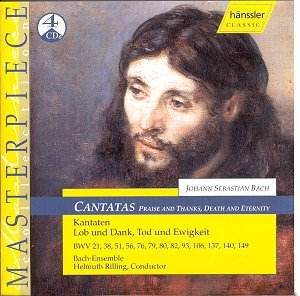
BACH: Cantatas Ich hatte viel Bekümmernis, BWV 21; Aus tiefer Not schrei ich zu dir, BWV 38; Jauchzet Gott in allen Landen, BWV 51; Ich will den Kreuzstab gerne tragen, BWV 56; Die Himmel erzählen die Ehre Gottes, BWV 76; Gott der Herr ist Sonn und Schild, BWV 79; Ein feste Burg ist unser Gott, BWV 80; Ich habe genug, BWV 82; Wer nur den lieben Gott lässt walten, BWV 93; Gottes Zeit ist die allerbeste Zeit (Actus tragicus), BWV 106; Lobe den Herren, den mächtigen König — der Ehren, BWV 137; Wachet auf, ruft uns die Stimme, BWV 140; Man singet mit Freuden vom Sieg, BWV 149 Arleen Auger, Nancy Amini, Eva Csapó (sopranos); Gabriele Schreckenbach, Julia Hamari, Helen Watts, Karen Hagermann, Ann Murray, Mechtild Georg, Hanna Schwarz (altos); Adalbert Kraus, Lutz-Michael Härder, Douglas Robinson, Aldo Baldin (tenors); Philippe Huttenlocher, Walter Heldwein, Sigmund Nimsgern, Wolfgang Schöne, Norman Anderson, Dietrich Fischer-Dieskau (basses); Gächinger Kantorei Stuttgart, Indiana University Chamber Singers, Bach-Collegium Stuttgart, Württemberg Chamber Players / Helmuth Rilling Hänssler Classic 94028 (4 CDs: 73:13, 76:25, 78:19, 69:25). Recorded 1975-1984, Stuttgart and Heidelberg. —
Helmuth Rilling’s Bach cantata project—all 200-plus works recorded between 1969 and 1985, in time for the tercentenary—remains one of those monuments you can’t quite dismiss even when you want to.
It’s there. It happened. And now Hänssler repackages selected chunks at superbudget prices, this four-disc set offering thirteen cantatas that range from the early — Actus tragicus to the trumpet-blazing glories of BWV 51 and the chorale cantatas that represent Bach at his most structurally assured.
The question isn’t whether Rilling’s achievement deserves respect. Of course it does. The question is whether these performances, recorded in an aesthetic moment now receding rapidly into history, offer more than documentary interest.
They do, actually—though not without reservations. Rilling’s approach descends directly from Karl Richter: big choirs, modern instruments, tempos that favor breadth over dance, a certain solemnity of utterance. The opening chorus of Ein feste Burg sounds like a fortified city rather than a congregational hymn—massive, weighty, the brass fanfares almost martial.
Some will find this too much. I confess a sneaking affection for it, even as I recognize that the current scholarly consensus points elsewhere. But Bach survives all interpretive fashions, and there’s something to be said for performances that don’t apologize for their romantic inheritance.
Where Rilling consistently triumphs is in his soloists. Arleen Auger’s BWV 51 is simply glorious—the voice riding those stratospheric trumpet lines with a security and radiance that never turns brittle, her ornaments stylish without becoming fussy. Listen to how she shapes “Sei Lob und Preis mit Ehren” in the final chorale, the tone floating yet firmly supported.
This is singing that reminds you why we fell in love with this music in the first place. Fischer-Dieskau, predictably, dominates the two solo bass cantatas. His Ich will den Kreuzstab gerne tragen and — well — Ich habe genug were already in his; discography via those Richter recordings for Archiv, and I can’t say these later traversals surpass them.
You can almost hear the rosin dust settling on the strings.
But they’re hardly negligible. The voice by the early 1980s had darkened, lost some of its easy upper range—you hear him managing rather than simply inhabiting the lines. Yet the intelligence remains formidable.
His shaping of “Schlummert ein” in BWV 82 finds that miraculous balance between lullaby and leave-taking, the oboe; obbligato (beautifully played, though I didn’t catch the player’s name in the documentation) weaving around the voice like incense. The documentation. Yes.
Here’s where Hänssler’s economies become problematic. The physical booklet offers almost nothing—you’re directed to download texts and notes from the website. Fine in theory, I suppose, though it rather defeats the point of owning physical discs.
And when I tried the website, the navigation proved… let’s say imperfect. Budget pricing shouldn’t mean information starvation.
Rilling’s continuo realizations tend toward the expansive—cellos reinforcing bass lines where a more ascetic approach might let the voice stand alone, organ registrations that fill every acoustic corner. In the intimate BWV 82, this can feel intrusive. The opening “Ich habe genug” wants to breathe, to sigh, and Rilling’s full-bodied accompaniment sometimes works against that affect.
Conversely, in the big chorale fantasias like BWV 80 and BWV 140, the richness pays dividends. The famous “Zion hört die Wächter singen” emerges with genuine warmth, the strings’ running eighth-notes providing a cushion of sound that supports rather than obscures. Tempos generally favor the moderate.
Rilling rarely rushes, and — well — his "allegro"s could often move with more spring. But there’s compensation in clarity of texture—you can actually hear what the second violins are doing in those dense contrapuntal passages. The Gächinger Kantorei sings with disciplined blend, though the vibrato is fuller than current taste prefers.
Mixed voices, of course, not the all-male forces some scholars insist Bach would have used. I’m ag