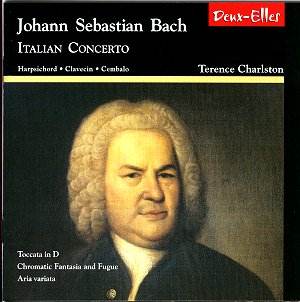
Johann Sebastian Bach: Italian Concerto and Other Harpsichord Works Terence Charlston, harpsichord Deux-Elles DXL 1017 [75:00] Recorded November 1999 The harpsichord anthology has become something of a lost art—not; the collection of suites or variations that Bach himself organized with such architectural precision, but the recital disc that draws from the corners and margins of a composer’s output. Terence Charlston has assembled just such a program here, and while the results are decidedly uneven, there’s enough genuine insight to reward patient listening. The centerpiece, inevitably, is the Italian Concerto in F major, BWV 971.
Charlston approaches the opening "Allegro" with what I can only describe as excessive caution. The tempo drags; where Glenn Gould found electrical current and Wanda Landowska discovered theatrical grandeur, Charlston seems to be negotiating a particularly treacherous staircase in the dark. This is Bach domesticated, Bach with the edges filed down.
The architecture remains visible—those alternations between tutti and solo writing that justify the work’s title—but the energy dissipates. Yet something shifts in the "Andante". Here Charlston’s restraint becomes contemplation rather than timidity.
The ornaments fall naturally, without the fussy over-articulation that mars so many period-instrument performances. He understands that this movement breathes, that its long melodic lines need space to unfold. Listen to how he shapes the descending chromatic bass around 2:30—there’s real harmonic awareness there, a sense of where the dissonance wants to resolve.
The "Presto" "finale" recovers much of the momentum that the first movement lacked, — though I wish Charlston had trusted his fingers more in the rapid passagework. There are moments—fleeting, but unmistakable—where you hear him pull back, as if afraid the instrument might run away from him. Andrew Garlick’s Ruckers copy deserves its own paragraph.
This is a magnificent instrument, recorded with unusual clarity by Deux-Elles. The two-manual registration allows for genuine dynamic contrast without resorting to the terraced effects that can make harpsichord listening so fatiguing…. In the D major Toccata — BWV 912, which opens the disc, you hear the full range of the instrument’s color—the bright, almost nasal quality of the upper register, the satisfying thud of the bass notes.
Charlston plays this early work (probably from the Weimar years) with appropriate swagger, though he misses some of the improvisatory freedom that should animate its episodic structure. The real discovery here is the Aria variata alla maniera italiana, BWV 989. This set of ten variations on a rather four-square theme dates from Bach’s youth, perhaps as early as 1705, and it rarely appears on disc.
One understands why—it lacks the contrapuntal density of the mature Bach, and the variations sometimes feel more like finger exercises than fully realized musical statements. But Charlston makes a persuasive case for its charms, particularly in the refined fourth variation and the surprisingly chromatic eighth. His ornamentation remains tasteful throughout; he resists the temptation to gild what is already adequately decorated.
The inclusion of the Goldberg Aria (here titled simply “Aria from the Clavierbüchlein for Anna Magdalena Bach,” BWV 988) strikes me as a miscalculation. Divorced from the thirty variations that transform and — well — transfigure it, the aria sounds almost banal—pretty, certainly, but insufficient. Charlston plays it beautifully, with just enough rubato to suggest flexibility without distorting the phrase structure.
The maestro’s presence feels palpable even in this studio setting.
Still, it feels like a teaser, an advertisement for a disc that doesn’t exist. Much more successful is the Prelude in C minor, BWV 999, originally for lute and here performed with the harpsichord’s lute stop engaged. The resulting sound—dry, percussive, with minimal sustain—approximates the plucked string texture surprisingly well.
Charlston’s rhythmic control in this piece is exemplary; he understands that the repeated note patterns create their own hypnotic momentum, that the music needs to flow without seeming to hurry. The Chromatic Fantasia and Fugue in D minor, BWV 903, receives a realization that hovers somewhere between competence and inspiration. The fantasia’s recitative-like opening passages sound tentative—Charlston seems uncertain whether to emphasize the harmonic audacity or the rhetorical gesture.
He settles for a middle path that satisfies neither impulse completely. The fugue fares better, though I wish he’d allowed more breathing room between the subject entries. This is music that thrives on accumulation, on the gradual intensification of contrapuntal density, and Charlston’s steady tempo doesn’t quite capture that sense of mounting pressure.
The miscellaneous shorter works that fill out the disc—the Prelude and Fughetta in G major, BWV 902, and the Fantasia in C minor, BWV 906—receive adequate rather than memorable performances. These are fragments, really, pieces that Bach left incomplete or never fully developed, and they resist the kind of interpretive insight that might elevate them beyond their status as curiosities. Seventy-five minutes is too much music, particularly when the interpretive approach remains as consistent as it does here.
Charlston has a single manner—careful, refined, somewhat reticent—and while that serves certain pieces well, it becomes monotonous over the course of a full disc. One longs for more variety of attack, more willingness to take risks, more personality. Still, this is honest work by a performer who clearly respects both the instrument and the repertoire.
The sound quality alone makes the disc worth hearing—this is how a harpsichord should be recorded, with presence but not aggression, clarity but not clinical sterility. And for listeners curious about Bach’s lesser-known keyboard works, Charlston provides a serviceable introduction, even if it’s not quite the revelatory experience one might hope for. A respectable achievement, then, undermined somewhat by interpretive caution and programming that overstays its welcome.
Worth hearing, particularly for the instrument and the rare repertoire, but unlikely to displace the classic recordings in anyone’s collection.