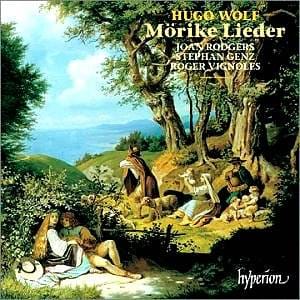
# Hugo Wolf: Mörike Lieder
Joan Rodgers, soprano; Stephan Genz, baritone; Roger Vignoles, piano
Hyperion CDA67311/2 (2 CDs: 74:09, 71:59)
Recorded January 1999 and October 2000, Clara-Wieck-Auditorium, Heidelberg-Sandhausen
There was a time—not so long ago, really—when admitting to difficulties with Wolf marked you as a philistine. Ernest Newman’s 1907 study had achieved scriptural status by the 1930s; Newman himself declared in 1918 that “the supreme master of form in music is not Beethoven or Wagner but Hugo Wolf.” The Wolf Society edition on HMV, featuring the greatest lieder singers of the interwar years, became holy writ. Later, Walter Legge marshaled his formidable forces—Schwarzkopf, Fischer-Dieskau, Gerald Moore—into thorough LP cycles that defined how we were supposed to hear this music.
And yet. Put your hand on your heart: after fifteen or twenty of these songs, wouldn’t some part of you—some uncultivated, unrepentant part—long for a simple melody? When that voice from La Scala’s loggione cried out during a Fischer-Dieskau Wolf recital, “Let’s have a bit of Verdi!”, was he quite the simpleton the cognoscenti took him for?
I’m playing devil’s advocate, of course. But Wolf is difficult. He requires work—repeated hearings to penetrate the density of his word-painting, the intricate marriage of voice and piano, the harmonic subtleties that refuse to declare themselves on first acquaintance.
The Mörike settings contain the whole of romantic Germany: landscape painting and religious ecstasy, folk legends and not-so-simple love. What they lack—and this is both limitation and glory—is Brahms’s instinctive melodic generosity, that quality which allows great music to seduce the ear before engaging the mind. —
Hyperion’s presentation exemplifies everything we’ve come to expect from this label.
Richard Stokes contributes a fine 1995 essay on Mörike alongside translations that fill gaps left by earlier efforts (Eric Sams and Paul Hindemith among the distinguished names here). Roger Vignoles provides not merely an introduction but virtually bar-by-bar analyses of individual songs. His prose style proves so interchangeable with Graham Johnson’s work on the Schubert and — well — Schumann editions that one would be hard-pressed to identify which taught the other the importance of being earnest.
Lucky Hyperion, possessing both Tweedledum and — well — Tweedledee! The distribution of songs between soprano and baritone follows the template established by Schwarzkopf and you-know-who—and why not? It works.
(Though one day it might prove interesting to try a mezzo and tenor, or even four voices, assuming Hyperion could engage the same quartet for simultaneous projects and keep costs reasonable.)
Joan Rodgers brings a light, golden-toned instrument that moves with startling ease through the upper register, where it acquires a vibrato that remains, for now, attractive rather than intrusive. I hope it stays that way. But she can also darken her sound effectively in the lower register, achieving a plangent quality that serves the more sober songs well.
Listen to the contrast between “Nixe Binsefuss”—all dulcet high tones—and the immediately following “Gesang Weylas” with its graver delivery. In “Lied vom Winde” she creates drama through characterization rather than volume; Vignoles matches her, supplying theatrical intensity without degenerating into mere noise. The comic songs find her equally at home: the bleary-eyed morning-after of “Zur Warnung” emerges with just the right touch of rueful self-awareness.
Throughout her disc, Rodgers maintains an exemplary legato line. Words emerge with perfect clarity, yet they don’t fracture the musical phrase. This is fundamental bel canto technique—the ability to sing “De-nee-shweiter” rather than “Den; (stop) ich (stop) weiter,” preserving the arc of the phrase while honoring the text.
Which brings me to Stephan Genz. He possesses a lovely, warm baritone, absolutely even throughout its range, unfailingly true in intonation, communicative with the words. That last quality, however, raises questions.
Too often he separates syllables at the expense of the legato line. Take “Heimweh”: the second line begins “Den ich weiter.” Genz articulates it as distinct syllables rather than allowing them to flow into each other. Fischer-Dieskau knew all about bel canto and applied it when he chose to—but; on other occasions he opted for syllabic separation, and Genz follows him in this.
I recall reading an interview years ago with a young Wagnerian baritone (the name escapes me now) who described seeking counsel from Hans Hotter and learning from him the paramount importance of true legato. There’s always the danger that what isn’t bel canto might become brutto canto—ugly singing. Genz never crosses that line; much of his work here is genuinely refined.
But I wish he’d do more work on this fundamental aspect of vocal artistry. The difference between good singing and great singing often resides precisely here, in the ability to honor both text and musical line without sacrificing either. —
I didn’t pull out the revered historical recordings for comparison—the set struck me as sufficiently fine to stand on its own merits.
This follows an honorable tradition: light soprano and resonant baritone, supported by a pianist of the first rank (Vignoles belongs in the distinguished line of British accompanists that extends from Harold Craxton through Gerald Moore). The album quality proves exemplary, the acoustic of the Clara-Wieck-Auditorium providing warmth without blurring detail. All those who care about the continuation of great lieder singing in our time will hear this with rejoicing.
It represents serious artistry in the service of demanding repertoire. I only wish—and only a little bit—that tradition might have been a mite less scrupulously honored, — that some element of interpretive surprise might have emerged from these thoughtful, accomplished, slightly too-careful performances. Still: this is Wolf sung with intelligence, technical security, and genuine musical understanding.
The subtle intake of breath before the pianist’s attack.
In an age when such qualities grow increasingly rare, that counts for a