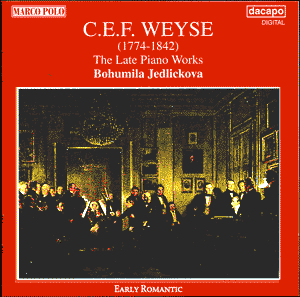
Christoph Ernst Friedrich Weyse: The Late Piano Works
Eight Etudes, Op. 51; Four Etudes, Op. 60; Allegro di bravura in A Minor, Op.
50
Bohumila Jedličková, piano
Marco Polo/Dacapo DCCD 9307 [50:23]
Here’s a puzzle worth pondering. Why did Christoph Ernst Friedrich Weyse—Copenhagen’s most celebrated organist, composer of songs that became part of; Danish national identity, a man who’d spent twenty years ignoring the piano—suddenly, at fifty-five, become a romantic? The answer involves Ignaz Moscheles, whose 1829 Copenhagen visit apparently jolted Weyse from compositional complacency.
What emerged were these twelve etudes and — well — the substantial A Minor Allegro di bravura, works that sound nothing like the classicist pieces Weyse had written in his youth. It’s as if Mozart’s devoted acolyte—a man who, remarkably, seems never to have registered Beethoven’s existence—woke up one morning speaking Chopin’s language before Chopin had fully articulated it himself. The transformation is startling.
Weyse’s youthful "allegro"s — those virtuoso showpieces that Johann Friedrich Reichardt championed in 1796, belonged squarely to the eighteenth century. But these late works, composed between 1831 and 1837, inhabit different territory entirely—chromatic, exploratory, shot through with that peculiar melancholy that marks early romanticism. The "Allegro" moderato in C Minor from Op.
51 opens with a restless figure that seems to question its own tonality; the "Andante" ben marcato from Op. 60, marked “il canto” in the score, sings with an intimacy Mozart never attempted at the keyboard. Bohumila Jedličková, who won the Carl Nielsen Prize and studied at Juilliard, understands what’s at stake here.
The warm acoustics of the concert hall seem to breathe through the recording.
These aren’t Chopin etudes—they lack that level of sustained inspiration—but they’re far more than academic exercises. Jedličková plays them as if they matter, which they do. Her touch in the Prestissimo in C Major has clarity without brittleness; she shapes — the Allegretto in E-flat Major with genuine affection for its odd, somewhat square melodic material.
When she hits the tremolo passages in the A Minor Allegro di bravura—that effect Moscheles taught Weyse, audible around 3:00 and 5:50—the piano really shimmers. The production itself, made in Copenhagen in 1993 and reissued here, captures the instrument warmly. Too warmly, perhaps—there’s a slight blur in the bass during the more turbulent moments of the Vivace in E-flat Minor.
The venue goes unnamed in the documentation, which seems careless, though the acoustic suggests a medium-sized hall with sympathetic resonance. What’s most intriguing about these pieces is their experimental quality. Weyse clearly studied what the younger generation was doing—those chromatic scales that thread through nearly every etude didn’t come from Haydn—but his harmonic language remains fundamentally conservative.
The result is music that occupies an odd transitional space: romantic in gesture and sentiment, classical in its underlying grammar. The two etudes in E major and F major from Op. 60 show Weyse at his most individual, particularly the E major with its almost Schumannesque alternation between declamatory and lyrical modes.
Jedličková’s commitment never wavers, even when Weyse’s invention does. Some of these etudes are very short—barely two minutes—and not all of them justify extended listening. The Allegretto in C-sharp Minor, for instance, seems to circle its material without quite knowing where to land.
But Jedličková plays it with the same conviction she brings to the more substantial pieces, finding poetry in what might otherwise sound merely pedagogical. The program notes deserve mention—detailed to a fault — complete with musical examples explaining that tremolo craft. One wishes similar care had been taken with basic documentation like the recording venue.
This reissue serves a useful purpose. Weyse isn’t a major figure, but he’s a fascinating one: a man who — lived long enough to witness his own obsolescence and responded by reinventing himself. These late piano works document that reinvention with touching earnestness.
They won’t displace Chopin or Schumann in anyone’s affections, but they illuminate an interesting — corner of early romantic piano literature—and Jedličková plays them as though they were masterpieces. That’s advocacy of the highest order.