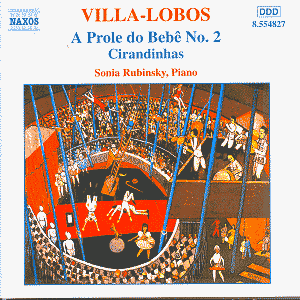
VILLA-LOBOS: Piano Music, Volume 2
A Lenda do Caboclo; Ondulando; Valsa da Dor; A Prole do Bebê No. 2; Cirandinhas
Sonia Rubinsky, piano
Naxos 8.554827 [66:48]
The second volume of Sonia Rubinsky’s Villa-Lobos survey for Naxos arrives with the kind of quiet authority that makes you wonder why we’ve been waiting so long for someone to record this repertoire with such complete understanding. Not flash, not exotic posturing—just deeply inhabited pianism that knows exactly what these scores demand.
A Prole do Bebê (The Baby’s Family), Book Two, occupies the disc’s center of gravity, and — well — rightly so. Where the first book—which Rubinsky recorded previously—charms with its relatively straightforward folk materials, this second set subjects Brazilian melody to the most extraordinary harmonic violence. I don’t use that word lightly.
Villa-Lobos was writing in 1921, fresh from his encounter with Parisian modernism, and — well — the music seethes with polytonal clusters, savage rhythmic displacements, and an almost Ivesian disregard for conventional piano sonority. “O Ursozinho de algodão” (The Little Cotton Bear) pounds along in perpetual motion, the left hand hammering out accents that seem designed to knock the melody permanently off-balance. It shouldn’t cohere.
That it does—and brilliantly—testifies both to Villa-Lobos’s structural cunning and to Rubinsky’s ability to clarify texture without sanitizing it. She understands something crucial about this composer: the folk elements aren’t decorative. They’re structural DNA, twisted and refracted through a harmonic language that owes as much to Ravel as to the choro bands of Rio.
In “A Baratinha de papel” (The Little Paper Bug), jazzy syncopations emerge not as quotation but as organic outgrowth of the melodic material itself. Rubinsky’s touch here—dry, precise, faintly percussive—captures the music’s strange blend of sophistication and earthiness. The Naxos engineers, production in Toronto’s Grace Church on the Hill, have given her; a piano sound that’s immediate without being harsh, resonant without blurring the often ferocious counterpoint.
The Cirandinhas (Little Round Songs) make for welcome relief after the Second Book’s formidable demands. These miniatures—most under ninety seconds—present Villa-Lobos in his most directly appealing guise, though even here the harmonic language can turn piquant without warning. Rubinsky plays them with affection but not condescension — finding real character in pieces like “Lindos olhos que ela tem,” where a simple children’s tune acquires unexpected chromatic shadows.
I’m less convinced by the three standalone pieces that open the disc. “A Lenda do Caboclo,” with its hypnotic, melancholy circularity, receives a reading perhaps too measured—the piece can feel static, and Rubinsky doesn’t quite find the rhythmic flexibility to make its repetitions accumulate meaning. “Ondulando” sits comfortably in salon territory, which is fine, though one wonders if Villa-Lobos wasn’t already moving beyond such gestures by 1914.
“Valsa da Dor” (Waltz of Sorrow) interests more: you can hear the composer absorbing Rachmaninov’s harmonic richness while maintaining his own melodic profile. The transformation from waltz to something closer to chanson triste happens gradually, and Rubinsky traces the metamorphosis with sensitivity. But it’s the Second Book of A Prole do Bebê that makes this disc essential.
These pieces remain stubbornly underrepformed—too difficult for all but the most technically accomplished pianists, too Brazilian (whatever that means) for programmers who can’t see past Debussy when they think “early twentieth-century piano music.” Rubinsky has both the fingers and the musical intelligence to make the case for them. Her octaves in “O Boizinho de chumbo” have real bite; the polyrhythmic complexities of “O Camondongo de massa” emerge with startling clarity; and she somehow finds singing tone in passages that look, on the page, like pure percussion. James Melo’s notes provide useful context without overreaching.
The recorded sound, as mentioned, serves the music well—clear sightlines into the texture, natural warmth in the mid-range, enough bass presence to register Villa-Lobos’s often hefty left-hand writing. This is serious pianism in service of seriously undervalued music. Rubinsky doesn’t make the mistake of treating Villa-Lobos as a primitive genius whose rough edges need smoothing.
She plays what’s written, trusts the composer’s instincts, and lets the music’s strange beauty speak for itself. The result is the most convincing case I’ve heard for this repertoire’s rightful place in the piano literature. Strongly recommended.