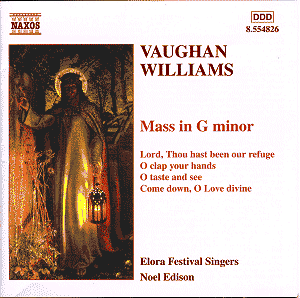
Ralph Vaughan Williams: Mass in G minor; Motets and Anthems
Elora Festival Singers/Noel Edison
Thomas Fitches, organ
Naxos 8.554826 [56:41]
The Mass in G minor sits at an odd angle in Vaughan Williams’s output—not quite Tudor pastiche, not quite twentieth-century modernism, but something more elusive. Written in 1922 for Gustav Holst’s Whitsuntide Singers, it emerged from the same creative wellspring as the Tallis Fantasia, yet it speaks with a different, more inward voice. Where the Fantasia luxuriates in spatial effects and orchestral color, the Mass works within the austere confines of unaccompanied double choir, finding its expressive range through modal harmony and the kind of long-breathed polyphony that Vaughan Williams absorbed from his years editing the English Hymnal.
The Elora Festival Singers bring considerable technical polish to this music. Edison’s choir produces a lean, focused sound—no cathedral wobble here, no excessive vibrato clouding the modal progressions. The opening Kyrie unfolds with appropriate solemnity, and the recorded acoustic (split between Toronto’s St.
You can almost hear the rosin dust settling on the strings.
Mary Magdalene and Elora’s St. Mary’s Church) provides enough resonance without blurring contrapuntal lines. These are capable musicians who understand the music’s architecture.
But understanding architecture isn’t the same as inhabiting it. What’s missing is that sense of inevitable forward motion, the way the greatest performances of this work—and yes, Matthew Best’s Hyperion album with the Corydon Singers remains the touchstone—make even the most static passages feel like they’re moving toward something. The Elora singers phrase competently, sometimes beautifully, but there’s a certain generalized quality to their approach.
Listen to the Sanctus, where Vaughan Williams builds toward that ecstatic “Hosanna in excelsis”—the climax arrives on schedule, the — dynamics are properly observed, but the accumulated tension that should make that moment feel like a release never quite materializes. The shorter works fare somewhat better. “O clap your hands” gets a vigorous reading, though one wishes for more bite in the rhythmic articulation.
“Lord, Thou hast been our refuge,” that extraordinary setting of Psalm 90 with its grinding dissonances and bleak modal landscape, sounds appropriately somber; but lacks the last measure of intensity—the sense that these singers have really grappled with the text’s vision of human mortality against divine eternity. Thomas Fitches provides sensitive organ support in the hymn “Come down, O Love divine” (to the composer’s own tune Down Ampney), though the instrument itself sounds a bit undernourished in the bass register. The recording captures the choir’s dynamic range effectively; one can hear individual voice parts emerging and receding within the texture.
That’s no small achievement in a cappella choral music, where balance issues can plague even experienced engineers. “O taste and — well — see,” written for the Queen’s coronation in 1953, receives a sweet-toned account that perhaps errs on the side of blandness—this music can take more robust treatment. The “Prayer to the Father of Heaven” and “O vos omnes” are done with appropriate devotional feeling, if not much individuality.
Here’s the problem: this is a well-executed but somewhat anonymous traversal of repertoire that demands more specific interpretive choices. Vaughan Williams’s modal writing can sound merely archaic if performers don’t find the harmonic tension within it, don’t articulate how his voice-leading creates expectation and resolution by different rules than functional tonality. The Elora Singers give us the notes, the correct dynamics, proper ensemble—but the music’s interior life remains somewhat veiled.
At Naxos pricing, this makes a decent introduction to Vaughan Williams’s choral music for listeners building a library. The engineering is professional, the performances are polished and — well — mistake-free. But those who already know this repertoire will find themselves reaching for other recordings—Best’s Mass, or the various collections that include these motets performed with more distinctive character.
Competence has its value. It’s just not the same as illumination. Terry Barfoot’s original review noted similar reservations, and — well — time hasn’t altered the essential equation.
Recommendable with reservations.