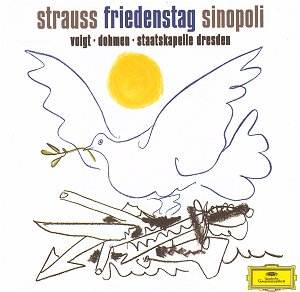
Richard Strauss: Friedenstag, op. 81
Albert Dohmen (Commandant), Deborah Voigt (Maria), Alfred Reiter (Wachtmeister), Tom Martinsen (Schätze), Jochen Küpper (Konstabel), André Eckert (Musketier), Jürgen Commichau (Hornist), Jochen Schmeckenbecher (Offizier), Matthias Henneberg (Frontoffizier), Johan Botha (Ein Piemonteser), Attila Jun (Der Holsteiner), Jon Villars (Bürgermeister), Sami Luttinen (Prälat), Sabine Brohm (Frau aus dem Volke). Sächsischer Staatsopernchor Dresden; Sächsische Staatskapelle Dresden; Giuseppe Sinopoli, conductor.
EMI (originally Deutsche Grammophon 463 494-2). Recorded September 1999, Lukaskirche, Dresden. Compact disc, 76:03.
Friedenstag occupies one of those peculiar corners in Strauss’s output—important, undeniably sincere, yet somehow resistant to the kind of theatrical life that keeps Salome or Der Rosenkavalier in constant repertory. Written in 1938 while the composer navigated his increasingly treacherous relationship with the Nazi regime, this single-act opera stands as both a political statement (however oblique) and a compositional challenge that Strauss himself admitted didn’t quite suit his temperament.
The libretto—Josef Gregor’s rather stiff verses about a besieged fortress commandant during the Thirty Years’ War—lacks the psychological complexity or erotic charge that typically ignited Strauss’s imagination. He groused about it being “a tiring assignment,” and you can hear that occasionally in the score’s relative austerity. Yet there’s real nobility here, particularly in the choral writing, which anticipates some of the grave beauty he’d achieve in Capriccio.
The work’s peculiar gender imbalance—this is essentially a male-voice opera with one important female role—creates its own dramatic problems. Maria’s aria, where the Commandant’s wife pleads for life over death, stands as an oasis of Straussian lyricism in an otherwise martial landscape. It needs a singer who can summon both steel and tenderness.
Sinopoli’s posthumously released recording captures the Staatskapelle Dresden in typically resplendent form. The orchestral sonority has that particular Dresden sheen—burnished brass, warm strings that seem to glow from within. The Lukaskirche acoustic provides ample space without washing out detail, and the engineering balances the large forces with considerable skill. The warm acoustics of the hall seem to breathe through the recording.
Where this interpretation truly excels is in the choral writing. The Staatsopernchor delivers the kind of focused, unanimous sound that makes the work’s final scene—that great vision of reconciliation—genuinely moving rather than merely pompous. Listen to the way Sinopoli shapes the gradual accumulation of voices in the peace celebration; there’s architectural grandeur here, carefully built.
But the solo singing presents a more mixed picture. Albert Dohmen brings considerable intelligence to the Commandant, and his German diction is exemplary. Yet the voice itself lacks that particular bronze quality, that ring of innate authority, which Hans Hotter brought to this role in the legendary 1939 recording supervised by Strauss himself. Dohmen can sound effortful in the upper range, pushing rather than soaring. It’s competent work, sometimes even compelling—but not quite commanding.
Deborah Voigt’s Maria fares better, though with reservations. Her Wagnerian credentials serve her well in the role’s more declamatory passages, and she certainly has the vocal heft for Strauss’s orchestration. But in Maria’s crucial aria, where the music demands a kind of inward radiance, Voigt’s approach feels somewhat generalized. She sings the notes—sings them well, in fact—but doesn’t quite inhabit the text’s desperation. Compare this to Viorica Ursuleac in that 1939 recording, or even Sabine Hass for Sawallisch, and you hear the difference between accomplishment and eloquence.
The supporting cast performs serviceably without particular distinction. This matters more than it might in another opera, because Friedenstag depends on its ensemble scenes—the soldiers’ various perspectives on war and survival need individual characterization to avoid sounding like mere choral filler. Here they’re competently sung but rarely vivid.
Sinopoli’s conducting shows his characteristic attention to orchestral color, though I wonder whether he doesn’t sometimes linger too lovingly over inner voices at the expense of dramatic momentum. The opening scene’s tension—that sense of men slowly suffocating under siege—could grip harder. He finds moments of real beauty: the subtle way he voices the woodwinds during Maria’s entrance, the carefully calibrated crescendo as news of peace arrives. Yet I kept thinking of Clemens Krauss, who knew exactly how this music should breathe, having worked closely with Strauss. Krauss understood that Friedenstag, for all its high-minded idealism, needs theatrical urgency to overcome its somewhat didactic libretto. Sinopoli, for all his evident sincerity, sometimes lets the music settle when it should surge.
The competition remains formidable. That 1939 recording, despite its age, still speaks with unique authority—these were singers who understood this music’s original context. Sawallisch’s EMI production offers stronger solo singing across the board and perhaps a keener sense of dramatic pacing. Robert Hass’s version on Koch Classics has its advocates, though I find it less consistently inspired.
Where does this leave Sinopoli’s effort? As a beautifully recorded document of Dresden’s orchestral and choral excellence, it has considerable value. The sound quality surpasses its predecessors, and anyone wanting to hear Strauss’s orchestration in full sonic glory will find much to admire here. But as a complete theatrical experience, it doesn’t quite achieve first-rank status. The choral singing is magnificent, the orchestra plays splendidly, yet the work needs stronger individual voices—not just capable ones—to make its case convincingly.
Friedenstag is already fighting an uphill battle for repertory survival; it needs advocacy, not merely respect. This is a worthy addition to the catalog, certainly worth hearing for those exploring Strauss’s less-traveled paths. Just don’t expect it to displace the competition.