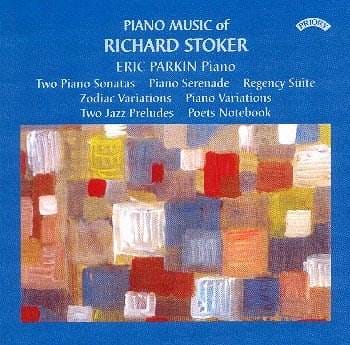
STOKER: Piano Music
Piano Serenade, Op. 17; Piano Sonata No. 1, Op.
26; A Poet’s Notebook, Op. 19; Piano Variations, Op. 45; Regency Suite, Op.
15; Two Jazz Preludes, Op. 63; Zodiac Variations, Op. 22; Piano Sonata No.
2, Op. 71
Eric Parkin (piano)
Priory PRCD 659 [79:00]
Richard Stoker—born 1938 in Castleford, West Riding—remains one of those composers whose relative obscurity has nothing whatever to do with merit. This disc offers substantial evidence that British music continues to overlook one of its more versatile and accomplished voices, a polymath who studied with Lennox Berkeley at the Royal Academy, took lessons with Britten and Nadia Boulanger, and has produced some 300 works spanning every major form.
That we have so little of this music on record—a handful of discs at most—represents a failure of programming imagination that has plagued British composers for generations. Eric Parkin, long associated with the piano music of Billy Mayerl and John Ireland, proves an ideal advocate. His touch has that particular clarity and rhythmic buoyancy these pieces demand, and in the Second Sonata—written expressly for; him—he navigates Stoker’s jazz-inflected writing with the ease of someone equally at home in Debussy and the cocktail lounge.
The earliest work here, the Regency Suite, Op. 15, assembled from pieces written between 1952 and 1959, already displays Stoker’s characteristic fingerprints: a flexible approach to serial mastery that never becomes doctrinaire, a fondness for cyclic forms, and an essentially French sensibility inherited from Berkeley. The “Minuet,” composed when Stoker was still a boy, contains cunning harmonic sidesteps at its cadences—those little chromatic evasions that suggest a tone row lurking beneath an otherwise diatonic surface.
The “"Scherzo",” ostensibly inspired by Picasso’s circus paintings, has a deliberate tonal chaos, figures tumbling over each other with controlled abandon. Parkin finds the right balance here between precision and playfulness. The Piano Serenade, Op.
17 (1962)—later orchestrated for strings—comprises five brief movements that pass almost too quickly. The opening “Prelude” inhabits that Berkeley-Poulenc universe of astringent lyricism; the “Air” maintains an almost frosty reserve until warmth seeps in near the close. But it’s the “Intermezzo” that arrests attention, a deeply considered miniature that Parkin shapes with particular care, allowing its melodic contours to breathe without sentimentality.
With the First Piano Sonata, Op. 26 (1967), we encounter Stoker at his most overtly modernist. Commissioned by the Romanian pianist Else Cross, this two-movement work takes Beethoven’s Opp.
90 and 111 as structural models—those compressed sonatas that create the illusion of larger architectures through internal contrast. The opening Ritmico has an impressionistic quality, themes emerging and dissolving before they fully coalesce. The longer second movement, described as a kind of passacaglia, achieves greater formal coherence, building to a bell-like coda.
It’s challenging music, more austere than most of what surrounds it on this disc, but never gratuitously difficult. A Poet’s Notebook, Op. 19 (1969) offers six thumbnail sketches—Ballad, Epigram, Elegy, Lampoon, Parody, Ode—that function rather like Prokofiev’s Visions Fugitives: fleeting — thoughts, pianistic experiments, ideas too compressed to sustain independent existence yet essential to understanding the composer’s developing language.
The “Elegy” has a poignant brevity; the “Parody” seems to glance at Britten’s Winter Words. Stoker can be almost profligate with good ideas, moving on before we’ve fully absorbed what he’s given us. The Zodiac Variations, Op.
22 (1965) prove far more approachable than the later Piano Variations — Op. 45 (1973), written for Rachmaninov’s centenary. The Zodiac set explores conventional pianistic idioms with wit and — well — imagination—onomatopoeia for Pisces’s swimming motions, Aries’s charging ram, the twang of Sagittarius’s bowstring.
The 1973 Variations, by contrast, feel deliberately constructed in the received avant-garde manner of their time, all concentration and cerebral intensity. Not everything convinces; some passages seem to tinkle rather than resonate. It’s perhaps the disc’s only real makeweight.
The Two Jazz Preludes, Op. 63 (1980) capture that 2 a.m. atmosphere at Ronnie Scott’s—smoky, intimate, slightly melancholic.
Parkin’s experience with light music serves him beautifully here; he understands the idiom from the inside, knows how to swing without exaggerating, how to let silence speak. But the revelation is the Second Sonata, Op. 71 (1992).
This five-movement work represents Stoker at his most confident and assured, synthesizing his various stylistic preoccupations into something genuinely distinctive. The opening Suonare (to sound, to peal like bells) balances romantic warmth with structural rigor, scales and pseudo-glissandi deployed with real pianistic imagination. The two Cantare movements explore jazz textures—the first more notated, the second allowing Parkin considerable melodic freedom—without ever descending into crossover banality.
The Scherzare discovers unexpected pleasures in whole-tone scales; there’s a touch of Debussy’s harmonic world refracted through Stoker’s serial sensibility. The final Toccare brings cyclic closure, referencing earlier material with satisfying inevitability. Parkin plays throughout with the expertise we’ve come to expect from his Ireland and Mayerl recordings—clean articulation, sensitive pedaling, an unerring sense of when to lean into jazz inflections and when to maintain classical restraint.
Priory’s sound captures the piano in a warm, resonant acoustic without excessive bloom. The program notes prove informative, and the cover reproduces one of Stoker’s own abstract