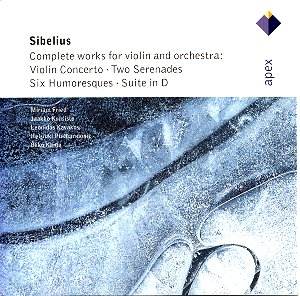
# Sibelius: Complete Music for Violin and — well — Orchestra
Violin Concerto in D minor, Op. 47; Six Humoresques, Opp. 87 & 89; Two Serenades, Op.
69; Suite in D minor for Violin and Orchestra Miriam Fried, Leonidas Kavakos, Jaakko Kuusisto, Jari Valo (violins); Helsinki Philharmonic Orchestra/Okko Kamu; Tapiola Sinfonietta/Jukka-Pekka Saraste; Kuopio Symphony Orchestra/Atso Almila; — Ostrobothnian Chamber Orchestra/Juha Kangas DECCA (originally Finlandia/Apex) 09274 06062 [79:17] — Here’s a sensible idea, long overdue: Sibelius’s complete output for solo violin and orchestra on a single disc. Not a crowded field, this—the composer’s violinistic imagination, so prodigal in the symphonies, produced surprisingly little concerted music. What exists, though, bears the unmistakable fingerprints of a man who knew the instrument from the inside, who had wrestled with it himself in those youthful dreams of a solo career that never quite materialized.
The centerpiece, naturally, is Miriam Fried’s 1988 recording of the Concerto with Okko Kamu and the Helsinki Philharmonic. This comes from her second encounter with the work—she’d already set down a well-received version for; Deutsche Grammophon in the early seventies, not long after winning the Queen Elisabeth Competition in Brussels. The later reading strikes me as the more considered, the more deeply inhabited performance.
Fried’s tone in the opening movement has that particular burnished quality, almost bronze-colored in the lower registers, that suits Sibelius’s Nordic melancholy. She takes considerable liberties with tempo in the expressive passages—pulling back, lingering over phrases in a way that some purists might find mannered. I don’t.
There’s real feeling here, not merely technical display. But I do have reservations. The slow movement, for all its eloquence, lacks the absolute purity of tonal production that Kyung-Wha Chung brought to her Decca production, or that Cho-Liang Lin achieved on Sony.
Fried’s vibrato occasionally widens beyond what the music’s austere poetry really wants. And the "finale"—well, here’s where things get complicated. Kamu and Fried adopt a relatively moderate tempo, emphasizing sonority and weight over the movement’s potential for sheer exhilaration.
It’s a valid interpretive choice, certainly, but one that costs the realization something in visceral excitement. The dance rhythms feel a shade too earthbound. Kamu, to his credit, partners with absolute sensitivity throughout.
The orchestral balance is exemplary—those tricky passages where the solo line must pierce through dense string writing never pose problems. The engineering captures the acoustic of the Helsinki concert hall with warmth and natural perspective. —
The real discovery here is Leonidas Kavakos in the Six Humoresques.
These pieces, composed in two sets (Op. 87 and Op. 89) during 1917-18, occupy a curious position in Sibelius’s catalogue—too substantial to dismiss as salon trifles, yet not quite achieving the concentrated intensity of the best late chamber works.
Kavakos, who has recorded both versions of the Violin Concerto for BIS with remarkable insight, understands the music’s elusive character. The fourth Humoresque, with its spectral harmonics and unsettling metric shifts, emerges with particular authority. The Tapiola Sinfonietta plays with idiomatic understanding; these musicians know this repertoire in their bones.
The two Serenades (Op. 69) receive competent if somewhat routine treatment from Jaakko Kuusisto and the Kuopio Symphony under Atso Almila. The first Serenade’s opening, with its gentle rocking motion, needs more poetry than we get here—the phrasing feels a bit square, the dynamic shaping insufficiently subtle.
The second Serenade fares better, its more robust character suiting Kuusisto’s somewhat literal approach. As for the Suite in D minor, performed by Jari Valo with the Ostrobothnian Chamber Company—this late work from 1929 presents problems that no performance can entirely solve. Sibelius was already well into his long silence, and the music sounds like it.
There are characteristic touches, certainly: a particularly fine slow movement with that familiar sense of vast, frozen distances. But the invention flags. One senses the composer’s creative exhaustion.
The reissue itself raises the usual questions about budget packaging. Why cram the annotation into microscopic print when there’s a completely blank page staring at you? And the documentation, while adequate, could be more generous in its discussion of these lesser-known works.
Still, as a survey of Sibelius’s violinistic output, this collection serves a useful purpose. Fried’s Concerto — despite my quibbles about the "finale", remains a performance of real distinction—warm-blooded, deeply felt, technically assured. The Kavakos Humoresques are valuable, period.
The remainder? Acceptable filler, though I’d not rush to these versions if alternatives existed. For anyone wanting to explore this corner of Sibelius’s output without assembling multiple discs, this Apex compilation makes sense.
Just don’t expect consistent inspiration, either from the composer or from all the performers. Even Sibelius nodded occasionally. Recommended, with reservations