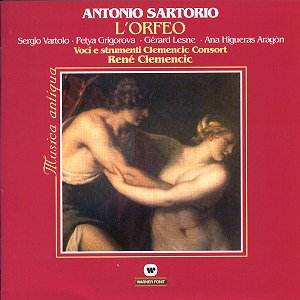
Antonio Sartorio: L’Orfeo** Voices and instruments of the Clemencic Consort/René Clemencic Warner Music Antiqua 8573 84103-2 [3 CDs: 62:21, 44:16, 51:02] Recorded live, Teatro Goldoni, Venice, October 1997 — There are operas that change everything—and then there are operas that simply exist, occupying their proper niche in the historical narrative without demanding too much attention from posterity. Sartorio’s L’Orfeo, premiered during Venice’s 1672-73 carnival season, belongs firmly to the latter category. Which isn’t to dismiss it entirely.
But let’s be honest: this is not Monteverdi’s revolutionary Orfeo of 1607 — nor is it Gluck’s radical reimagining a century later. It’s a thoroughly professional example of mid-baroque Venetian opera—competent, occasionally inspired, often conventional. Aurelio Aureli’s libretto takes some remarkable liberties with the myth.
Orpheus here is no noble lover descending into hell for his beloved. He’s a jealous husband who actually plots Euridice’s death. Read that again.
The transformation is so complete that when she dies a second time—well, yes, he delivers a proper lament (the one truly affecting; moment in the score, preserved on disc three), but he recovers with unseemly haste and simply vanishes from the drama, forswearing all womankind. What remains are the invented subplots, which naturally resolve themselves into the obligatory happy ending. One wonders what the carnival audiences made of this psychological peculiarity.
Sartorio’s music reflects his Venetian training—the shadows of Monteverdi and Cavalli hover over the score—but something crucial has shifted. Where Monteverdi made recitative the beating heart of operatic expression, Sartorio offers more than fifty arias. Fifty!
Each of the ten characters gets multiple opportunities to step forward and address the audience directly in monologue scenes, typically structured as two contrasting arias separated by a brief recitative passage. It’s effective theater — certainly. But the dramatic architecture feels diffuse — episodic.
The Clemencic Consort brings impeccable credentials to this material. René Clemencic has spent decades excavating this repertoire, and the instrumental forces sound thoroughly idiomatic—gut strings, lute, viola da gamba, the harpsichord providing harmonic foundation. The recording, based on live performances at Venice’s 1979 International Festival of Contemporary; Music (and filmed by Italian television), captures the Teatro Goldoni’s acoustic with surprising clarity.
One hears few extraneous noises, little premature applause. The balance between voices and period instruments feels right. But.
Sergio Vortolo as Orfeo presents a serious problem. The title role demands not just technical security but a certain vocal generosity—and Vortolo’s thin, ungracious tone defeats the character from the start. This isn’t about expecting René Jacobs or David Daniels; it’s about basic timbral appeal.
When Orpheus sings, we need to understand why Euridice might have loved him; in the first place, even if Aureli’s libretto undermines that premise at every turn. Vortolo simply doesn’t provide that fundamental pleasure. The supporting cast performs adequately—three countertenors, three sopranos, two tenors, a baritone, and — well — a bass navigating Sartorio’s often formulaic vocal writing.
Occasional vibrato creeps in where it shouldn’t — but the stylistic commitment remains generally sound. One wishes for more individual distinction, more theatrical personality in the delivery. These are capable musicians executing their assignments without igniting much dramatic fire.
The edition itself raises questions. Six ballets existed in the original Venetian score; they’re not included here, though no explanation is offered for their absence. The accompanying booklets provide a synopsis and brief essays that occasionally contradict each other on factual matters—sloppy editorial work that undermines confidence.
The libretto appears without translation, which limits the set’s usefulness for anyone without Italian. Who needs this album? Specialists in baroque opera, certainly.
Scholars tracking the development of Venetian operatic conventions in the later seventeenth century will find valuable material here. It represents the first modern revival of a work that enjoyed considerable success in its time, traveling as far as Vienna. That historical significance shouldn’t be minimized.
But for the general listener? The music itself — while professionally crafted, rarely rises above competence. Sartorio writes effective monologue scenes without achieving the dramatic intensity that makes Cavalli’s best work still compelling.
The arias follow predictable patterns; the harmonic language, while fluent, contains few surprises. Combined with Vortolo’s inadequate Orfeo and the production’s various compromises, this becomes a document of primarily musicological interest. The mid-price reissue makes the financial commitment less daunting.
The maestro’s presence feels palpable even in this studio setting.
Still, unless you’re completing a survey of baroque opera or need this specific work for research purposes, your time and money might be better spent elsewhere. There’s a reason some operas remain buried for three centuries—sometimes the burial is premature — sometimes it’s simply appropriate. Sartorio’s L’Orfeo occupies an uncomfortable middle ground: worth hearing once, perhaps, but not worth returning to with any frequency.
The Clemencic Consort has done honorable work in exhuming it. One can admire the scholarship while remaining circumspect about the artistic rewards.