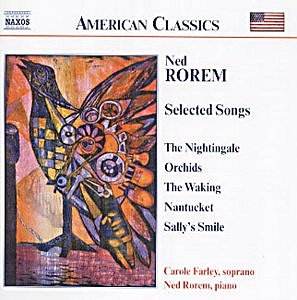
Ned Rorem: Selected Songs
Carole Farley, soprano; Ned Rorem, piano.
Naxos 8.559084. Recorded at Old North Church, Nantucket. Compact disc, 57:36.
There’s something both intimate and slightly risky about a composer playing for a singer in his own songs—the interpretive authority becomes absolute, but so does the exposure. Here we have Rorem himself at the keyboard with Carole Farley, a collaboration that yields performances of considerable theatrical vividness, though not always of what I’d call vocal refinement. The program draws from Rorem’s vast catalog of over 250 songs, leaning heavily on his beloved Roethke—”Root Cellar,” “My Papa’s Waltz,” “The Waking”—with generous helpings of Whitman and a scattering of Tennyson, Hopkins, and Spenser.
Rorem’s aesthetic, that peculiarly American synthesis of French mélodie (Poulenc especially, with touches of Satie’s economy) and a certain jazz-inflected flexibility, has always struck me as more sophisticated than it initially appears. The melodic lines seduce you before you realize how carefully wrought they are.
Farley is a singer of strong theatrical instincts—perhaps too strong for some tastes. In “Orchids,” she elongates vowels, plays with intonation, gives the word “damp” a plosive emphasis that borders on the grotesque. It’s acting, really, more than pure singing. Compare this with Susan Graham’s Erato recording with Malcolm Martineau (a splendid disc, incidentally), and you hear two fundamentally different philosophies. Graham shapes the line, maintains tonal beauty, suggests meaning through subtle inflection. Farley seizes words and shakes them.
Sometimes this works brilliantly. “The Serpent” benefits from her jazzy fleetness, her willingness to coarsen tone for effect—listen to how she attacks the word “note” with almost violent emphasis. In Spenser’s “What If Some Little Pain,” her breathy delivery of “doth” in the final line reveals genuine intelligence about textual ambiguity. The visceral approach pays dividends.
But elsewhere? In Tennyson’s “Now Sleeps the Crimson Petal,” Graham takes 4:19, Farley a mere 2:51. I don’t judge music by stopwatch—God forbid—but that disparity tells you everything. Graham finds languid sensuousness, elliptical reflection. Farley and Rorem push forward with almost impatient energy. The composer’s pianism here is crystalline, exact, yet somehow he encourages Farley’s excesses rather than tempering them.
In “Stopping by Woods on a Snowy Evening,” her sudden withdrawal of tone at “miles” feels calculated where Graham’s slight lengthening feels organic. The fundamental question is whether you value immediacy over vocal integrity, theatrical directness over arching simplicity. Farley will buckle a line if it serves her dramatic purpose; she’s never artless when perhaps she should be. Her extremes of register and volume, her willingness to break the voice—these are choices that illuminate certain layers of meaning but often at considerable cost to purely musical values.
Rorem’s playing deserves mention. He knows exactly where these songs want to go, and his touch has that dry clarity one associates with the French school. The piano part in “Visits to St. Elizabeths” (Bishop’s brilliant villanelle about Pound) shows his characteristic harmonic sideslips, those jazz-tinged chord voicings that sound so fresh even now.
The disc, made in Nantucket’s Old North Church, sounds rather airless compared to the bloom Erato gave Graham and Martineau. You feel the acoustic constriction, especially in the soprano’s upper register.
My preference runs strongly toward Graham’s disc, which seems to me more musically satisfying and ultimately more revealing of Rorem’s craft. But Farley and the composer offer something valuable too—a certain bracing theatrical energy, the sense of words being actively discovered rather than beautifully presented. It’s the difference between a lieder recital and a cabaret, between refinement and raw communication.
For those who already know the Graham disc, this makes a fascinating comparison. For those new to Rorem’s songs, I’d recommend starting with the Erato before venturing here. But don’t dismiss Farley entirely—her very obviousness sometimes cuts through to something genuine.