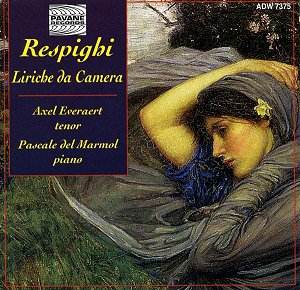
Respighi: Liriche da Camera—Italian Song
Axel Everaert, tenor; Pascal del Marmol, piano
Pavane ADW 7375 [60:24]
Recorded at Théâtre La Colonne à Miramas, France, April 1997
The Italian song repertoire remains oddly neglected—not quite as fashionable as the mélodie, lacking the intellectual cachet of the lied. Which makes this Pavane disc, now over two decades old but still very much worth seeking out, something of a quiet revelation. Twenty-two songs spanning Respighi’s career, from his student years through his mature period.
The bookends are telling: “L’ultima ebrezza” and “Notturno,” both from 1896–97, show a young composer thoroughly steeped in Tosti’s salon manner. Perfectly respectable apprentice work. But it’s the later songs that matter here—particularly the 1917 cycle Deità silvane (Gods of the Woods), where Respighi finally shakes off the drawing-room conventions and discovers his own voice.
These four songs shimmer with that peculiar twilit atmosphere he conjured so brilliantly in the orchestral works. You can hear Debussy, certainly. Ravel too.
The piano writing has the same liquid transparency as Fountains of Rome, all those gently rippling figurations suggesting water and filtered light. Everaert brings a honeyed, almost feminine delicacy to these songs. His legato is genuinely silken—he negotiates Respighi’s sensuous melodic curves with remarkable finesse, letting each phrase unfold at its own pace.
Sometimes too much at its own pace, actually. In “Invito alla danza” his niceness becomes a liability; this should be seductive, irresistible, but Everaert sounds like he’s asking permission rather than sweeping anyone off their feet. Compare Leonardo de Lisi’s disc from the previous year on Channel Classics—darker-grained voice, more oaken timber, considerably more erotic urgency.
De Lisi and his pianist Reinild Mees also point up the dance rhythms more clearly, those gavotte and waltz allusions that Respighi embeds in the piano part. Yet for the fragile, atmospheric songs—particularly “Contrasto” with its opening image of the moon weeping slow tears—Everaert’s lighter approach pays dividends. There’s a haunting, almost otherworldly quality to his singing here.
The melodic line rises and falls with timeless beauty, and he resists the temptation to overinterpret. Just lets Respighi’s inspiration speak for itself. Pascal del Marmol deserves equal credit.
His piano work throughout is exquisitely calibrated—listen to how he captures the falling rain in “Pioggia,” or the hollow ardor and well-drawing ostinatos in “Razzolan, sopra a l’aia le galline.” That last song, a Tuscan rispetto, is a genuine discovery: a miniature drama about a tongue-tied young man and the exasperated girl who finally snaps at him. Everaert nails the tempo shift at the end, that sudden slackening that delivers the song’s sting. A little masterpiece, indeed.
The four songs from Cinque canti all’antica (1906) show Respighi wrestling with archaic Italian poetry, trying to forge a modern idiom from Renaissance models. “Ma come potrei” wants more passion than Everaert gives it—this is where de Lisi’s smoky intensity serves the music better. But “Bella porta di Rubini” and “Ballata” benefit from Everaert’s restraint, his refusal to push.
One serious frustration: Pavane provides no texts. Just brief program notes in three languages and some biographical material. For a repertoire this unfamiliar, that’s simply inadequate.
Yes, Everaert’s essay describes the songs’ content admirably, but we need the actual poetry. Respighi’s word-setting is too subtle, too nuanced to appreciate fully without seeing what he’s responding to. The recorded sound captures both voices well—warm but not overly resonant, with good presence.
The theater acoustic at La Colonne provides just enough space without blurring detail. This isn’t a perfect disc. The omission of “Canzone di Re Enzo” from the Cinque canti cycle makes no sense, and Everaert’s temperament doesn’t suit every song equally.
But as a survey of Respighi’s achievement in this genre, it’s valuable and frequently luminous. The composer emerges as a more interesting songwriter than his reputation suggests—less merely picturesque, more genuinely poetic. Worth hearing, certainly.
And for those Deità silvane songs alone, worth owning.