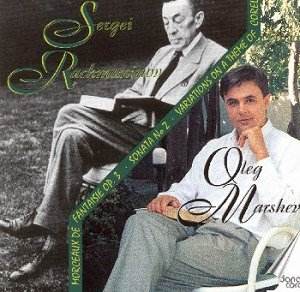
Sergei Rachmaninoff (1873-1943)
Morceaux de Fantasie, Op. 3; Piano Sonata No. 2 in B-flat minor, Op.
36 (1931 revision); Variations on a Theme of Corelli, Op. 42 Oleg Marshev, piano Danacord DACOCD 525 [67:18] There’s something to be said for a disc — that doesn’t try to do everything but manages, through intelligent programming, to suggest a composer’s entire trajectory. Marshev has given us three works spanning nearly forty years—the Op.
3 pieces from 1892, the Second Sonata from 1913 (though we hear the 1931 revision), and the Corelli Variations from 1931. Add to this the fact that Rachmaninoff returned to revise two of the Op. 3 pieces as late as 1940, and you have a kind of condensed autobiography in sound.
You can almost hear the rosin dust settling on the strings.
Whether this constitutes ideal programming is another matter. The Second Sonata remains problematic in its revised form—Rachmaninoff cut nearly five minutes of music, streamlined passages that some of us rather liked in their original luxuriance, and generally gave us a leaner, more “modern” work that sacrifices a certain romantic sprawl for the sake of tautness. I’ve argued elsewhere (and will continue to argue) that the 1913 version deserves to be heard more often.
But that’s not what we have here, and one must judge what’s actually on the disc. Marshev plays the revised Sonata with commanding authority. His craft is formidable—those octave passages in the "finale" don’t faze him in the slightest—but what impresses more is his sense of architecture.
The first movement’s exposition repeats (which Rachmaninoff marked but which many pianists ignore) are observed, giving the movement proper weight. The slow movement, that strange nocturnal meditation with its bell-like sonorities, emerges with unusual clarity; Marshev doesn’t sentimentalize it, doesn’t linger over every melodic turn as if each were a precious jewel to be admired. The result is paradoxically more moving for being less obviously “expressive.”
3 Morceaux de Fantasie present a different challenge. Everyone knows the C-sharp minor Prelude—that albatross Rachmaninoff carried around his neck for fifty years, the piece he referred to; simply as “It.” Marshev has the good sense not to overdo the famous opening chords; they’re massive, yes, but not apocalyptic. The middle section, with its tolling bells and ascending sequences, moves with genuine momentum rather than getting bogged down in fake profundity.
If you can somehow forget you’ve heard this piece a thousand times—an impossible task, I know—you might hear again what made it so immediately successful: its theatrical gestures are perfectly judged, its harmonic progressions inevitable yet surprising. The other four pieces deserve more attention than they usually get. The “Élégie” in E-flat minor (that characteristically Russian key, as someone once noted) has a Tchaikovskian melancholy—think of “September” from The Seasons—but already there’s that Rachmaninoff obsession with descending lines, with music that seems to sink under its own emotional weight.
The “Mélodie” is salon music, to be sure, but salon music of a high order. “Polichinelle” offers welcome relief from all this gloom: a virtuoso showpiece full of octaves, trills, and the kind of keyboard fireworks that audiences love…. Marshev tosses it off brilliantly without making it seem trivial.
The “Sérénade,” supposedly based on a Spanish theme, is perhaps the least interesting of the set—though Rachmaninoff himself liked it enough to revise it decades later, so what do I know? The Corelli Variations—or rather, the Variations on a theme misattributed to Corelli but actually from the Portuguese folk tradition via Liszt’s Spanish Rhapsody—represent Rachmaninoff’s late style at its most austere. (Whether he knew the theme wasn’t by Corelli remains unclear; Barrie Martyn suggests he might have encountered it through Kreisler, to whom the work is dedicated.) This is spare Rachmaninoff, if such a thing exists: less doubling of the melodic line, more air between the notes, a kind of refinement that looks ahead to the Paganini Rhapsody (which, as the original reviewer correctly notes, isn’t really a rhapsody at all).
Marshev understands the work’s strange trajectory—thirteen variations in D minor, then that startling shift to D-flat major for the emotional core, then back to D minor for the conclusion. What’s most unusual is the ending: quiet, tranquil, almost resigned. No grand peroration, no virtuoso display.
Just… acceptance? Marshev judges the architecture perfectly, knows when to press forward and when to let the music simply breathe.
The famous “intermezzo” variation (No. 13, in the D-flat major section) emerges with touching simplicity. The disc, made in Sønderborg, Denmark, captures the piano with admirable clarity—perhaps a; shade too much brilliance in the upper register, but nothing that seriously distracts.
Danacord’s documentation is adequate if not lavish. This Ukrainian pianist (he studied at the Moscow Conservatory with Natan Perelman and — well — Lev Naumov) has been making outstanding recordings for years—Prokofiev, Medtner, Sauer, even a fascinating disc of Richard Strauss’s youthful piano music. Everything he touches reveals intelligence, formidable technique, and that elusive quality of making familiar music sound freshly considered.
In this Rachmaninoff program, he more than holds his own against the established competition. Recommended.