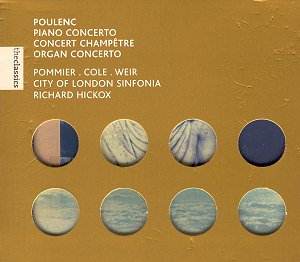
Francis Poulenc: Concerto for Piano; Concert champêtre for Harpsichord; Concerto for Organ, Strings and Timpani*
Jean-Bernard Pommier, piano; Maggie Cole, harpsichord; Gillian Weir, organ; City of London Sinfonia/Richard Hickox
Virgin Classics VM5619792 [69:22]*
Poulenc without his masks is barely Poulenc at all—and yet these three keyboard concertos, recorded in London during February 1988, catch him in all his protean moods, from the tenderly nostalgic to the wickedly parodistic. The sheer variety of timbres here is intoxicating. Piano, harpsichord, organ: three utterly different ways of attacking a keyboard, three distinct sonic worlds that Poulenc inhabited with equal facility.
The Piano Concerto of 1949 remains the most problematic of the three, though Jean-Bernard Pommier’s account makes the strongest case for it I’ve encountered. Written for Poulenc’s own American tour, it’s simultaneously his most cosmopolitan and most provincial work—Ravel’s glittering — surfaces meet a kind of Gallic Gemütlichkeit that doesn’t quite know what to do with itself. That notorious quotation from “Old Folks at Home” in the "finale" was meant — as a greeting to Boston audiences, though apparently they missed the joke entirely.
Pommier doesn’t overplay the wink; instead, he draws out the Rachmaninov-like lyricism in the central Andante con moto, phrasing with such tenderness that you forget to worry about stylistic incongruity. His touch in the opening Allegretto comodo has the requisite Gallic dryness—those staccato chords need to snap without percussive harshness, and they do. The Concert champêtre presents different challenges altogether.
Written for Wanda Landowska in 1929, it’s Poulenc’s love letter to the eighteenth century filtered through his characteristic irreverence—Mozart if Mozart had spent too much time in Parisian cafés. Maggie Cole catches the pastiche elements beautifully, her registration choices vivid and imaginative throughout. Listen to how she colors the opening Allegro molto: those plucked sonorities emerge with just the right degree of astringency.
The slow Sicilienne breathes with genuine poignancy, not merely antiquarian charm. But—and this is a important reservation—the release balance defeats her. Virgin’s engineers have placed the harpsichord too far back in the soundstage, even during solo passages.
The band, clearly enjoying itself immensely under Hickox’s sympathetic direction, simply overwhelms the instrument in the more densely scored sections. It’s a miscalculation that mars an otherwise fine rendition. You find yourself straining to hear registrational details that should register immediately.
The Organ Concerto fares better sonically, despite the curious choice of the Royal Festival Hall instrument. This 1951 Ralph Downes organ, designed primarily for Bach and his contemporaries, seems an odd vehicle for Poulenc’s 1938 essay in ecclesiastical drama. Yet Dame Gillian Weir—and yes, she deserves every honor ever bestowed on her—makes it work through sheer force of interpretive imagination.
That particular brightness of period instruments catches the ear.
Her registration in the opening Andante exploits the instrument’s bright mixtures to create something approaching — the Parisian sound Poulenc would have known at Saint-Sulpice, where Maurice Duruflé premiered the work. The Allegro giocoso that follows erupts with almost grotesque theatricality—Weir understands that Poulenc’s religious music always teeters on the edge of camp without quite toppling over. Those sudden dynamic contrasts, the way she pulls back to whispered string stops before unleashing full tutti registrations: this is playing of complete technical command married to profound musical intelligence.
In the final Tempo allegro. Molto agitato, she finds genuine spiritual urgency beneath the surface glitter, the timpani punctuations landing with visceral impact. Hickox deserves special mention.
Accompanying keyboard concertos requires a particular kind of ego suppression, and throughout these performances he calibrates his forces with exemplary sensitivity. The City of London Sinfonia responds with playing that’s both polished and affectionate—they clearly relish Poulenc’s orchestral writing, which gives them far more to do than merely tread water between solo episodes. What lingers after multiple hearings is how well these three works complement each other despite their disparate origins and aesthetics.
Together they map Poulenc’s contradictions: the devout Catholic who couldn’t resist a dirty joke,; the serious craftsman who distrusted seriousness, the tunesmith who occasionally achieved something approaching profundity. The harpsichord balance issue rankles, certainly. But the performances themselves—particularly Weir’s commanding account of the organ work and Pommier’s poetic approach to the piano concerto—make this reissue worth acquiring.
At mid-price, it’s practically essential for anyone exploring Poulenc’s instrumental music beyond the obvious chamber works.