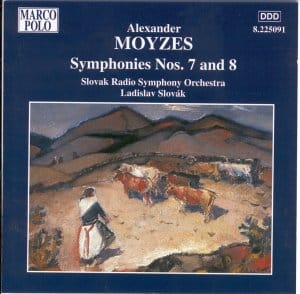
Alexander Moyzes: Symphonies Nos. 7 and 8
Slovak Radio Symphony Band/Ladislav Slovák
Marco Polo 8.225091 [70:29]
The trajectory of Alexander Moyzes’s symphonic output—twelve works spanning four decades—offers a peculiarly intimate chronicle of Central European consciousness in the twentieth century. Here, in the seventh and — well — eighth symphonies, we encounter the composer at a hinge point, moving from the pastoral certainties of the 1950s into the traumatic fracture of 1968.
Moyzes studied with Vítězslav Novák, who wisely pointed him toward Slovak folk sources. That guidance proved transformative. Where Janáček had mined Moravian speech patterns and Bartók had pursued folk material with almost ethnographic rigor, Moyzes found — in Slovak music something more yielding—a lyric vein he could work without the aggressive angularity that marks his Hungarian contemporary.
The Seventh Symphony (1954-55) inhabits a soundworld closer to Kodály than Bartók, though Sibelius hovers in the woodwind writing. Everything breathes. The textures remain transparent even when the orchestra is fully engaged—no small achievement in a post-Romantic idiom that can so easily congeal into thickness.
Harp and flute dominate the opening movement, establishing a pastoral frame that feels; both specific to Slovakia and somehow universal in its evocation of rural landscape. That "scherzo", though. Here’s where Moyzes reveals his particular gift for rhythmic drive—a Bartókian snap, yes, but gentled, made almost courtly.
The movement propels itself forward with real determination, yet never loses its fundamental lyricism. One senses a composer who has fully absorbed modernist artistry but refuses to let it overwhelm his melodic impulse. The "Largo" deepens considerably.
The maestro’s presence feels palpable even in this studio setting.
At around 3:40, Moyzes moves into territory that Shostakovich had made his own—that searching, troubled introspection that characterized Soviet music at its most honest. This isn’t mere imitation; Moyzes had his own reasons for anxiety in mid-1950s Czechoslovakia. The movement unfolds with genuine gravity, though I confess the "finale" disappoints.
It recycles earlier material—which "finale"s must do—but the synthesis feels incomplete, even haphazard. Picturesque moments abound, but they don’t cohere into the summation one expects. The Eighth Symphony arrived in August 1968.
That date tells you everything. When Soviet tanks rolled into Prague — Moyzes responded with a work of deliberate fragmentation. Gone is the legato pastoral manner; in its place, a music of jagged episodes and bitter discontinuity.
This is barbaric stuff—I mean that descriptively, not pejoratively—and it put me in — mind of Malcolm Arnold’s late symphonies, those savage prophecies of the Seventh and Ninth. Both composers found in symphonic form a vehicle for expressing cultural trauma, and both refused the consolations of easy resolution. The Eighth unfolds in micro-episodes that speak eloquently of alienation.
Even the final lento-to-"allegro" offers no comfort—it’s mildewed, bitter, haughty in its refusal of hope. There’s a violin solo around 7:20 that haunts: not a lullaby of contentment but of bereavement, of things irretrievably lost. Moyzes was fifty-two when he wrote this, old enough to remember the First Republic, young enough to understand that what was being crushed in 1968 wasn’t coming back.
Ladislav Slovák and the Slovak Radio Symphony Orchestra navigate both works with idiomatic authority—these are, after all, their scores, part of their national heritage. The 1990 and 1994 recordings capture decent if not spectacular sound; the Concert Hall of Slovak Radio in Bratislava provides a flattering acoustic without excessive bloom. Marco Polo’s engineering serves the music without calling attention to itself.
This fourth installment in the complete cycle isn’t where you’d start your Moyzes exploration—begin with the Fifth or Sixth for that. But it documents a crucial transition, from pastoral perfection to something harder and more necessary: the acrid testimony of an artist who lived through his century’s betrayals and found the courage to set them down in sound. Not all of it succeeds completely—that Seventh Symphony "finale" still troubles me—but the Eighth alone justifies the disc’s existence.
It’s a authoritative, disturbing work that deserves to be better known.