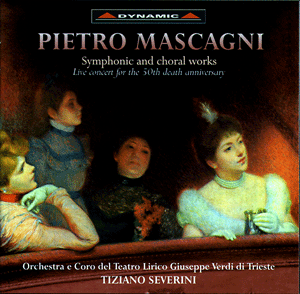
 MASCAGNI: Symphonic and Choral Works Cavalleria rusticana – Prelude and Intermezzo; L’Amico Fritz – Intermezzo; Isabeau – Intermezzo; Silvano – Barcarola; Le Maschere – Sinfonia; Inno a Rosaura; Furlana; — Danza esotica; Guglielmo Ratcliff – “Sogno”; Iris – Prelude Choir and Orchestra of the Teatro Lirico Giuseppe Verdi, Trieste / Tiziano Severini DYNAMIC CDS 379 [78:17] Here’s a curious paradox. Mascagni famously quipped that when his imagination ran dry, he’d compose symphonies—yet this disc, assembled for the fiftieth anniversary of his — death in 1945, reveals that the old rascal’s theatrical instincts never really left him, even in these extracted symphonic and choral fragments. The man who conquered the world at twenty-seven with Cavalleria rusticana spent the rest of his life chasing that lightning strike…
and failing, mostly. What we have here is the salvage operation: orchestral bits plucked from forgotten operas, a few early non-theatrical essays, the predictable Cavalleria excerpts that no Italian orchestra can resist programming. The selection itself tells you everything about Mascagni’s afterlife.
We get the Intermezzo from L’Amico Fritz—still a gorgeous thing, that sustained violin melody floating over pizzicato strings like a Tuscan sunset made audible. The Intermezzo from Isabeau, an opera that triumphed in Buenos Aires in 1911 and held — on until the mid-1940s, reveals Mascagni’s genuine gifts as an orchestrator: rich — lyrical, unafraid of sentiment. But then there’s the Barcarola from Silvano, which aims for the crude verismo punch of Cavalleria and lands somewhere softer—dreamlike, folksy, almost apologetic in its delicacy.
Tiziano Severini, who opened the Puccini festival in Valencia in 1999, knows this repertoire from the inside. He coaxes warm, idiomatic sounds from the Teatro Lirico forces, though one senses the orchestra’s familiarity with the warhorses (Cavalleria, Fritz) versus the lesser-known pages. In the “Sogno” from Guglielmo Ratcliff—an opera of genuine originality that deserves resurrection—the violas and cellos sound under-rehearsed, missing some interior voicings that would give the music its proper shimmer.
Live rendition, of course. You make allowances. The Danza esotica from 1891 captures that fin-de-siècle orientalism that infected every composer from Puccini to Delius—pentatonic scales, gong strokes, the whole exotic apparatus.
It’s skillfully done but hardly essential. More intriguing is the Sinfonia from Le Maschere, Mascagni’s 1901 attempt at eighteenth-century pastiche. Here the composer reveals an unexpected lightness of touch, a Rossinian sparkle that his verismo reputation obscures.
The choral numbers—Inno a Rosaura, Furlana—add textural variety, though the choir sounds enthusiastic rather than polished. And then there’s the Prelude to Iris. I confess I find this piece tedious in its opening minutes, all portentous buildup and — well — orchestral throat-clearing.
Yes, it warms into an exciting crescendo with choral accompaniment—the famous Hymn to the Sun—but the scoring lacks distinction. This isn’t Mascagni at his best. Surely the programmers could have found something more revealing to close the concert?
The audience, bless them, behaves until the final numbers, when coughing becomes pronounced. Not through boredom, one hopes. The release places the company rather far back on the soundstage, which robs some passages of immediacy but serves the lyrical numbers well enough.
Dynamic’s engineering captures the Teatro Lirico’s warm acoustic without excessive resonance. The annotation, available in four languages, rambles a bit but covers the essential biographical ground. What emerges from this seventy-eight-minute survey?
A composer of genuine melodic gifts and orchestral flair who never escaped the shadow of his youthful masterpiece. The serious Mascagni collector will welcome this disc, making allowances for the commonly accessible Cavalleria items. For the casual listener, it’s a pleasant enough introduction to the byways of Italian opera—but let’s be honest: we’re listening to the footnotes, not the main text.
That particular brightness of period instruments catches the ear.
Mascagni wrote one indisputable masterpiece and spent forty years trying to write another. These fragments—luminous, skillful, occasionally inspired—remind us that lightning rarely strikes the same place twice. Raymond J.