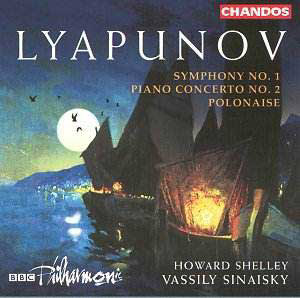
Howard Shelley, piano
BBC Philharmonic · Vassily Sinaisky, conductor
Recorded 26–31 October 2000, Studio 7, New Broadcasting House, Manchester
Chandos CHAN 9808 · 64:31
I must confess that Sergei Lyapunov has long hovered on the fringes of my listening life—known to me only through a handful of piano works on an old Olympia disc recorded by Anthony Goldstone. Those pieces hinted at something more expansive, more orchestrally minded, waiting to be discovered. Chandos’s release provides exactly that: a full symphony, a substantial concerto, and a charming Polonaise. And what a curious and rewarding trip it is.
The Symphony No. 1, Op. 12, completed in 1897, emerges from the great Russian orchestral tradition—familiar in its gestures, yet never merely imitative. Lyapunov clearly inherits the legacy of Borodin and the broader nationalist school, but his voice maintains a delicacy and refinement that set him apart. Vassily Sinaisky leads the BBC Philharmonic in a performance notable for its clarity and balance: the woodwinds glisten, the strings have a soft, tactile shimmer, and the brass interject with disciplined precision rather than brute force.
The opening Allegro moderato is a labyrinth of thematic development—light in places, yes, but consistently engaging. Lyapunov favors economy over bombast, developing small motifs into broad, lyrical arcs. The slow movement reveals the symphony’s emotional heart: a noble, expansive lyricism that occasionally hints at Elgar, though its temperament is more inward and restrained. Themes unfold patiently, worked with a quiet dignity and unexpected warmth.
The "scherzo", with its moto perpetuo motion, is a delight. Its balletic lightness evokes the swirling elegance of a masked ball—anticipating, in spirit if not detail, the effervescence of Khachaturian’s Masquerade decades later. Every pizzicato and staccato figure is crisply etched, sustaining momentum without mechanical repetition. The "finale" bursts forth with rich, energetic writing: blazing brass, rhythmic vitality, and references to earlier thematic material, all culminating in an affirming, if conventional, conclusion. No, the symphony is not a neglected masterpiece—but it is undeniably well-crafted, melodic, and richly orchestrated.
The Piano Concerto No. 2, Op. 38, is the real revelation. Cast in a single continuous movement, it belongs unmistakably to the Lisztian lineage—not derivative but clearly in dialogue with Liszt’s Second Concerto. Virtuosic display and lyrical repose blend seamlessly, and Lyapunov’s distinctive charm emerges through the clarity of his thematic writing and the sincerity of its emotional expression.
Howard Shelley is superb. His tone is warm, full-bodied, and elegant; his phrasing natural and unforced. There is no showiness for its own sake. Sinaisky and the BBC Philharmonic provide finely judged support, allowing Shelley’s lines to float above the texture without ever being swamped. The concerto’s climaxes are thrilling but never overblown. The cadenza, in particular, is a highlight—technically dazzling, yet structurally integral and expressively poised.
The disc concludes with the Polonaise, Op. 16, a compact seven-minute orchestral gem. Light on its feet and rich in color, it alternates bright brass fanfares with lush string writing while the piano adds sparkle with crystalline runs and playful motifs. Less weighty than the preceding works, it nonetheless provides a delightful and characterful conclusion.
Taken together, these performances reveal Lyapunov as a composer more than worthy of renewed attention. His music inhabits the fringes of the late-Romantic Russian tradition yet speaks with individuality and craftsmanship. Shelley and Sinaisky bring uncommon nuance to this repertoire, and Chandos’s warm, resonant sound showcases every detail with clarity.
Is the Symphony No. 1 a masterpiece? No. Is the Piano Concerto No. 2 a hidden gem? Absolutely—and a work that deserves far wider circulation among pianists and listeners alike. For those willing to explore beyond the familiar canon, this album offers a richly rewarding journey—and moments that linger long after the final chords fade.