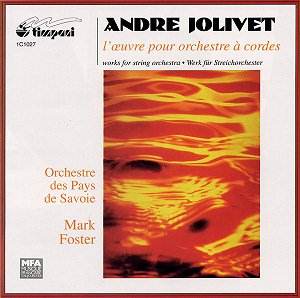
André Jolivet (1905–1974) Symphonie pour cordes (1961) [21:51] Yin-Yang (1973) [19:20] "Adagio" (1960) [8:07]; La Flèche du Temps (1973) [15:18] "Andante" (1935) [8:13] Orchestre des Pays de Savoie, cond. Mark Foster
Recorded 23–26 September 1994, Dôme-Théâtre, Albertville
TIMPANI 1C1027 [73:34] DDD
André Jolivet isn’t a household name — at least not in the way Messiaen or even Varèse, his more famous influences, are. Yet this disc, featuring the Orchestre des Pays de Savoie under Mark Foster, offers a compelling case for the French composer’s unique voice, particularly in his late string works.
The disc itself, made in the intimate acoustic of the Albertville Dôme-Théâtre, captures a telling mix of raw immediacy and refined control—strings that bite and shimmer with a spectral clarity. It feels like you’re sitting right in the middle of the players, hearing; the very scrape of the bow hairs on gut and synthetic strings alike. Jolivet was part of Jeune France, a short-lived collective of like-minded souls craving something more “human” in the music of the 1930s, pushing back against the detached neo-classicism of the era.
Unlike Messiaen — who carved out an indelible niche, Jolivet’s path has been more shadowed, his music difficult to pin down. Listening freshly, you immediately sense an idiosyncratic fusion of primal energy and spiritual depth. It’s a music that resists easy categorization—neither comfortably tonal nor shamelessly avant-garde, but constantly on the razor’s edge.
The maestro’s presence feels palpable even in this studio setting.
The Symphonie pour cordes (1961) is a tough nut. Right from the start, dense polyphony and — well — high harmonic tension claw at the ear. Foster’s strings navigate this labyrinth with admirable precision, delivering Jolivet’s jagged rhythms and — dense chord clusters with a tautness that maintains architectural clarity without sacrificing emotional intensity.
You feel the music’s “primitive and — well — percussive rhythmic energy,” to borrow a phrase, but also an underlying ritualistic pulse—hints of Messiaen’s solemn lyricism hover just beneath the surface here. This symphony demands patience: its expressive depths unfold only after repeated hearings, revealing a profoundly serious work that confronts you with a kind of inscrutable, dark spirituality. Contrast Yin-Yang (1973) — written for 11 strings and commissioned by Rostropovich — which takes a more introspective and serene path.
The title is no mere flourish; the work’s dualistic structure and beguiling textures suggest a cosmic balance. Eleven discrete parts interweave with such subtlety that the soundscape often resembles a shimmering veil of tone colors, not a conventional ensemble. The players here achieve remarkable transparency, a feat considering how easily such fine detail can dissolve into mush.
The spiritual dimension Jolivet infuses into Yin-Yang is tangible. It’s as if one could sit immersed in its quietude for hours, letting its subtle harmonic interplay wash over the senses. La Flèche du Temps (also 1973) is a different beast: a twelve-string canvas — that grows progressively aggressive and violent, embracing dissonance with an almost physical force.
Foster’s baton is firm but flexible, coaxing the ensemble through sudden dynamic surges and unsettling harmonic shifts, all while maintaining a sense of narrative coherence. The piece’s relentless forward momentum—its “arrow of time”—feels viscerally embodied in the string textures, from snarling sul ponticello passages to brooding, glimmering harmonics. Turning back to the earlier Adagio (1960), a work inspired by El Greco’s Burial of the Count of Orgaz, one encounters a more overtly expressive and — well — pictorial music.
The title, somewhat modest, belies the piece’s dense harmonic architecture. Jolivet’s writing here is lush and organ-like, with block chords that suggest ritual and prayer, yet there’s also a disturbing undercurrent of unease. The Orchestre des Pays de Savoie render this with a sensitive touch—their control of vibrato and long-breathed phrasing heightening the music’s meditative intensity.
The disc opens with the Andante (1935), a transcription from an earlier string quartet movement. It’s the least representative of the set, somewhat conventional, and serves mostly as a historical marker, offering a glimpse into Jolivet’s artistic beginnings before he developed the distinctive voice heard in the later works. What struck me, listening to this collection, is how demanding this music is—not only for performers but for listeners.
Jolivet rarely offers easy melodic comforts or repetitive anchors; instead, his music moves constantly, sidestepping tonal expectations. The players here are stretched near the limits of their instruments’ capabilities—double stops that bite, tremolos that quiver on a knife-edge, and a wide dynamic palette that ranges from whisper-quiet austerity to violent outbursts. Mark Foster’s reading feels authoritative; it’s clear he has wrestled with these scores at length and understands their complex inner logic.
The balance strikes a nice midpoint—close enough to capture every subtle inflection, yet not so clinical as to feel sterile. The listeners will find themselves drawn into a world that is sometimes forbidding, often enigmatic, but ultimately rewarding. This release stands as an important document: Jolivet’s music, too often overlooked, deserves to be heard more widely.
It is music that confronts you—uncompromising, sincere, and deeply human. This is not background music; it demands your full attention but, in return, offers profound expressive rewards. Highly recommended for adventurous listeners and string aficionados alike.