John Jeffreys: Organ Music
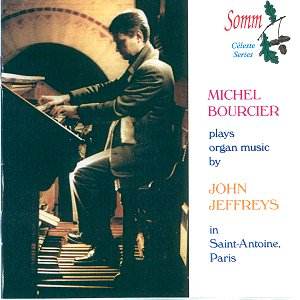
Michel Bourcier (organ)
Organ of Saint-Antoine des Quinze-Vingts, Paris
Recorded circa 2000
SOMM – Celeste Series – CD019 [57:00]
A casual stroll through Suffolk, an organist friend’s improvisation—a spark igniting a modest yet deeply thoughtful corpus of organ music. Such is the genesis of John Jeffreys’s organ oeuvre, brought vividly to life on this release by Michel Bourcier on the formidable instrument of Saint-Antoine des Quinze-Vingts. Originally built for Baron Albert de l’Espée’s Bois de Boulogne residence, the organ’s relocation to the Parisian church was no mere formality; its power, too vast for domestic confines, now resonates magnificently within cold stone walls.
Bourcier’s playing conveys this duality superbly—watch how the mighty pedals rumble like distant thunder, yet the loftier manuals whisper with the delicacy; of a rustling autumn leaf, especially in the charming “Canon Howard’s little mice,” which showcases the chamber organ at Otten, North Essex. Jeffreys, better known for his lieder—renderings of 16th-century texts and interwar Georgian poetry—here applies his contrapuntal and philosophical training with a slower, more deliberate hand. This is music demanding patience, the kind that rewards the listener who surrenders to its unfolding architecture rather than skimming for immediate gratification.
There’s a Warlockian gaiety in his songs, but the organ works are sober, almost meditative, with complexity simmering beneath their surface. The disc’s anchor is the Fantasia, a 17-minute behemoth penned for Alfred David Williams, whose improvisations first kindled Jeffreys’s creative flame. Its sprawling structure resists facile summary.
One is drawn into a labyrinth of motives—some lyrical, others jagged—interwoven with contrapuntal mastery that nods to the old masters but never slips into pastiche. Bourcier’s registration choices here are crucial: the swelling reeds and flutes carve out a landscape that is at once intimate and monumental, the harmonic language occasionally veering into the chromatic shadows that hint at a late-Romantic sensibility without ever relinquishing clarity. Complementing the Fantasia is the Flourish, Affirmation, Meditation and Six Variations, another large-scale work that balances muscularity with introspection.
The Flourish—brilliant, almost Baroque in its fanfare-like vigor—gives way to the Meditation, a profound contemplation underscored by sonorous pedal points and dissonances that resolve slowly, as if reluctant to relinquish their tension…. The Six Variations, each with distinct character, show Jeffreys’s deft hand at variation; form, cleverly transforming thematic material with subtle shifts in rhythm and — well — harmonic color. Among shorter pieces, selections from Music from Otten and Duodecimedes (twelve character pieces) provide moments of light relief and textural contrast—some bright and sprightly, others shaded with the melancholy that seems to pervade Jeffreys’s worldview.
The Christ in Majesty offers a brooding, solemn meditation; its dark-hued harmonies echo through the cavernous space with a palpable gravity. The closing Cader Idris is a quietly haunting evocation of vast loneliness, its Welsh roots evident in the plaintive melodic contours and expansive harmonic pauses—a spiritual reckoning in sound. Bourcier’s realization throughout is commendable for its sensitivity and command.
The director’s presence feels palpable even in this studio setting.
He never overplays the instrument’s strengths; instead, he tempers its power with finesse, allowing Jeffreys’s subtle colors and contrapuntal lines to breathe. Dynamic contrasts are handled with care—one can almost feel the tactile resistance of the keys and the nuanced shifts of the swell pedals under Bourcier’s fingers. Occasionally, the organ’s cavernous acoustics introduce a touch of reverberant blur, but this only deepens the music’s sense of timelessness.
In sum, this is organ music that rewards immersion rather than casual listening. Jeffreys’s compositions are neither facile nor flashy; they demand contemplation. They reveal a composer deeply attuned to the instrument’s vast expressive potential and grounded in a tradition of contrapuntal discipline infused with spiritual earnestness.
Bourcier’s interpretation honours this with thoughtful pacing and tonal variety. This disc deserves a place alongside other understated gems of late 20th-century British organ repertoire—a compelling journey into a quietly profound sound world. A recording to be savoured slowly, like fine wine, with the lights low and — well — the mind open.