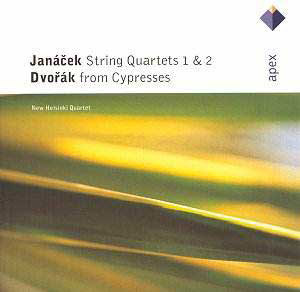
Janáček: String Quartet No. 1 The Kreutzer Sonata & String Quartet No. 2 Intimate Letters / Dvořák: From Cypresses, B.152
New Helsinki Quartet
Recorded August 1996, Sigyn Hall, Turku, Finland
WARNER APEX 0927 40603 2 [59:02] DDD
There’s something invigorating about hearing the two Janáček quartets side by side—like glimpsing two facets of the same restless soul.
These works, born from the composer’s final, feverish creative period, pulse with an urgency one rarely finds in chamber music. The New Helsinki Quartet, whose previous Apex outing of Grieg and Sibelius quartets impressed with its crisp articulation and tonal warmth, return to these Czech masterpieces with a palpable sense of purpose. The result is a disc that, despite its budget pricing, feels anything but secondary.
The subtle intake of breath before the pianist’s attack.
The Kreutzer Sonata—Janáček’s first quartet, composed in a single week in 1923—opens with a chord so raw and — well — anguished it arrests the ear immediately. It’s a bleak, almost brutal declaration: a sonic bruise that sets the tone; for the narrative of Tolstoy’s novella, which Janáček used as a subconscious template. The music shudders between lyrical outpourings and sharp, often sul ponticello-driven violent outbursts, those fanfare-like bursts cutting through the texture like shards of glass.
The New Helsinki players negotiate these jagged edges with admirable clarity and ensemble precision; their attack is — muscular yet never harsh, and the tonal blend—warm, yet taut—supports the work’s emotional volatility without tipping into melodrama. There is a palpable sense of tension in their phrasing: moments marked energico ed appassionato throb with a near-verbal intensity, while passages marked molto espressivo unfurl with an intimate breathiness. Particularly telling is the "finale", which bears the marking jako v placi (“like in tears”): here the quartet’s sound turns fragile, almost wounded.
The repeated refrain, returning like a specter, retains its bitter poignancy throughout, and the New Helsinki’s control of dynamic nuance—swelling and receding without losing momentum—is exemplary. Yet it’s the Intimate Letters that truly lays bare the composer’s heart. Written in the final weeks of Janáček’s life and — well — suffused with the bittersweet glow; of his obsession with Kamilla Stosslová, this quartet is less tempestuous but infinitely more intimate.
The opening motif—a tentative, searching phrase allegedly representing the first meeting with Kamilla—functions as a structural lodestar, recurring throughout the movements in varied guises. The New Helsinki Quartet immediately grasp this motif’s narrative weight, shaping it not as mere thematic material but as the beating heart of the work. Their tone at once breathes tenderness and restrained passion, avoiding any temptation to over-sweeten what is essentially music of profound longing and subtle torment.
The balance between lyricism and undercurrent tension in Intimate Letters is razor-sharp here. Outbursts are fewer and more subdued than in The Kreutzer Sonata, but when — they erupt, they carry the weight of buried anguish rather than unrestrained fury. The ensemble’s rhythmic precision—never mechanical, always expressive—allows the music’s complex moods to breathe fully,; revealing Janáček’s masterful ability to fuse folk-inflected modal harmonies with a modernist expressive language.
On the side, Dvořák’s From Cypresses functions as an elegant counterpoint. These arrangements of youthful love songs, though brief, are gems of melodic invention and subtle charm. The quartet’s approach here is consistently stylish and intimate, lending a natural grace that complements the more muscular Janáček works.
It’s a tasteful filler—elegant, yes, but never mere padding. What perhaps most impresses is the production itself. The Sigyn Hall acoustics, captured with crystalline realism, allow the strings to bloom fully without excess warmth or artificial sheen.
One hears each sul ponticello tremolo shimmer — every pizzicato snap, with a immediacy that’s almost tactile—a testament to the engineering as much as the performers. Is this the definitive Janáček? Certainly not.
One might crave a touch more rawness in the Kreutzer or a bit more emotional volatility in Intimate Letters, but such quibbles are minor. The New Helsinki Quartet’s performances are thoughtful, deeply felt, and technically assured—qualities that transform these challenging quartets from intellectual curiosities into living, breathing dramas. In sum: a disc that’s both rewarding and affordable, worthy of a place in any chamber music lover’s collection.
The Janáček quartets—once the preserve of specialists—here sound vibrant and immediate, while the Dvořák selections add a lyrical foil. This is an Apex release that punches well above its weight. For those curious about Janáček’s chamber voice, look no further.