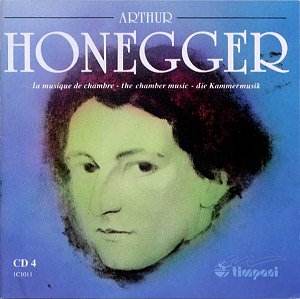
Arthur Honegger: String Quartets Nos. 1–3; Pâques New York
Quatuor Ludwig; Fusako Kondo (mezzo-soprano)
Recorded September–October 1991, Église Évangélique St Pierre, Paris
Label: Timpani 1C1011 [72:39]
Arthur Honegger’s string quartets are something of a hidden trove—serious, wrought, and stubbornly intense, they resist the easy charms so often associated with Les Six, the Parisian coterie to which he belonged. This Timpani set, featuring the Quatuor Ludwig, offers a remarkable, if somewhat underappreciated, window into the composer’s chamber oeuvre, including the rarely heard Pâques New York, a poignant song cycle pairing mezzo-soprano and string quartet.
The First Quartet, begun as early as 1917 and completed around 1920, wears its youthful struggle on every bowed phrase. The opening movement—marked ‘violent and tormented’—is exactly that: jagged rhythms clash with dense counterpoint, creating a texture that feels, at times, almost claustrophobic. The Quatuor Ludwig dives in with admirable commitment; their articulation is incisive without ever hardening into mere aggression.
You can almost feel the varnish scraping on the instruments, the rosin’s grainy grit against the strings as they negotiate Honegger’s relentless dissonances. The production captures this rawness nicely—there’s an atmospheric reverberation from the church that envelops without smothering the detail. Yet the "Adagio" that follows is a tougher nut.
Spanning thirteen minutes, it demands a kind of sustained breath and line that few quartets manage to maintain without some ebb in tension. Here, the Ludwig’s control is impeccable—intonation is flawless, the slow tempo carefully measured—but I found myself longing for a deeper, more visceral pull from the music’s dark undercurrents. It’s a movement that both rewards and — well — tests the listener’s patience; Honegger’s austere lyricism here feels uncompromising.
By contrast, the Second Quartet from 1935 announces a composer fully in command. This is, quite frankly, one of the finest quartets written in the twentieth century. The opening "Allegro" marcato "finale" crackles with kinetic energy—its rhythmic propulsion is utterly infectious.
The subtle intake of breath before the pianist’s attack.
The Ludwig ensemble seizes this movement’s muscularity, while maintaining impeccable phrasing and a clarity that prevents the texture from becoming muddied amid the driving chords and syncopations. The structural logic here is compelling: themes evolve organically, with shifts of mood and colour that feel both inevitable and fresh. It’s no surprise that this quartet ranks alongside the best of Bartók or Shostakovich in terms of craftsmanship and emotional heft.
The recording’s sonic balance is superb—each instrument has presence and warmth, allowing the intricate interplay to shine through. The Third Quartet (1936) continues this trajectory, commissioned by Elizabeth Sprague Coolidge and premiered in 1937. Harry Halbreich’s claim that it is ‘even finer than its predecessor’ is bold, but not without merit.
This quartet is dense, serious, and imbued with a more reflective temperament. Its contrapuntal complexity demands intense concentration, both from performers and listeners. The Ludwig players meet the challenge head-on; their ensemble cohesion is remarkable, especially in the more intricate passages where voices weave in close canon.
The sound here is a touch darker, more brooding, with subtle dynamic shading that reveals Honegger’s penchant for tension and release. One notes, too, the composer’s Swiss heritage in the austere, sometimes stark harmonic language, which eschews romantic lushness for a leaner expressivity. Finally, Pâques New York (1924) offers a rare, haunting gem: a song cycle for mezzo and string quartet, with palpable religious undertones.
The text settings—particularly the third, incorporating the Dona nobis pacem—are handled with reverence and restraint. Fusako Kondo’s mezzo is supple and clear, though I would have welcomed a slightly warmer timbre to better conjure the spiritual depth of the work. The quartet provides a luminous but restrained accompaniment, weaving a subtle tapestry that complements without overpowering.
This piece’s scarcity in the repertoire is regrettable but understandable; works for such an unusual ensemble rarely find traction. Still, this interpretation argues eloquently for its inclusion in the chamber canon. This Timpani release is admirably documented, with full texts and translations available—an important touch for appreciating Pâques New York.
It’s a set that not only showcases Honegger’s chamber music strengths—serious, sometimes forbidding, but always compelling—but also reveals the formidable skills of the Quatuor Ludwig. Their interpretation is both intelligent and heartfelt, never yielding to facile lyricism, instead dwelling in the music’s more challenging emotional terrain. In sum: a collection that rewards patience and attention, offering a rare glimpse of a composer often overshadowed by his more flamboyant contemporaries.
The recording’s balance of atmosphere and precision suits the music beautifully. For anyone interested in twentieth-century quartet literature beyond the usual suspects, this is an essential—and deeply satisfying—listening experience.