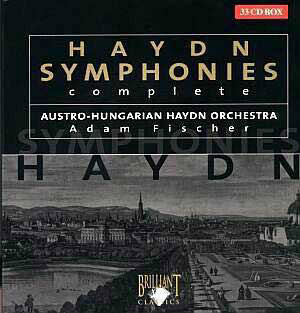
Joseph HAYDN (1732–1809)
The Complete Symphonies
Austro-Hungarian Haydn Band / Adam Fischer
Nimbus original recordings, 1987–2001; 33 CDs, Brilliant Classics 99925
When it comes to Haydn’s symphonic oeuvre, one might wonder if the sheer volume of complete sets risks numbing the senses rather than enlightening them. But Adam Fischer’s monumental undertaking, recorded over a span of fourteen years in the very Haydnsaal of Esterházy Palace, resists such complacency with a mixture of vividness and idiosyncrasy that few other cycles can rival. This 33-CD box is not just a repository but a lively, sometimes unsettling, but always fascinating dialogue with the music.
Let’s consider the sound world first. Fischer opts for modern instruments — a choice that, while occasionally contentious in Haydn circles, is here more than justified. The orchestral palette is neither overly polished nor aggressively raw; it breathes with a rustic vitality that suggests these are players steeped in Viennese and Hungarian traditions, as Fischer himself notes in the liner essays.
The horns’ dotted rhythms in the opening bars of Symphony No. 47 in G major, Hob.I:47, ring out with a brashness that conjures authentic corni da caccia rather than the tame and veiled horn sounds one too often hears. This is Haydn, yes, but rendered with a vigorous, almost folkloric energy, not the sanitized “classical” veneer.
Yet this set is not a sterile, urtext purism. Fischer is a leader unafraid to leave his fingerprints on the music — discreet, yes, but unmistakably present. He peppers the symphonies with elegant ornaments and gracenotes, invents dynamics when the score remains silent, and employs solo strings — in place of tutti in repeated sections, lending these centuries-old scores a vibrancy that makes you feel you’re hearing them anew.
One is reminded of Mahler’s approach to older repertory — not museum pieces, but living organisms, ripe for expressive shaping. This individualism becomes more pronounced over the project’s arc. Take the two G minor symphonies, Nos.
83 and 39. The former (recorded in 1991) shows Fischer as a loyal, almost reverential interpreter — careful tempi, restrained dynamics. The latter (a final session from 2001) is a tempest: rhythmically taut, dynamically hairpin-rich, with a hair-raising tension that sometimes verges on hyperactive.
Some listeners may find this headiness excessive, but it undeniably commands attention. And what about the slow movements? There is a remarkable intimacy in moments like the "Andante" of Symphony No.
26 in D minor, the so-called “Lamentatione.” Here the strings’ naked tone — almost stark — perfectly suits the penitential character. A prayerful hush falls, contrasting with the insistent, almost Bartókian martellato rhythms that pulse in the opening movement. These contrasts reveal a Haydn who is far from the genial party host of; cliché — a composer capable of depth and soul-searching that modern audiences perhaps still underestimate.
The sound engineering — despite early challenges with the resonant but occasionally boomy Haydnsaal acoustics — grows more refined over time. Initial fuzziness and muddiness give way to clarity and better-controlled reverberation, especially in the later sessions. The orchestral bloom remains intact, never sterilized by digital clarity, allowing the music’s warmth to come through.
It would be churlish not to commend the musicianship here. The principal oboist, Harald Hörth, is a delight: his playing in the minuet trio of Symphony No. 38 in C major is a model of charm and — well — precision.
The horn players — led by Martin Bramböck — display heroic stamina and flexibility, particularly in the slow movement of Symphony No. 51 in B flat major, reaching notes that challenge even today’s most skilled virtuosi. Yet, for all their expertise, there are moments of untidiness — fleeting ensemble slips, audible shuffles, occasional breaths that intrude a bit too conspicuously.
One wonders if these occasionally stem from the pressure of such an ambitious project; the recordings sometimes feel like marvels of endurance as much as artistry. And the humour! Haydn’s wit comes across with rare clarity here.
His famous silences — the pregnant pauses that trap the unsuspecting listener — are held with delicious exaggeration. The bassoon “fart” in the slow movement of Symphony No. 93 is unabashedly earthy — a reminder that Haydn’s jokes were not always polite.
In the trio of the minuet in Symphony No. 88, the strings mimic ragged bagpipe drones so convincingly that for a moment you’re transported to a peasant dance rather than a palace concert. Fischer and his ensemble clearly delight in these moments, and their joy is contagious.
This set’s sequence is straightforward, following Hoboken’s numbering — which, as the review notes, is largely but not strictly chronological. The inclusion of early symphonies, “A” and “B,” and the youthful orchestrations of string quartets, fills out a historically complete portrait of Haydn’s symphonic evolution. While some might compare and prefer the Dorati set for its alternative versions and textual completeness, Fischer’s readings are more than just scholarly documents; they are performances with impulse and personality.
In the crowded marketplace of Haydn cycle recordings, this one stakes its claim with a unique voice. It’s neither the pristine historical authenticity of a Pinnock nor the polished grandeur of a Davis, but something altogether more idiosyncratic and alive…. It’s music-making on a scale that feels joyous and at times dangerously close to chaotic — a marathon, yes, but a thrilling one.
To wrap up: this is a set that rewards patience and — well — attention, offering insights into Haydn’s symphonies that are fresh, occasionally challenging, and often exhilarating. The resonant sound of the Esterházy Palace, the distinctive stamp of Fischer’s direction, and the deep commitment of the players coalesce into a landmark achievement. Not without flaws, certainly, but with a spirit of discovery and affection that any serious Haydn lover will find hard to resist.
Laus Deo, indeed. —