Georg Friedrich Handel (1685–1759)
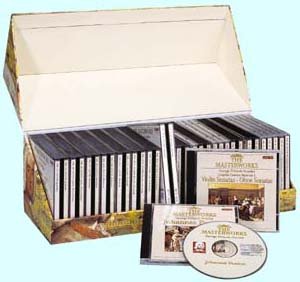
The Masterworks (40-CD set)
Performers: Kammerchor, Akademie für Alte Musik Berlin, Marcus Creed; English Chamber Orchestra, Johannes Somary; Berliner Singakademie, Kammerorchester Berlin, Dietrich Knothe; Capella Savaria, Nicholas McGegan & Pál Németh; Ama Deus Ensemble, Valentin Radu; Brewer Chamber Players, Rudolph Palmer; Holland Boys Choir, Sir David Willcocks; Consort of London, Haydon Clark; Scottish Chamber Ensemble, Donald Runnicles; Franz Liszt Chamber Orchestra, János Rolla; Neues Bachisches Collegium Musicum, Max Pommer; Ivan Sokol (organ), Slovak Chamber Orchestra, Bodan Warchal; L’École d’Orphée
Label: Brilliant Classics 99777
Duration: Approx. 40 hours
Release: Various dates, mainly 1970s–1980s, reissued 2023
It’s a curious beast—a 40-CD box of Handel’s complete masterworks, crammed into the surprisingly modest price bracket that Brilliant Classics has made its signature. Forty hours of music by a towering figure of the Baroque, spanning oratorios, operas, concerti grossi, organ concertos, chamber works, and a fair few rarities.
A treasure trove? Yes, but with caveats — plenty of them. The first thing to note: this is very much a collection of historical snapshots, not a current-day fresh take.
The roster of ensembles and — well — conductors reads like a who’s who of a couple of generations past. Johannes Somary’s English Chamber Orchestra-led Messiah and Judas Maccabaeus date from the early 1970s and carry all the hallmarks of that era’s Handel performance — lush strings soaked in vibrato, choruses that pound and swell with robust, if old-fashioned, fervor. The strings’ heavy vibrato, once de rigueur, now sometimes feels like a veil obscuring Handel’s crystalline textures.
The choir, too, tends toward a forthright, occasionally blunt delivery rather than the agile, transparent articulation one expects from today’s period-instrument specialists. Yet, there’s something undeniably compelling in the emotional directness of these performances. John Shirley-Quirk’s bass, especially, is a standout — resonant, authoritative, and imbued with an English tradition that privileges clear diction and narrative force.
Alexander Young’s tenor sings with a certain weight that can verge on the ponderous but also grounds the recitatives in human gravitas. These aren’t historically informed performances in the modern sense — but they do possess a certain old-school charm and visceral appeal, a reminder that Handel’s drama can breathe through many interpretative lenses. Contrast this with the chamber music discs, performed by L’École d’Orphée.
Here, the difference is stark. The ensemble’s period instruments—John Holloway’s violin, Philip Pickett’s recorder, Susan Sheppard’s cello—produce a lighter, more agile sound world. The clarity of counterpoint and the dance-like energy of the trio sonatas feel palpably alive.
In these moments, Handel’s inventive melodic lines and nimble harmonic progressions sparkle with the freshness that comes from historically informed realization practice done with conviction and expertise. The warm, responsive harpsichord continuo under Lucy Carolan is the glue, and the ensemble’s subtle dynamic shading—the occasional breath between phrases, the deftly measured rubato—creates a chamber atmosphere that’s both intimate and detailed. The inclusion of the organ concertos, with Ivan Sokol at the keyboard alongside the Slovak Chamber Orchestra under Bodan Warchal, is intriguing, though the sonic balance here is frustrating.
The orchestra often overwhelms the organ, disrupting what should be a conversation between soloist and ensemble. Sokol’s playing is technically adept, with tasteful registrations that reveal Handel’s improvisatory brilliance, but — the mix leaves the listener straining to catch the nuances of the organ’s dialogue. The sound engineering dates the disc, with a somewhat dry, boxed acoustic that lacks the warmth one hopes for in these works.
Among vocal highlights beyond Somary’s Judas Maccabaeus, Arleen Augér’s recording of Handel’s German arias stands out. Recorded in 1980, at the height of her vocal powers, Augér’s crystalline soprano is a joy. She inhabits the music with a poised, yet expressive touch.
If only the instrumental accompaniment had been as assured—the violin is occasionally too prominent, its modern timbre breaking the illusion of Baroque intimacy, and the ensemble occasionally lurches between stylistic registers. Yet, Augér’s phrasing and the subtle shaping of the arias—some of which are seldom heard—make this disc a gem. And then, there’s Belsazar, sung in German—a curious choice that immediately challenges purists.
The translation mutes the Hebrew and Babylonian cultural resonances, and the vocal lines, designed for Italianate declamation, sometimes feel at odds with the language’s natural inflections. This, coupled with the somewhat stolid approach of the Berliner Singakademie and Kammerorchester under Dietrich Knothe, renders the oratorio a less than compelling listen—more curiosity than conviction. The set’s breadth is both its glory and its undoing.
On one hand, it offers a panorama of Handel’s output rarely matched—opera, oratorio, instrumental music, even rare cantatas and coronation anthems. On the other, the flow is uneven, with performances ranging from inspired to lackluster, and sound quality from warm analog to flat and dated digital. One notable omission: no harpsichord solo works.
A missed opportunity, given Handel’s contributions to the keyboard repertoire. Likewise, some listeners may find the lack of more recent historically informed recordings disappointing, but that’s hardly the point here. This is archival rather than avant-garde, a museum with both treasures and dusty corners.
In sum, this Brilliant Classics The Masterworks set is a paradoxical trove. For the Handel novice or the budget-conscious collector, its price and scope are irresistible. For the seasoned connoisseur, it offers moments of genuine delight—especially the chamber music discs—alongside reminders of how much performance practice has evolved.
It’s a listening journey with potholes and panoramas alike. If you want to immerse yourself deeply in Handel’s world and don’t mind a few rough edges, this is a fine gateway. But if your taste leans to the most polished and historically rigorous, seek elsewhere.
Still, one must admire the ambition and the generosity of putting such a vast and varied survey within reach. A flawed diamond, yes, but one worth owning.