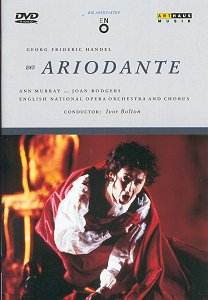
Georg Friedrich Handel (1685–1759)
Ariodante
Ann Murray (Ariodante), Joan Rodgers (Ginerva), Gwynne Howell (Dalinda), Christopher Robson (Polinesso), Lesley Garrett (Odoardo), Paul Nilon, Mark le Brocq
English National Opera Orchestra and Chorus / Ivor Bolton
Recorded 1996, London Coliseum
DVD release: Arthaus 100 064, 178 minutes, PCM stereo, PAL, Region 2/5
Sung in English (originally Italian)
Review source: MusicWeb (UK), 2023
There’s a peculiar tension about this Ariodante—one caught between the baroque’s glittering theatricality and a stage presentation that often feels, well, hesitant. That hesitation starts with the casting of Ann Murray in the title role, which remains a jarring choice, especially visually. Handel’s heroic male roles, originally crafted for castrati, naturally invite a high voice that is, admittedly, easier to accept in purely auditory terms, but seeing Murray embody Ariodante—her gaze frequently adrift, a deer caught in headlights—throws one off balance.
Vocal timbre is fine, if a touch over-vibrato’d, which at times blurs the elegant clarity Handel’s lines demand. Yet, moments like the heartrending “Take your pleasure” in Act II offer her a chance to shine, her plaintive phrasing conveying the aria’s slow pulsing rhythm with genuine feeling, albeit with occasional lapses into overly florid vibrato that undercuts the music’s innate delicacy. Joan Rodgers as Ginerva provides a more compelling dramatic foil.
The warm acoustics of the concert hall seem to breathe through the recording.
There’s a seductive conviction in her voice and an assuredness in her stage presence that bridges seduction and scorn with admirable fluidity. The aria “The pain and grief I suffer” is delivered with crystalline purity and emotional intensity—her control over Handel’s coloratura passages is deft, and her expressive shading brings the character’s turmoil palpably to life…. Rodgers’ poise lends the drama weight that the production otherwise struggles to sustain.
Contrast this with Christopher Robson’s Polinesso, whose uneven vocal production and — well — problematic microphone placement combine to create an unfortunate effect. The voice sometimes emerges muddy and — well — amateurish, especially in “When cunning is shrouded,” which should sparkle with malice and wit but instead stumbles through hesitant phrasing and unstable tone. The second-act duet, “Since deception can prove,” suffers mightily; the tension dissipates, and I found myself—and I confess this is rare—contemplating skipping ahead.
Musically, Ivor Bolton’s conducting is attentive, if somewhat cautious. The English National Opera Company plays with nimbleness and a bright, buoyant energy well suited to Handel’s French ballet-inflected style in this late work. The ballets concluding each act—an innovation inspired by Marie Sallé’s influence—are tastefully integrated, spotlighting the graceful dance rhythms without overindulgence.
Although the choreography itself seems restrained, almost minimalist, favoring measured movement over flamboyant virtuosity, it suits the opera’s often dark and brooding atmosphere, even if that atmosphere leans toward oppressive on occasion. Speaking of darkness—the lighting design often clouds the stage in gloom, obscuring the finer gestures and subtle interplay that Handel’s drama hinges on. Baroque opera thrives on clarity of expression, both vocal and visual, and here the murkiness undercuts some of the impact.
It’s a curious directorial choice, perhaps aiming for psychological depth, but it sometimes feels at odds with the music’s radiant textures and emotional candor. Despite these flaws, this disc remains a noteworthy addition to the Handel discography. The chorus and supporting cast provide solid, if not spectacular, contributions, and the orchestral playing is consistently engaging.
The English language translation, while inevitably altering the vocal line’s natural prosody, is clear and — well — intelligible, making the drama accessible without sacrificing too much musical integrity. All told, this Ariodante is a somewhat uneven but still valuable document—a recording that captures both the opera’s exquisite moments and its occasional falterings. Handel aficionados will find much to admire here, especially in Rodgers’ radiant Ginerva and the orchestra’s spirited dance rhythms.
However, for those seeking a fully immersive dramatic embodiment of the score, the casting and — well — staging choices may prove frustrating. In the end, it’s a execution that—like much in Handel’s operatic world—thrills and falters in equal measure. Worth owning, certainly, but not to be mistaken for definitive.