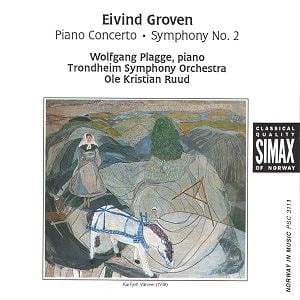
Eivind Groven (1901–1977)
Piano Concerto (1947–1949) | Symphony No. 2 (1939–1945)
Wolfgang Plagge, piano
Trondheim Symphony Orchestra / Ole Kristian Ruud, maestro
Recorded: Olavshallen, Trondheim, August 1991 / April 1992
Label: SIMAX – Norway in Music PSC 3111 [58:56]
Eivind Groven remains, regrettably, something of a cipher outside Norway’s borders — a composer whose name rarely trips off the international tongue despite his rare blending of folk idioms and symphonic craft. This SIMAX release, featuring Symphony No.
2 and the Piano Concerto, offers a compelling case for reassessment. Here, the rugged landscapes of western Telemark—Groven’s birthplace—aren’t merely evoked; they are woven into the very fabric of his orchestral voice. The Symphony No.
2, composed during the grim years of 1939 to 1945, carries a subtitle as evocative as any: “The midnight hour.” Yet, it’s not the overt gloom one might expect from wartime music. Instead, Ruud’s reading reveals a work of subtle resilience. The opening Allegro moderato nods quietly to Grieg’s Symphonic Dances and even conjures hints of Tubin’s; lighter orchestral textures—suggesting a Nordic kinship that’s less about brooding darkness and more about tempered strength.
The second movement’s hymn-like calm—akin to certain reflective Nielsen moments—provides a balm without tipping into sentimentality. And that "finale"? A sprightly dance with a melody that cheekily recalls a Nordic take on Sussex by — the Sea, infusing the symphony’s close with a buoyancy that’s at once unexpected and utterly convincing.
Plagge’s piano playing in the Piano Concerto is another revelation—never pandering to virtuosic showboating, it instead embraces a percussive clarity that recalls Bartók’s incisiveness or Vaughan Williams’s earthy lyricism…. The concerto’s gestation over many years, including motifs derived from Groven’s boyhood harmonica improvisations, lends it a distinctly personal narrative. The central Andante, especially, lingers—its quiet, understated build-ups serve as fertile ground for the finally jubilant, con brio "finale".
This closing movement is nothing less than a celebration—joyous, life-affirming, and utterly alive. It’s easy to imagine standing on a fjord’s edge in summer, the sheer mountain air mingling with the music’s bright echoes. One senses, too, the imprint of literary inspiration here—the novella Marihand by Ingeborg Refling Hagen, which apparently provided some conceptual impetus.
Yet Groven’s music transcends any programmatic strictures; it breathes and speaks on its own terms. The orchestral textures throughout are finely balanced, though the Trondheim Symphony Band doesn’t quite approach the lushness of Norway’s leading ensembles. Still, the transparency of Ruud’s conducting allows the folk-derived rhythms—the slått, halling and springar—to breathe with authentic rusticity rather than romanticized nostalgia.
The album quality is clean, capturing the hall’s acoustic without undue warmth or dryness. There’s a certain crispness in the woodwinds and a pleasing bite in the strings, though the brass occasionally edges towards a hint of brittleness in climactic moments. It’s not a luxurious soundstage but it serves the music’s directness admirably.
Groven’s oeuvre deserves wider exposure. His music is not a polemical stance but rather a lived-in expression—rooted quietly in the soil of his homeland, yet open to broader modernist currents. This disc, with its informative bilingual booklet and — well — diligent performances, is an indispensable entry point.
For those who treasure Nordic music’s intertwining of folk idioms and symphonic form, and who appreciate a concerto that eschews flashiness in favour of substance, this is a rare gem. In short: if the name Groven has passed you by, here is a chance to encounter a voice both singular and deeply rewarding. Highly recommended.