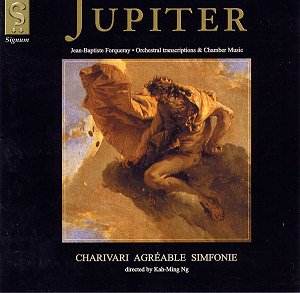
Jean-Baptiste Antoine Forqueray (1699–1782)
Jupiter: Orchestral Transcriptions and Chamber Music Extracts from Pièces de Viole (Paris 1747)
Premier Divertissement, Deuxième Divertissement, Troisième Divertissement, Quatrième Divertissement, Charivari Agréable Simfonie
Performed by The Period-Instrument Players of Oxford, directed by Kah-Ming Ng and Susanne Heinrich (viola)
Recorded 3–5 October 1998, St Andrew’s Church, Toddington, Gloucestershire
Label: SIGNUM SIGCD008 [77:32]
Forqueray on record tends to inhabit a shadowy corner of the baroque repertoire—much admired by viol aficionados but seldom embraced beyond the connoisseur’s drawing room. This SIGNUM release, ambitiously reimagining Forqueray’s Pièces de Viole in orchestral and chamber; settings, offers an intriguing if occasionally uneven glimpse into the composer’s tempestuous genius. The original book, fraught with familial strife—his father’s notorious jealousy and imprisonment of the son—casts a long shadow over this music’s history.
The maestro’s presence feels palpable even in this studio setting.
The booklet notes lean heavily on this biography, enriching our understanding though sometimes at the expense of detailed musical analysis. From the outset, the titular Jupiter strikes a curious chord—its repetitive melodic contour and insistent rhythm evoke, oddly enough, the minimalist strains of Michael Nyman’s The Draughtsman’s Contract. This resemblance is not mere coincidence: Forqueray’s baroque idiom, with its crisp articulation and pointed phrasing, naturally lends itself to such rhythmic propulsion.
Yet the arrangement, involving a flexible ensemble of three to seven players, sometimes feels over-engineered. The lushness and depth sought here occasionally verge on excess, particularly when the pardessus de viole cuts through with a slightly brash, astringent timbre that distracts rather than blends. A smaller group might have served pieces like “La Tronchin” better—where the melody’s simplicity cries out — for the intimate dialogue of solo viol and harpsichord rather than the fuller textures on offer.
But the disc’s real heart lies in the balance it strikes—between the energetic and — well — the lugubrious, the courtly dance and the plaintive lament. The second track, “La Silva,” is touching in its mournful restraint, the viol’s voice layered with a plaintive Irish lament quality—recalling, if faintly, O’Carolan’s Farewell to Music. There is a folk-like inflection throughout these pieces, undeniably French yet tinged with a rustic earthiness that stops them from sounding merely ornamental.
The ensemble’s director, Kah-Ming Ng, alongside violist Susanne Heinrich, has arranged these works with a deft hand that respects their original contours while giving them fresh life. The interweaving instrumental lines in the Chaconne of the first Divertissement, for instance, shimmer with — a delightful clarity and texture, the layering of voices never feeling cluttered despite the ensemble’s size. The Charivari Agréable Simfonie deserves special mention.
The term “charivari” usually connotes a cacophonous, discordant serenade—mocking and noisy. Here — however, the adjective “agréable” is no mere euphemism: the orchestral textures craft a playful, sprightly soundscape, a merry riot rather than a racket. This piece, especially, highlights the ensemble’s ability to navigate historically informed rendition practice without the stiffness that often haunts period instrument groups.
Yet, the overall disc balance leans forward, sometimes aggressively so, which suits the music’s intimate nature by forcing the listener’s ear into the textures, but can also rob the sound of some natural resonance and space. The acoustic of St Andrew’s Church offers warmth but occasionally results in a slightly congested blend in the fuller passages. What this disc brings to the table is an engaging reappraisal of Forqueray’s music—no longer confined to viol and continuo or solo harpsichord but expanded into an orchestral conversation.
It is music of considerable charm and technical challenge, notable for its harmonic daring and melodic inventiveness. Some arrangements hit the mark splendidly; others lean a touch too heavily on the orchestral palette. Still, the recording’s generosity of playing time and the authenticity of style make it a valuable addition for those who cherish the subtleties of 18th-century French baroque.
In sum: a recording that rewards patience and close listening, offering both scholarly insight and genuine musical pleasure. Forqueray fans—and those curious about the roots of the French viol repertoire’s expressive power—will find much to admire here, despite the occasional imbalance and — well — instrumental idiosyncrasy. Not quite definitive, but certainly indispensable for a fuller picture of baroque string art beyond the usual suspects.
Final verdict: recommended with a cautious enthusiasm—this is a disc that shines brightest in its quieter moments, where the music breathes and the ensemble listens as much as it plays.