Gabriel Fauré (1845–1924)
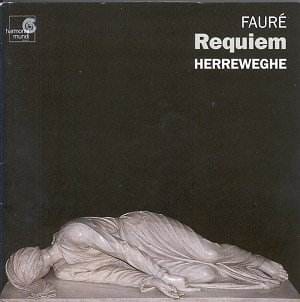
Requiem, Op. 48 César Franck (1822–1890) Symphony in D minor Johannette Zomer, soprano Stephan Genz, baritone La Chapelle Royale Collegium Vocale Gent Orchestre des Champs Élysées Philippe Herreweghe, leader Recorded Le Grande Salle de l’Arsenal de Metz, November; 2001 Harmonia Mundi HMC 901771 [75’46”] — Philippe Herreweghe returns to Fauré’s Requiem with this new recording after his notable earlier foray into the “Madeleine version”—a chamber arrangement that stirred fresh debate in the early 1990s. This time, it’s the full “concert version,” the orchestral score, yet with a distinctly period flavor: gut strings hum with gentle warmth, the orchestral palette is transparent rather than lush, and—most intriguing—the use of a harmonium, loud and insistent, as Fauré himself permitted when an organ was lacking, punctuates the texture.
But it is the linguistic choice that immediately arrests: Herreweghe and his forces opt for Gallic Latin pronunciation, a style resurrected from archival recordings—most notably a 1930 Parisian broadcast under Gustave Bret. This is no mere historical curiosity; it subtly reshapes the soundscape, lending the choral lines a natural inflection and a slightly nasal bite foreign to the Italianate Latin more often deployed. Jean-Michel Nectoux’s scholarship, cited in the booklet, underscores this as an attempt to approximate the vocal soundscape of Fauré’s milieu.
The result is unmistakably authentic—or at least one authentic possibility among many—and it adds a fresh layer of immediacy to the liturgical text. Yet, the realization’s virtues, while many, do not entirely dispel reservations. The opening Introit and — well — Kyrie linger—too long, perhaps.
The tempo chosen here feels stately to the point of rigidity; the music congeals, marble-like, its momentum arrested. One gets the impression Herreweghe sought to chart a spiritual journey from solemn introspection to transcendent peace, but the slow pacing risks inertia rather than transcendence. The chorus, exact and warm, often shines, but when the tempo stiffens, the phrasing loses some of its natural breath.
Contrast, then, the Offertoire, where the gut strings’ rich timbre and — well — the carefully balanced orchestral texture offer moments of genuine luminosity. The choral writing at In excelsis sparkles with nimbleness, the voice-leading crisply etched; here, Herreweghe’s hand is at its most assured. Soloists Stephan Genz and Johannette Zomer lend their voices with commendable poise.
Genz’s baritone is pleasant, imbued with a natural warmth and clear diction. Zomer brings a bright, silvery soprano to bear, with a keen dramatic instinct; however—and this is regretful—her terminal vibrato often grows unwieldy — especially at phrase endings where it oscillates, risking distraction. These moments jar against the overall textual clarity Herreweghe so earnestly cultivates.
The Libera me culminates the Requiem with an atmosphere of hushed reverence, yet — here Herreweghe’s hallmark “Elysian languor” perhaps softens the drama a touch too much. The pastel-hued violins that close the work are radiant, but one yearns for greater narrative urgency—the music’s promise of deliverance feels slightly muted. Turning to the César Franck Symphony on this disc—an odd inclusion, considering Harmonia Mundi’s; cover art and notes pay little attention to it—the approach is characteristically restrained, even diplomatic.
Herreweghe avoids the crass excesses that sometimes mar performances of Franck’s dense, richly scored first symphony. The orchestral textures are transparent; the phrasing, thoughtful, perhaps to a fault. While the playing is polished and the architecture respected, the performance lacks the visceral pull that Franck’s visionary harmonic language can unleash.
That particular brightness of period instruments catches the ear.
It’s a polite rendering, admirable for its control but ultimately too circumspect to fully convince. In sum, this disc offers much to admire: historically informed decisions, textual clarity, and — well — a refined sonic palette, all hallmarks of Herreweghe’s artistry. But the Requiem’s pacing falters in places, the solo soprano’s vibrato sometimes unsettles, and — the Franck symphony, while neat and tidy, leaves a yearning for more emotional breadth.
A performance of subtlety and grace, certainly—but not one to displace the great landmarks in the discography. Still, any release that invites us to reconsider Fauré’s Requiem—and that does so — with such careful attention to linguistic and instrumental detail—demands our respect and reward. For those seeking a gentle, intelligent, and somewhat unconventional reading, this is a valuable addition.
Just don’t expect it to sweep you off your feet.