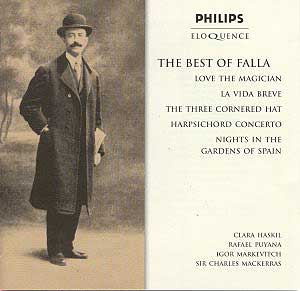
Manuel de Falla
El Amor Brujo (1915, revised 1925) [25:05]
Noches en los Jardines de España (1916) [22:31]
Harpsichord Concerto (1926) [13:15]
Miller’s Dance and Jota from El sombrero de tres picos (1919) [9:10]
Interlude and Dance 1 from La Vida breve (1905) [6:43]
Inés Rivandeneyra (mezzo-soprano), Orquesta Sinfónica de la RTV Española/Igor Markevich – recorded October 1966, Spain (El Amor Brujo)
Clara Haskil (piano), Orchestre des Concerts Lamoureux/Igor Markevich – recorded October 1960, France (Noches en los Jardines de España)
Rafael Puyana (harpsichord), David Sandeman (flute), Neil Black (oboe), Thea King (clarinet), Raymond Cohen (violin), Terence Weil (cello), Sir Charles Mackerras (leader) – recorded August 1969, England (Harpsichord Concerto)
Orchestre du Théâtre de l’Opéra de Paris/Roberto Benzi – recorded June 1964, France (El sombrero de tres picos)
Minneapolis Symphony Orchestra/Antal Dorati – recorded 1966-67, USA (La Vida breve)
PHILIPS ELOQUENCE 468 313-2 [77:02]
Philips Eloquence unearths a rather compelling anthology of de Falla’s music, spanning some four decades of analogue grandeur—with all its attendant virtues and rough edges. The recordings themselves, dating from the 1960s, exhibit that warm but slightly raw acoustic texture that; risks alienating audiophile purists but, paradoxically, injects a certain earthy verve into the music’s rustic roots. This is no glossy, overpolished affair; it’s closer to the village square than the salon.
And here, I find that suits de Falla’s idiom rather well, as too much polish risks draining the Spanish folk essence that he so carefully embroidered into his scores. There is an urgency in Markevich’s El Amor Brujo that is immediately arresting. His rhythmic bite—fleet, yet not hurried—brings out the flamenco fire inherent in the dance rhythms.
Yet, the mezzo-soprano, Inés Rivandeneyra, while spirited, occasionally struggles with breath control, particularly in the guttural vocal flourishes. It’s not a faultless vocal realization, but the rawness oddly complements the music’s primal, almost incantatory qualities. One must admit: a more refined delivery might have dulled its spiky edges.
Markevich’s conducting in Noches en los Jardines de España with Clara Haskil at the piano offers a study in contrasts. Haskil’s playing is unhurried, poetic, and nuanced—qualities that serve the work’s impressionistic palette beautifully, especially in “Generalife.” At 5:07 in — that movement, the piano’s tone is squeezed, almost pliant, as if the keyboard itself breathes with the Andalusian night air. The Orchestre des Concerts Lamoureux under Markevich’s hand responds with character and warmth, capturing the vibrant shimmer of moonlit gardens.
The opening pages of the “Sierra de Córdoba” movement crackle with an orchestral savagery that few recordings—Melodiya’s, for instance, notwithstanding—have matched. It’s a late-night brilliance, spilling forth with a primal exultation. The Harpsichord Concerto (1926) is a curious artifact of de Falla’s flirtation with neo-classicism: a chamber concerto that flirts with angularity and lyricism in equal measure.
Here, Sir Charles Mackerras leads a luminous ensemble that spotlights Rafael Puyana’s harpsichord with crystalline clarity. The concerto’s acid-etched lines slice through the texture, though the work itself can feel somewhat cerebral, its neo-classical austerity occasionally flirting with detachment. Still, Mackerras balances the piece’s crisp articulation with a certain warmth, ensuring the brittle textures do not become brittle moods.
Roberto Benzi’s Paris Opéra Ensemble tackles the two dances from El sombrero de tres picos with a sprightly precision. The trumpets’ brash, brassy Mexican swagger—raucous, rough-gruff—is an unexpected delight. These movements snap and crackle with verve, though the soundstage, bound to the era’s recording technology, sometimes feels restrained.
Meanwhile, Antal Dorati’s La Vida breve from Minneapolis is less compelling; the disc often sounds undernourished, lacking the work’s earthy urgency and verismo angst. The opening Interlude projects a grim intensity, reminiscent of a Giordano or Mascagni prelude, but this seldom sustains itself. The real value of this collection lies in its unvarnished character; the unsanitised performances breathe life where some more polished readings might risk stasis.
For all its technical limitations—occasional vocal imperfections, the age-worn sound—Philips Eloquence gives listeners a vividly textured tour through de Falla’s oeuvre, illuminated by conductors who know the idiom intimately, not from a distance. In terms of alternatives, the Melodiya LP from the 1970s featuring Irina Arkhipova, despite its grittier string sound, is a reference for sheer visceral intensity. Yet, it’s not as readily available, and Haskil’s Noches remains a touchstone for pianistic poetry within this repertoire….
The warm acoustics of the concert hall seem to breathe through the recording.
To conclude: this Philips Eloquence issue is not a top-tier audiophile proposition, nor can it claim absolute technical perfection. But in its spirited, rhythmic insistence and colourful engagement with the folkloric elements, it offers something essential—rawness that feels genuine rather than artifice. For anyone curious about de Falla beyond the usual suspects, this collection merits close attention.