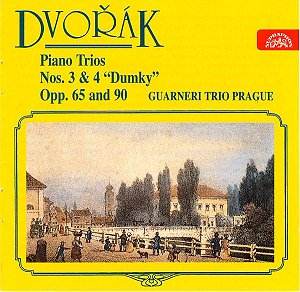
Antonín Dvořák: Piano Trio No. 3 in F minor, Op. 65; Piano Trio in G minor — Op.
90 “Dumky”
Guarneri Trio Prague (Cenek Pavlik, violin; Marek Jerie, cello; Ivan Klansky, piano)
Recorded October–November 1997, Domovina Studio, Prague
Label: Supraphon 11 1463-2 [66:45]
The Guarneri Trio Prague returns with a pair of Dvořák’s piano trios, offered here in a warmer, more intimate album than their earlier efforts, notably outshining their 1991 version of the Dumky Trio, which suffered from a rather chilly, unyielding acoustic. This 1997 session bathes these chamber jewels in a sound that’s neither too polished nor too raw — the balance strikes a comfortable middle ground, allowing the texture of each instrument to breathe, yet never evaporate into thin air. Begin with the Piano Trio No.
3, Op. 65. The opening "Allegro" non troppo immediately reveals a tonal blend that’s lush but never indulgent.
The violin and cello interweave with a Brahmsian solidity, underscored by Klansky’s restrained yet deeply felt piano. There’s a subtle push-pull here—phrases unfold with a kind of deliberate elasticity; not rushed, but never bogged down. The substantial first movement feels like a conversation among old friends: intense but tempered by experience.
Then the second movement arrives—a lilting "scherzo"-"allegro" that teeters playfully on the edge of rustic dance. Pavlik’s violin, here, has an almost mischievous bounce, contrasting with the piano’s gently accented melody in the trio section. It’s a dance, yes, but one shaded with a faint, ironic smile—Dvořák’s Bohemia filtered through the trio’s refined sensibility.
The “clod-hopping” rhythm mentioned in previous recordings is softened into something more urbane, yet the underlying earthiness remains intact. The Poco Adagio that follows is a miniature triumph of chamber balance. The canonic imitation in the faster middle section is executed with crystalline clarity, the players listening keenly to one another’s breath and bow stroke.
Pavlik’s violin sings with eloquence here, while Klansky’s piano anchors the harmonic framework without ever dominating—exemplifying chamber playing at its most democratic. The "finale", "Allegro" con brio, maintains this equilibrium; Klansky’s weightier chords propel the movement forward, but sometimes the momentum feels slightly tentative, as if the trio is unwilling to fully surrender to the music’s inherent drama. A touch more edge and risk would have propelled this "finale" into something more memorable.
Turning to the Piano Trio in G minor, Op. 90, the Dumky—Dvořák’s masterpiece of Slavic melancholy and exuberance—the Guarneris are consistently faster; than the Suk Trio’s legendary interpretations, which lends the rendition a certain youthful urgency. Yet Pavlik’s violin tone here is more mellow, less fiery than in their earlier recording, which tempers the emotional impact but adds a layer of subtlety.
The Poco Adagio sections unfold with a quiet dignity, the phrasing more reserved, the emotional heat simmering rather than boiling over. Their sensitivity to dynamics shines especially in the Allegretto scherzando episodes—the transitions between contemplative and playful, between shadow and light, are negotiated with admirable finesse. Still, I found moments in the "finale" where the musical argument seemed unfinished, as though some thematic corners were left unturned, some tensions unresolved.
The trio catches the sumptuous, almost voluptuous qualities of Op. 90, but occasionally this richness smudges into a kind of impressionistic haze, blunting the work’s sharper edges. One must note, too, the recording’s attributes—Supraphon’s engineering here deserves a nod.
The close yet natural soundstage allows the listener to hear the subtle rasp of bow hairs on strings, the — quiet pedaling in Klansky’s piano, the nuanced shifts in vibrato and articulation that give these works their living pulse. This is not a pristine, antiseptic sound; one hears the human touch, the occasional breath or fingering noise, all adding to the immediacy. In sum, these performances fall short of the very highest tier, which might have demanded a little more fire in the Dumky and a firmer grasp of the final movement in Op.
65. Yet they remain compelling, thoughtful, and crafted with great musical intelligence. The Guarneri Trio Prague here offers a mature, carefully wrought perspective on Dvořák’s chamber voice—one that rewards close listening despite a few moments of hesitance.
For anyone seeking a richly detailed, well-balanced survey of these trios, this Supraphon release is a strong contender—especially given the comparative warmth and clarity of sound. It may not unseat the Suk or the Melos Trios in the pantheon, but it certainly enriches it, shedding new light on familiar territory.