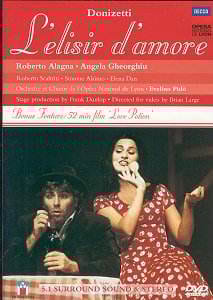
Gaetano Donizetti (1797–1848)
L’elisir d’amore
Roberto Alagna (Nemorino), Angela Gheorghiu (Adina), Simone Alaimo (Dr. Dulcamara), Roberto Scaltriti (Sergeant Belcore), Elana Dan, Lyon National Opera Chorus, Lyon National Opera Orchestra/Evelino Pidò
Recorded 1996, Lyon
DECCA 4400741039 [2 hrs 5 mins]
That this 1996 Lyon production of L’elisir d’amore has enjoyed a second life as a DVD and — well — CD set is unsurprising, given its magnetic selling point: the extraordinary pairing of Roberto Alagna and Angela Gheorghiu, opera’s most luminous couple of the era. Not yet married when this was conceived, their private romance — fresh and palpable — seems to; seep into the very fabric of Donizetti’s effervescent score, lending an intimacy that is rare and, frankly, intoxicating.
The opening scene, however, is a bit of a mixed bag. The village tableau looks, candidly, economical — a sparse cluster of harvesters ambling about without much conviction. Nemorino’s entrance on a bicycle, followed almost instantly by an awkward tumble, sets a comic tone that borders on slapstick.
It’s endearing in its human clumsiness, but hardly a masterstroke of staging. That said, once Alagna’s tenor voice emerges — warm, buoyant, and imbued with a gentle rustic innocence — any doubts about production values simply evaporate. His “Quanto è bella, quanto è cara” blossoms with a lyrical simplicity that feels naturally idiomatic rather than forced.
Roberto Scaltriti’s Sergeant Belcore provides a sharper contrast — vocally solid but theatrically inclined toward caricature. His overblown pomposity, coupled with his band of bumbling soldiers, yields moments of attempted farce that, to me, fell a bit flat—embarrassingly so—eliciting more wincing than laughter. But that’s the gamble with broad comedy in opera: it either lands as charming or becomes a distraction.
Angela Gheorghiu’s Adina, clad in immaculate riding habit, is a fascinating study. Physically she commands attention with a crop that she wields like a sceptre, yet her characterization has a certain stiffness, as if she’s responding to external direction rather than embodying Adina’s mercurial spirit from within. This was, after all, Gheorghiu’s first foray into comic opera, and that tentative approach is understandable.
Yet—and this is crucial—when Gheorghiu and Alagna come together in the exquisite duet concluding the first scene, all theatrical reservations vanish. Here, Donizetti’s melodic architecture is on full display: the tender interplay of lines, the seamless legato phrasing, the subtle dynamic undulations. Their voices weave as if in a private conversation, a confession, heightened by the offstage love that colors every phrase.
The maestro’s presence feels palpable even in this studio setting.
It’s a duet not merely to be heard but to be felt — a living, breathing thing. Scene two brings a noticeable uplift in production values and dramatic momentum. Dr.
Dulcamara’s arrival in a gleaming gold vintage car and caravan transforms the stage into something more polished, more visually engaging. Simone Alaimo’s Dulcamara is a triumph—both vocally and dramatically. His bass-baritone is rich, agile, and — well — imbued with an amused wit; he strikes a perfect balance between the charlatan’s self-assured bluster and a genuine comic zest.
His timing is impeccable; the quicksilver shifts in his delivery keep the audience alert and amused, bringing a zing that enlivens the entire scene. As the plot thickens, the duet and ensemble work between Alagna and Alaimo prove the production’s heartbeat. Their synergy, both in comic timing and vocal interplay, is a highlight — the kind of comic partnership that feels spontaneous yet meticulously crafted.
Act Two reveals the emotional core: Nemorino’s slow blooming passion and the bittersweet complexities of love’s misunderstandings. The chemistry between Alagna and — well — Gheorghiu here is tangible—perhaps because their offstage marriage was barely months old when this was recorded. The love story doesn’t just unfold; it simmers, occasionally burning through the veneer of operatic cliché with genuine warmth and sincerity.
This lends the work an emotional texture that elevates it beyond mere light-hearted buffa. Evelino Pidò’s conducting is characterful, at times brisk, never allowing the score to languish. The Lyon National Opera Players responds with a crispness that complements the vocal lines without overpowering them.
The chorus, while not always in perfect unison, adds a rustic authenticity that grounds the piece in its village setting. One cannot ignore the value added by the included documentary — a nearly hour-long “making of” feature. It serves as a revealing peek behind the curtain, chronicling the painstaking efforts of cast and crew alike.
The insights from Pidò and the British production team remind us that such seamless artistry is the product of relentless labor, collaboration, and — yes — a fair share of nerves and serendipity. So where does this leave us? The production’s visual elements waver between the modest and the effective, sometimes veering into the awkward.
Yet, this is more than compensated by the magnetic vocal presence of Alagna and Gheorghiu, whose passion and polish breathe contemporary life into Donizetti’s score. The supporting cast, especially Alaimo, imbue the execution with necessary sparkle and comic vitality. In the end, this L’elisir is less a flawless gem than a heartfelt, living thing — imperfect, occasionally uneven, but radiant in its core.
For those who cherish vocal brilliance married to genuine dramatic connection, this Decca release remains; a compelling acquisition, a testament to the enduring charm and emotional depth of Donizetti’s masterpiece.