Laurent Korcia, violin
Sonia Wieder-Atherton, cello
Philharmonie de Lorraine · Pascal Rophé, conductor
Recorded March and July 1998, Arsenal, Metz
Timpani 1C1048 · 47:05
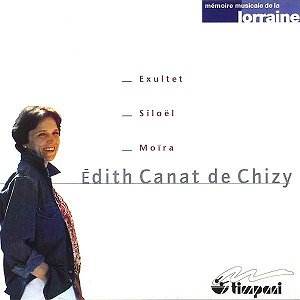
Edith Canat de Chizy’s music invites the listener into a world of luminous chiaroscuro—shadows and light in constant dialogue, the sacred intertwined with the visceral. This Timpani release, featuring three major orchestral works from the 1990s, offers a penetrating portrait of a composer whose voice remains distinctive in the contemporary French landscape. Exultet opens the program, a violin concerto in all but name, though to classify it merely as such undersells the breadth of its architecture and expressive range.
Laurent Korcia’s solo violin line threads through the orchestra not as a traditional soloist set apart but as a vital strand in an intricate sonic tapestry. The work unfolds in a continuous span, its linked sections bearing evocative titles such as “Sheol,” “Colonnes de feu,” and “Trône céleste,” each conjuring a particular atmosphere. Canat de Chizy’s orchestration blends spectral shimmer with muscular gesture, at times recalling Dutilleux’s refined color palette or Lutosławski’s aleatoric freedoms, yet always speaking in her own unmistakable voice. Korcia captures this duality with impressive range—his upper register alternates between soaring lyricism and incisive bite, especially in the “Voix-lumière,” where ecstasy and dread seem to fuse.
Siloël, for twelve solo strings, offers a striking contrast. Its opening, marked “very violent,” bursts forth with jagged bow strokes and tightly wound rhythmic cells. The aggression gradually dissolves into an ethereal central section—a suspended, near-motionless landscape in which the ensemble’s transparency and control are on full display. The closing passage regains momentum but ends not with a decisive cadence; instead, it fades into a luminous suspension, like the final flicker of a candle before darkness. The work’s arc—from turbulence to serenity to unresolved stillness—is executed with remarkable clarity and discipline.
Moïra, composed several years later, distills the hallmarks of Canat de Chizy’s mature style into a single-movement cello concerto of considerable emotional weight. Sonia Wieder-Atherton’s playing is revelatory: her tone is rich and burnished, capable of molten lyricism in one moment and sharply etched articulation in the next. The concerto alternates between episodes of harmonic tension—clustered dissonances, biting intervals—and passages of introspection, creating a large-scale design that remains taut throughout. As in Exultet, echoes of Dutilleux’s Tout un monde lointain… appear in the music’s textural clarity and its ability to evoke vast spaces from restrained means.
Under Pascal Rophé’s assured leadership, the Philharmonie de Lorraine supports the soloists with a chamber-like sensitivity. The balance is exemplary: the orchestra never overwhelms, even in its most forceful gestures. The recorded acoustic of the Arsenal in Metz contributes to this clarity—the sound is warm yet detailed, allowing bow changes, harmonic overtones, and dynamic gradations to emerge naturally. The “very violent” passages of Siloël crackle with immediacy, while the contemplative moments in Moïra float with spectral luminosity.
This release is a gem. Canat de Chizy’s music stands apart for its expressive depth, its spiritual resonance, and the rigorous craftsmanship underpinning every gesture. These works reward repeated listening: each return reveals new details—the interplay of harmonics, the shifting internal pulse, the carefully judged harmonic pacing. Exultet and Moïra merit a place in the repertoire of adventurous soloists seeking concertos beyond the familiar canon, while Siloël offers a compelling, ritual-inflected chamber experience.
Music fashioned from contemplation and prayer, yes—but also from restless energy and a searching intelligence. Highly recommended.