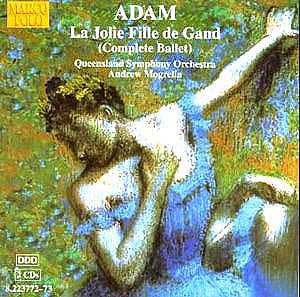
Adolphe Adam: La Jolie Fille de Gand* (complete ballet)*
Queensland Symphony Band/Andrew Mogrelia
Marco Polo 8.223772-73 (two CDs: 66:45, 69:04)
Recorded Ferry Road Studio, Brisbane, Queensland, Australia, March 1996
Here’s a curiosity—a complete album of Adam’s 1842 ballet La Jolie Fille de Gand, a work that upstaged Thomas’s opera Le Guérillero on the same Paris evening and then more or less vanished from view. Marco Polo’s willingness to excavate these forgotten scores deserves gratitude, even when the results prove mixed. Adam himself set modest goals: “My only aim is to write music which is transparent, easy to understand; and pleasing to the public.” He succeeded brilliantly with Giselle a year earlier, and lightning nearly struck twice here.
The score brims with elegant melody—Adam never lacked for good tunes—and the orchestration shows real color, particularly in his fondness for brightening theme lines with piccolo. The scenario, concocted by Jules-Henri Vernoy (Marquis de St. Georges, naturally) and Perrot, unfolds in Ghent with that peculiar logic ballet plots require.
Beatrix loves Benedict but gets distracted by a dashing Marquis who wins a shooting contest, abducts her (with her consent), loses interest, gambles away his fortune, and… well — it was all a dream anyway. The wedding proceeds.
One doesn’t look to nineteenth-century ballet for psychological realism. But here’s the trouble. Andrew Mogrelia’s reading too often sounds stately when it should sparkle.
That church chimes passage opening track seven on the first disc—it drags lethargically when the bustling fair scene demands energy nearly twice as brisk. Without access to Adam’s tempo markings one can’t be certain, yet this ponderous approach (however dignified) seems fundamentally at odds with choreographic logic. Ballet music must propel dancers, not anchor them.
The Queensland Symphony plays competently enough. The recording captures adequate detail. But comparing this with Mogrelia’s other Adam ballet for Marco Polo—Le Filleule des Fées, — recorded around the same time with the same forces—reveals a similar lack of vital energy.
These scores need the effervescence Adam intended — that warm theatrical glow that made him successful. Here the music too often sounds dutiful rather than delightful. Keith Anderson’s booklet notes provide thorough background and a detailed track-by-track synopsis in three languages.
As documentation — the set fulfills its archival purpose admirably. Yet archival purpose isn’t quite enough. Adam wrote this score at the height of his powers, fresh from Giselle‘s triumph, and the music deserves better advocacy.
That particular brightness of period instruments catches the ear.
The melodies are genuinely charming—occasionally even compelling—but they need conductors who understand that “transparent” and “pleasing” don’t mean sluggish. The piccolo figurations should glitter, not plod. The dance rhythms should lift, not lumber.
One welcomes the opportunity to hear this rarity. The work itself reveals Adam’s considerable gifts. But Mogrelia’s interpretation misses the theatrical vitality that would justify reviving La Jolie Fille de Gand for modern audiences.
The dream sequence at the ballet’s end proves prophetic: like Beatrix awakening, we — return to reality knowing the past two hours haven’t quite delivered what they promised.