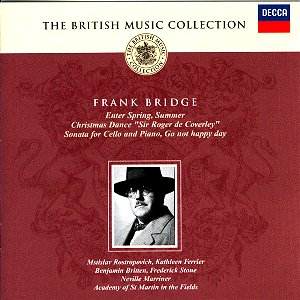
Frank Bridge: Enter Spring; Summer; Christmas Dance—Sir Roger de Coverley; Sonata for Cello and Piano; “Go Not, Happy Day”
Academy of St. Martin in the Fields; Sir Neville Marriner, conductor (1996). Mstislav Rostropovich, cello; Benjamin Britten, piano (1968). Kathleen Ferrier, contralto; Frederick Stone, piano (1952).
Decca 470 189-2. Compact disc, 57:11.
There’s something quietly revelatory about revisiting Frank Bridge through a compilation such as this. A smorgasbord of his middle and late period works, the disc lays bare the evolution of a composer whose name too often lurks in the shadows of his more famous pupil, Benjamin Britten. And yet Bridge’s idiom is richly individual—expressive, occasionally volatile, and always meticulously crafted.
Enter Spring opens the program with a blast of verdant vitality, a tone poem that is anything but coy. Imagine the English countryside bursting into life after a long, gray winter. The orchestra does not merely suggest this awakening; it roars it. The wild, pagan climaxes feel almost primordial, and Marriner’s approach—while occasionally lacking the visceral bite of Sir Charles Groves’s EMI account—still conjures the natural chaos beautifully. The birdsong choruses that flutter and trill amidst the strings are keenly observed; one can almost smell the damp earth and hear the rustling hedgerows. Then, that central section—a sudden lull, where the orchestral texture thins to a crystalline serenity. It’s a moment of true, almost magical stillness, the kind of passage that lodges itself deep in the memory. British pastoralism at its most enchanting, yes, but there’s no sentimentality here. Rather, a quietly profound sense of renewal.
By contrast, Summer feels more introspective, slower, and suffused with nostalgia. Yet there’s a subtle undercurrent of tension, almost an unsettled quality beneath the golden haze. Marriner captures this duality well, shaping climaxes with a supple hand that balances languor and latent energy. The rustling strings and warbling woodwinds evoke a warmer, more reflective tableau—but also something just out of reach, quietly disquieting. It’s a nuanced portrayal of an English summer’s day that resists easy pastoral clichés, and the composer’s keen ear for naturalistic detail is again front and center.
The Christmas Dance—Sir Roger de Coverley is a charming interlude, a folksong-based string miniature that brims with rustic cheer. It’s fleet-footed, elegantly spun, and contains that little nod to “Auld Lang Syne” at the end—a perfect festive flourish. Here Bridge’s middle-period craftsmanship shines through in the tight contrapuntal lines and the buoyant rhythmic drive.
Perhaps the disc’s emotional and historical heart lies in the Sonata for Cello and Piano, recorded in 1968 with Mstislav Rostropovich and Benjamin Britten himself at the keys. The connection between composer, pupil, and performer is palpable here; one hears Britten’s intimate knowledge of Bridge’s harmonic language and phrasing. The sonata, dating from the middle period, is suffused with yearning and melancholy, its expansive melodic lines tinged with the kind of wistful anguish one associates with Rachmaninoff—though there’s also a faint ghost of Bax’s lush harmonic palette. Folkish inflections thread through the work, yet it’s never pastiche. The texture is rich but never dense; every phrase feels carefully weighed and balanced, with an eloquence that speaks of Bridge’s meticulous compositional mind. Rostropovich’s cello tone—dark, sumptuous, and deeply expressive—is a perfect counterpoint to Britten’s fleet-fingered, almost conversational pianism. Their interplay is intimate, almost like two old friends confiding in dim light.
Finally, Kathleen Ferrier’s performance of “Go Not, Happy Day” closes the album on an intimate, lyrical note. Accompanied by Frederick Stone, Ferrier’s voice is that rare thing—both robust and tender, full-bodied yet limpid. The Tennyson setting is small in scale but profound in sentiment, and Ferrier’s phrasing captures the poetry’s subtle shifts with enviable inevitability. The piano accompaniment ripples delicately beneath her, providing a calm but expressive foil.
Taken as a whole, this compilation is a testament to Bridge’s undervalued gifts. The program offers a panorama of styles and moods, from the robust and elemental to the quietly reflective. It’s clear why Britten held his teacher in such high regard; Bridge’s music here reveals an artist both rooted in his time yet remarkably forward-looking. The performances range from the palpably affectionate to the deeply committed, and while Marriner’s interpretations may occasionally lack a bit of fire compared to others, the disc as a whole is a rich, rewarding journey. For Bridge enthusiasts and those curious about the currents beneath early twentieth-century British music, this is a valuable and absorbing collection.
Recommended without hesitation.