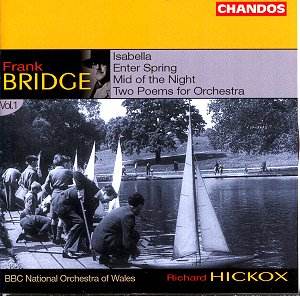
Frank Bridge: Orchestral Works, volume 1. Enter Spring; Isabella; Two Poems for Orchestra; Mid of the Night
BBC National Orchestra of Wales; Richard Hickox, conductor.
Chandos CHAN 9950. Recorded November 2000, Brangwyn Hall, Swansea. Compact disc, 75:48.
This first volume in Chandos’s ongoing exploration of Frank Bridge is a quiet revelation—a glimpse into a composer often eclipsed by his pupil Britten, yet possessing a voice of rare individuality and subtle power. The disc spans some twenty-plus years of Bridge’s output, from the youthful Mid of the Night (1903), a somewhat derivative tone poem, through the dappled impressionism of the Two Poems (1915), to the radiant autumn of Enter Spring (1927). The performances by Richard Hickox and the BBC National Orchestra of Wales are a model of commitment and insight, capturing the composer’s shifting moods with palpable affection and technical assurance.
Mid of the Night might have languished unheard for nearly a century, but it’s a crucial point of departure. The influence of Liszt’s symphonic poems and Tchaikovsky’s lush orchestration looms large here, though Bridge’s own orchestral voice is unmistakably assured. The textures are dense but lucid; the woodwinds notably carve out a nocturnal atmosphere with shimmering filigree and well-judged dynamic shading. It’s not revolutionary, but its ambitious scale and deft handling of orchestral color—particularly the warmth of the strings and the burnished brass chorales—mark it as a substantial early statement.
By contrast, Isabella (1906) displays a newfound structural economy and lyric grace. Here Bridge’s fascination with Keats is translated into long-breathed melodies and a rich but never overripe harmonic palette. The oboe theme representing Isabella herself is a tender triumph—a voice that lingers long after the music fades. The orchestration is sumptuous without excess: harp glissandi sparkle like morning dew, and the woodwinds’ interjections feel like intimate confidences rather than mere color. There’s a warmth and directness that suggests Bridge was already confident in his idiom, evolving from his earlier, more Romantic indulgences.
The Two Poems from 1915 are fascinating as transitional works—edges of Delius and French impressionism shimmer through their textures, especially in the subtle pastel scoring of the first piece. The music breathes with delicate nuance: muted strings and gently rippling harp create an almost tactile softness in the air, while the second poem bursts forth with agile rhythms and vivid orchestral effects. One can hear Bridge edging toward the more modernist idioms that would soon reshape his compositional approach. They feel like subtle sketches—intimate, probing, not yet fully resolved, but suggesting a restless creative mind.
Then, after the upheaval of the First World War, Bridge’s style shifts decisively, though this disc stops short of his postwar radicalism. Enter Spring (1927) stands as a late triumph, a radiant rhapsody shimmering with orchestral brilliance. The piece is sunlit but never saccharine; its central pastoral section is a marvel—seductive yet restrained, with woodwind solos that glide effortlessly over a shimmering string background. Hickox’s pacing here is impeccable, allowing the music to breathe organically, the climaxes swelling with natural inevitability rather than forced grandeur. The orchestral colors are vivid: bright brass fanfares announcing renewal, flutes trilling like songbirds, and a lush peroration that feels both expansive and intimately joyous. This is Bridge at his most assured and inventive, a composer fully at home with his medium and expressive aims.
Hickox and the BBC National Orchestra of Wales respond with warmth and precision throughout. The strings offer a polished sheen without gloss, the winds articulate cleanly with subtle phrasing, and the brass provide weight without bluster. There’s a sense of collective ownership that permeates the performances—a belief in these works that lifts them beyond mere revival.
This disc is indispensable for anyone interested in English music’s early twentieth-century trajectory. It unveils not only Bridge’s technical mastery but his emotional and stylistic evolution—from youthful Romanticism through impressionistic hues to mature brilliance. While Bridge’s postwar works might challenge listeners more, here is a composer whose music, richly textured and emotionally direct, deserves a wider audience. If you thought Bridge was merely a footnote to Britten, think again. Enter Spring and its companion pieces reveal a composer both of his time and ahead of it—crafting music of real depth, color, and heart. Highly recommended.