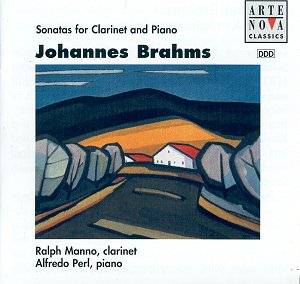
Johannes Brahms
Two Sonatas for Clarinet and Piano, Op. 120: No. 1 in F Minor, No.
2 in E-flat Major
Ralph Manno (clarinet), Alfredo Perl (piano)
Recorded 24 & 27 August 1992, Sendsaal Radio Bremen
Label: ARTE NOVA 74321 27767 2 [45:34]
Budget release
Approaching Brahms’s late clarinet sonatas is always a nuanced affair. These works—his final chamber pieces—are distilled, intimate, and charged with a kind of autumnal lyricism that demands both affection and a firm pulse. Ralph Manno and Alfredo Perl’s 1992 recording, though widely available on budget, struggles to inhabit this terrain convincingly.
Take the Sonata No. 2 in E-flat Major right off the bat. Marked Allegro amabile, the opening movement should breathe a tender, buoyant warmth—lovingly, yet with an insistence on forward momentum.
Instead, here it unfolds at an almost Andante pace, lethargic where it ought to be lively. The clarinet’s mellow start is pleasing enough, a soft woodiness that caresses the ear, but the surging lyricism Brahms weaves in mere bars is dulled, the narrative sagging under a lack of propulsion. That passionate outburst—so crucial—is robbed of its urgency by a tempo that is too leisurely, a kind of hesitance that feels more cautious than contemplative.
This hesitation seeps further into the Allegro appassionato "scherzo". The outer sections swing with a modest energy—though never quite catching fire—but the trio, marked Sostenuto, suffers most. Brahms’s direction demands a holding back that never loses sight of the original pulse; here, however, the pace slows to the point of stasis.
Perl’s piano playing compounds the problem. His approach is curiously “vertical”—each chord struck almost in isolation, lacking the smooth legato Brahms explicitly calls for with “ben cantando.” The resulting texture feels fragmentary, more a series of static snapshots than a flowing song. With no melodic line to hold onto, the music drags.
The Andante con moto fares marginally better thanks to a steadier tempo, but the texture remains somewhat plodding. Perl’s pedaling and voicing lack the finesse needed to illuminate the subtle rhythmic interplay between clarinet and piano; it’s too heavy, too blunt-edged. The "finale"’s Allegro begins with promise—there is some spark, some energy—but the Più tranquillo section again invites a retreat into sluggishness.
The new tempo is treated like an optional guideline, not a firm instruction. Over in the Sonata No. 1 in F Minor, the pattern unfortunately repeats.
The opening Allegro appassionato should blaze with intensity and a restless urgency; the interpretation, however, is muted, weighed down by Perl’s occasionally heavy-handed textures. There’s little bite here, and the rhythmic drive often feels uncertain. The Andante un poco adagio is where the ensemble’s flaws become most audible: the crucial rocking quaver figure in the piano is not sufficiently articulated, leaving the motion limp; Manno’s clarinet misses the subtle emphasis on the bar’s final quaver, a tiny detail but one that informs the pulse and phrasing profoundly in Brahms.
The last two movements gain a measure of grace. Manno’s clarinet tone is warm and occasionally tender, hinting at the intimate nobility Brahms intended. Yet Perl’s response remains ponderous and occasionally unresponsive to the clarinet’s phrasing nuances.
The textures become turgid, the rhythms diffuse rather than taut, and the interplay—the very heart of chamber music—is compromised. The album itself is serviceable but uninspiring. The Sendsaal Radio Bremen captures the instruments with clarity, no doubt, but there is little sense of bloom or resonance, no lingering warmth in the reverberation to complement Brahms’s rich harmonic palette.
The balance often favors the piano, but not in a way that reveals the dialogue; rather, it underscores the heaviness of Perl’s touch. In short—Manno and Perl do not lack technical command, but their conception of these sonatas misses Brahms’s late style’s essential qualities: urgency balanced with reflection, lyricism that breathes and pulses, and a dialogue that is as much about subtlety as it is about passion. These performances feel hesitant where Brahms demands sureness, ponderous where he wants lightness.
It’s a respectful effort, but at this price, the curious might be better — off exploring other interpretations that fully capture the bittersweet vitality of these masterworks. For anyone serious about Brahms’s clarinet sonatas, this one doesn’t convince. It’s a recording that—like a fine wine kept too long in the fridge—seems to have lost its warmth and — well — sparkle.
Approach with caution.