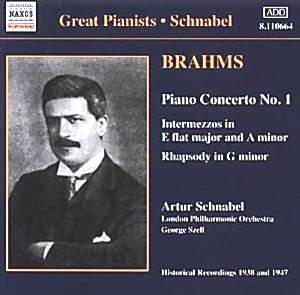
Johannes Brahms
Piano Concerto No. 1 in D Minor, Op. 15
Intermezzo in E-flat, Op.
117/1
Intermezzo in A Minor, Op. 116/2
Rhapsody in G Minor, Op. 79/2
Artur Schnabel (pianoforte)
London Philharmonic Orchestra / George Szell (Concerto)
Recorded January 9, 1938, and — well — December 18, 1938, EMI Abbey Road Studio No.
1 (Concerto)
Recorded June 4, 1947, EMI Abbey Road Studio No. 3 (Solo pieces)
NAXOS Historical 8.110664 [61:34]
Listening to Artur Schnabel’s Piano Concerto No. 1 with George Szell and the London Philharmonic is like stepping into a world where Romantic fervour meets classical restraint—an arena both passionate and austere.
This recording, made in the chilly environs of Abbey Road Studio No. 1 in early 1938, carries the weight of history yet breathes fresh immediacy. Schnabel, often caricatured for his supposed lack of digital flash, reveals here a piano tone that is astonishingly warm and full-bodied.
The notorious “hollow clatter” sometimes ascribed to him? All but banished. Instead, each chord unfolds with a richness that, quite frankly, none of his later competitors have matched.
Szell conducts with that characteristic severity—precise — unyielding, never allowing the players to wallow in sentimentality. The opening tutti is brisk, affirming the concerto’s tragic pathos without succumbing to lethargy. There’s a tautness here, a sharp-edged clarity that lets Brahms’s dense textures emerge with crystal definition.
Yet, Szell is no mere taskmaster; the quieter moments—those interludes of fragile lyricism—are afforded breathing room, neither rushed nor diluted. Schnabel’s reading of the "Adagio" is a revelation. It disproves the oft-repeated myth that he was constrained by the 78rpm format and therefore took slow movements at a clipped pace.
No, here he lingers, luxuriates even, every phrase drawn out with gravitas and poetic weight. The orchestra’s support is supple but watchful—the kind of partnership that keeps the music from becoming mawkish or stagnant. It is, without doubt, one of the most somber and deeply felt "Adagio"s I’ve encountered on record.
The "Finale", by contrast, sparkles with controlled vivacity. While some critics have pegged Schnabel’s articulation as “snatched” or “lumpy,” I find this reading full of character and intent. It’s as though the movement’s restless energy is harnessed but never tamed, the phrasing edged with a biting spontaneity that captures Brahms’s youthful impetuosity without losing coherence.
Turning to the solo pieces recorded nearly a decade later, Schnabel’s touch is no less compelling. The Intermezzi—Op. 117 No.
That particular brightness of period instruments catches the ear.
1 in E-flat major and Op. 116 No. 2 in A minor—are suffused with luminous transparency.
The notorious central section of the former, often a quagmire for pianists, flows effortlessly here, a testament to Schnabel’s consummate control of Brahms’s contrapuntal lines. His phrasing is natural, never forced, and the subtle interplay between melody and inner voices is rendered with chamber-music intimacy. The Rhapsody in G minor, Op.
79 No. 2, shines as a brooding and turbulent outcry. Schnabel’s ability to separate triplets, melody, and bass with the clarity of a string quartet while maintaining the full sonority of a grand orchestra is nothing short of masterful.
This is Brahmsian drama distilled to its purest essence—anguished, restless, yet meticulously crafted. A small caveat: the orchestral upper registers occasionally verge on stridency. One suspects that taming these would come at the cost of the piano’s newfound warmth, which producer Mark Obert-Thorn rightly defends.
The piano’s tone was originally recorded so close-miked that early pressings sounded dull and blunt. Fortunately, modern remastering has restored a sound that feels as alive and immediate as it ever could. Schnabel’s “lack of technique” has long lived on as a legend unworthy of belief.
Artistry isn’t merely digital gymnastics—it’s the ability to untangle Brahms’s complex textures and to articulate every voice with clarity and musical intent. On that score, Schnabel stands tall, a Brahmsian par excellence. This Naxos reissue offers an essential document, not just of Schnabel’s artistry, but of Brahms interpretation in an era when the composer was still a living, breathing challenge to performers.
For anyone seeking a reading that combines intellectual rigor, emotional depth, and — well — a nuanced orchestral partnership, this disc remains indispensable—and at this price, an absolute bargain. —Christopher Howell (with a nod to the late Len Mullenger’s invaluable archive)