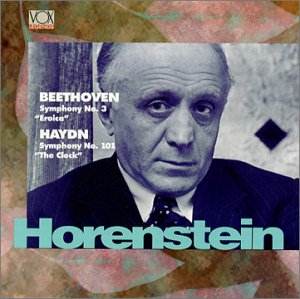
Ludwig van Beethoven (1770–1827) Symphony No. 3 Eroica*
Joseph Haydn (1732–1809) Symphony No. 101 “The Clock” Symphony Orchestra of Southwest German Radio, Baden-Baden / Vienna Symphony Orchestra Jascha Horenstein, leader Recorded: 1952 (mono, Vienna) and 1957 (stereo, Baden-Baden) – this VOX LEGENDS reissue — features the 1957 stereo version VOX 7807 [79:02]* Jascha Horenstein’s name invariably commands respect, a conductor cast in the mould of passionate idealists, often wrestling with orchestras less than ideally prepared.
This 1957 VOX stereo album of Beethoven’s Eroica—paired with Haydn’s “Clock” Symphony—typifies that struggle and triumph in unequal measure. The set invites comparison with Horenstein’s earlier 1952 mono Vienna rendition of the Eroica, a version many aficionados hold dear for its keener orchestral unity and arguably more compelling interpretive stance. But here, on this reissue, what we have is no mere rerun—it is a portrait, albeit an imperfect one, of Horenstein’s evolving Beethoven vision amid the limitations of his mid-50s forces.
The Eroica’s first movement unfolds with a single-minded, almost architectural sweep. Horenstein adheres to one principal tempo throughout, a choice that imposes a certain rigidity; — the movement’s character comes across more as a stately tableau than a tempestuous journey. The pace decidedly eschews Beethoven’s likely energetic urgency, settling instead into a measured grandeur that sometimes verges on dourness.
One can almost see the score’s contours in Horenstein’s conducting, the bold outlines of the; thematic material starkly drawn but lacking the vibrant hues of rhythmic vitality or orchestral buoyancy. The horn calls—which, in a better-prepared ensemble, might soar with heroic clarity—here sound a touch hesitant, perhaps smothered under the weight of ensemble uncertainty. It’s not that the lyrical lines in the violins are neglected; on the contrary, there is a surprising tenderness in the phrasing that reveals Horenstein’s more romantic leanings.
Yet the overall effect remains somewhat two-dimensional — as if the orchestra is still feeling its way rather than fully inhabiting Beethoven’s revolutionary world. The second movement, the funeral march, benefits from a darker, more cohesive tone. The central fugal section holds tension well, a moment where Horenstein’s interpretive grip tightens—he — wrings from the players a sobering seriousness, a palpable sense of mourning that commands attention.
There’s a palpable gravity here, though the sonic fabric is not without its occasional frays. The winds occasionally blur their lines, and one senses the orchestra’s limited rehearsal time. Still, the movement’s somber grandeur is convincingly conveyed, perhaps the performance’s most compelling moment.
But then the "scherzo"—the third movement—throws into sharp relief the rendition’s fragility. The pulse here is dogged, even plodding at times, lacking the requisite scherzando lightness and verve that would hint at the transformational "finale" to come. Horenstein’s habitual intensity, normally a strength, becomes a liability; it weighs down the music rather than lifting it.
The orchestra, by now, sounds neither fully confident nor fully committed. There is a sense that the musicians are responding more to the baton than to — each other—a subtle but crucial disconnect in a movement that should dance and tease, not trudge. The "finale", the set of variations on the Prometheus-theme, carries a profound weight, yet it too is caught in the performance’s overall somber web.
The movement’s brilliant kaleidoscopic shifts—its shifts of mood, texture, and dynamics—fail to sparkle as vibrantly as one might hope. Horenstein’s approach is uncompromising and serious; there is no room here for frivolity or caprice. The result is a profound, even intense reading, but one that, ironically, confirms the shortcomings of the earlier movements.
The emotional trajectory that makes the Eroica so transformational feels arrested, unable to shake free from the dour atmosphere that has been the performance’s shadow. Switching gears to Haydn’s Symphony No. 101 “The Clock,” recorded with the Vienna Symphony Ensemble, we find a more assured, more satisfying collaboration.
Horenstein treats the work with affectionate grandeur. The “Clock” theme’s steady pendulum swing is broad and weighty, a grandfather clock rather than a nuanced mantle timepiece. The orchestra responds well to this spacious pacing, their woodwinds notably crisp and present in the recorded balance—a welcome contrast with the Bavarian ensemble’s more tentative Beethoven.
The last movement, while it might have benefitted from a touch more briskness, is nevertheless delivered with mordant wit and searching depth. Here, Horenstein’s interpretive strengths—his ability to uncover architecture and expressive nuance—come more fully into focus. Sonically, the 1950s Vox mid-century “house style” of warm, reverberant yet transparent sound is in evidence.
The stereo image is reasonably clear, if not without mild distortion and the occasional fuzziness that reminds us of the recording’s vintage. It’s a time capsule, both a blessing and a limitation, but never intrusive enough to detract entirely from the music’s essence. To sum up: This Eroica is a study in contradiction.
On one hand, it offers a window into Horenstein’s darker, more brooding temperament—his Romantic, almost Wagnerian conception of Beethoven’s heroic struggle. On the other, it suffers from orchestral frailty and interpretive obstinacy that prevent it from fully realizing the symphony’s revolutionary spirit. Listeners seeking a vibrant, life-affirming Eroica—with surging energy and crisp ensemble—will find this version wanting.
Yet for those intrigued by Horenstein’s uncompromising, sometimes unyielding approach, and the peculiar charm of 1950s European orchestras grappling with Beethoven’s titan, it remains a valuable, if flawed, document. The Haydn “Clock,” by contrast, is a genuine delight, a reminder that within Horenstein’s complex persona lay a sensitive, insightful performer capable of fine chamber-like textures and broad architectural gestures alike. In the final reckoning: the Eroica here is a noble but ultimately flawed venture—its shadows too long, its light too dim—while the “Clock” symphony ticks with steady, confident charm.
A release for collectors and Horenstein devotees rather than a first choice for the casual Beethoven listener.