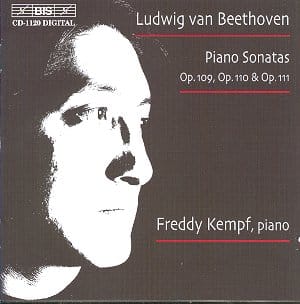
Freddy Kempf: Kempf Plays Beethoven
Ludwig van Beethoven: Sonata No. 30 in E major, Op. 109; Sonata No.
31 in A-flat major, Op. 110; Sonata No. 32 in C minor, Op.
111 Freddy Kempf, piano Recorded March 2000, Nybrokajen 11, Stockholm BIS CD 1120, 63:25 Released 2002 — Listening to Freddy Kempf’s early foray into Beethoven’s; final sonatas is like watching a young athlete—brimming with raw energy, technical mastery, yet still on the cusp of fully inhabiting the music’s profound emotional architecture. Recorded at the turn of the millennium but only recently revisited, this disc captures Kempf in a state of intense focus, his fingers darting with impressive agility, but his interpretative voice still finding its distinct timbre. Right from the outset, the Sonata No.
30 in E major, Op. 109, reveals a pianist fascinated by rhythmic complexity. Kempf’s articulation of the first movement’s jagged accents is notably clear—each syncopation and off-beat placement sharply delineated, avoiding any vague smudging that often blunts Beethoven’s rhythmic ingenuity.
The opening "presto" is nimble, yes, but there’s also a kind of youthful urgency, a rapid heartbeat racing beneath the surface. The adagio espressivo, on the other hand, unfolds with a rare sense of spaciousness. Kempf’s touch here is soft enough to float, especially around bar 83 where the una corda pedal conjures a gauzy, almost ethereal veil over the sound—the effect momentarily suspends time, like clouds drifting silently over a distant horizon.
It’s a magical moment, though perhaps one that hints at a pianist still exploring how much silence and decay truly mean in Beethoven’s late style. By contrast, the Sonata No. 31 in A-flat major, Op.
110, demands an altogether different temperament—one steeped in mystery and spiritual searching. Kempf approaches the first movement with a measured restraint, relying on minimal rubato that bestows a crystalline clarity on the texture. His pedaling is judicious, never blurring the staccato passages, and the dynamic shadings are finely calibrated.
There’s a lightness here—almost a dance of tone colors—where every note, even the softest one at bar 21, is registered with precision. Yet, this very delicacy sometimes undercuts the movement’s inherent tension. The inexorable march forward feels more like a gentle amble; the movement moves, yes, but without the driving force that can make Beethoven’s late sonatas so compellingly urgent.
Then we arrive at the monumental Op. 111, arguably the most daunting of Beethoven’s late piano sonatas. Kempf’s artistry is unquestionably formidable—his arpeggios in the Maestoso have a thrilling immediacy and clarity, each note ringing with crystalline precision.
The opening, with its carefully sustained accents, has a sharpness that commands attention. Yet, despite these strengths, the Arietta’s famously fragile lyricism proves elusive. At times Kempf’s tone—especially in the more hushed passages—strays into a louder register than Beethoven’s; subtle dynamic markings suggest, as if the pianist is overcompensating for the music’s introspective whispers.
His tempi, however, sit comfortably within the ideal range: the "finale"’s "allegro" con brio pulses with a vitality that neither rushes nor drags, preserving the polyphonic layers’ shimmering transparency. What Kempf brings to these sonatas is an undeniable technical command paired with an instinctive flair for piano color. His playing sparkles with moments of genuine beauty—the floating clouds of Op.
109’s adagio, the delicately painted phrases of Op. 110, the arpeggiated clarity of Op. 111’s Maestoso—each revealing a pianist who can draw remarkable sonorities from the instrument.
But there remains a slight hesitance, a sense that Kempf is still wrestling with the music’s deeper spiritual and architectural complexities. One hears a “young tiger” here, to borrow a phrase, bristling with energy and determination but yet to settle into the profound, sometimes painful quietness of Beethoven’s late voice. This disc isn’t the final word on either Beethoven or Kempf.
You can almost hear the rosin dust settling on the strings.
It’s a spirited, fastidiously crafted snapshot of a major artist at a formative stage. Those curious can certainly hear the seeds of greatness; one hopes—and expects—that Kempf’s subsequent journeys into this repertoire will bring greater depth and insight. Meanwhile, this production remains a valuable document: vivid, occasionally electrifying, but also candidly human in its imperfections.
In sum, Kempf Plays Beethoven is a compelling listen—not least because it captures the pianist’s formidable technique and fresh enthusiasm. Just don’t mistake it for Beethoven’s final say, or Kempf’s. The story — happily, is far from over.