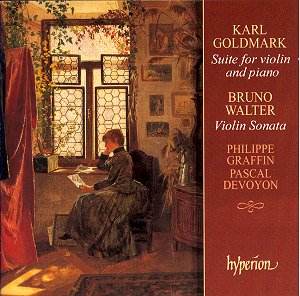
Bruno Walter and Karl Goldmark: Chamber Works
Philippe Graffin, violin; Pascal Devoyon, piano
Hyperion CDA67220
Hyperion’s engineers have given us something close to ideal here—a warm, present acoustic that lets you hear the rosin on the bow, the hammer felt on the strings. Henry Wood Hall doing what it does best. The question is whether the music itself rewards such lavish treatment.
Bruno Walter as composer. One hesitates.
Not because he lacked the training—he had it all, every bit of it. But Walter himself concluded, with what sounds like admirable self-knowledge, that his creative gifts didn’t measure up to his interpretive ones. This Sonata for piano and violin, substantial at over thirty minutes, makes you wonder if he was being too hard on himself… and then, after a second hearing, you suspect he knew exactly what he was about. It’s well-made. Always sounds right. The voice-leading is impeccable, the proportions carefully judged. But where’s the necessity? Where’s the idea you couldn’t have predicted from knowing the piece was written in the early twentieth century by a cultivated Viennese player?
The first movement unfolds with a certain earnestness—themes announced, developed, recapitulated with all proper ceremony. Yet nothing catches fire. The slow movement reaches for profundity but grasps only sentiment. By the finale, you’re admiring the craft while checking your watch. It’s music that knows all the right gestures without quite believing in them.
What strikes me most forcefully is the curious omission in Martin Anderson’s otherwise thorough notes: no mention of Mahler. Walter was Mahler’s protégé, brought by him from Hamburg to Vienna—surely this matters? Surely it illuminates something about Walter’s compositional reticence, his ultimate decision to channel his creativity through the music of others rather than his own? One wants to know: did Mahler ever look at this sonata?
Graffin and Devoyon play it with complete professionalism and what sounds like genuine conviction. They can’t make it more interesting than it is, but they never let it sound less.
The Goldmark Suite—now here’s a different animal entirely. Written in 1869, it makes no claims to depth. What it has instead is charm, directness, a kind of unabashed melodic appeal that the later Walter piece seems almost embarrassed to attempt. Goldmark knew his gifts: melody, color, a certain theatrical flair. This is salon music, if you like, but salon music written by someone who understood how to make a violin sing.
The opening movement has real spring in it. The central movements—particularly the “Allegretto quasi andantino“—allow Graffin to spin out those long-breathed phrases Goldmark loved, while Devoyon provides more than mere accompaniment. The finale dances. Actually dances, I mean, not just moves in triple meter while thinking serious thoughts.
Graffin’s tone throughout has an appealing directness—not a big, Romantic sound, but clean and focused, with vibrato used for expression rather than as constant seasoning. Devoyon matches him in clarity and purpose. Their balance feels natural, conversational. In the Goldmark especially, they seem to be enjoying themselves, and that enjoyment communicates.
So we have an excellently recorded disc of two works that occupy rather different aesthetic territories. The Walter remains more interesting as biography than as music—evidence of a creative impulse that found its true outlet elsewhere. The Goldmark, slighter in ambition, succeeds more completely on its own modest terms. Sometimes knowing what you’re not trying to do is as important as knowing what you are.
Worth hearing? The Goldmark certainly. The Walter… well, it’s unlikely to need replacing.