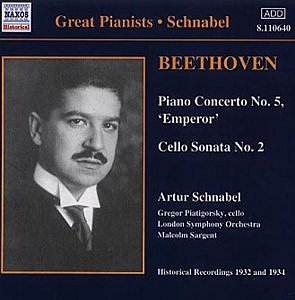
Ludwig van Beethoven
Piano Concerto No. 5 in E-flat major, Op. 73, Emperor
Cello Sonata in G minor, Op.
Artur Schnabel, piano
Gregor Piatigorsky, cello
London Symphony Orchestra / Sir Malcolm Sargent
Recorded Abbey Road Studio No. 1, 24 March 1932 (Emperor)
Abbey Road Studio No.
3, 6 & 16 December 1934 (Cello Sonata)
NAXOS HISTORICAL 8.110640 [60:07] — Mono digital transfer by Mark Obert-Thorn
Listening to this Emperor in Schnabel’s hands is like stepping back through a narrow doorway to an earlier Beethoven world — one that feels at once formidable and intimately human. Despite its near-century age, the 1932 Abbey Road mono release has been rendered with surprising clarity, though not without the occasional shrill edge, especially evident in the players’s first "Rondo" statement. It’s a sound profile you learn to accommodate — a little grit beneath the gilding, if you will.
Schnabel’s approach is the antithesis of flash or superficial bravura; instead, his reading is a measured, almost conversational negotiation with Beethoven’s grandeur. The opening "Allegro" sparkles with a tender tension between piano and orchestra — that dialogue over the repeated chords around the ten-minute mark is a masterclass in pacing and dynamic subtlety. Sir Malcolm Sargent’s baton is quietly assertive, never drowning Schnabel but never reduced to mere background.
He deftly balances the orchestra’s role — providing solid architecture without heavy-handedness. The "Adagio" movement… here Schnabel’s genius really blossoms.
His legato phrasing breathes life into the simple descending scales, coaxing a profound expressiveness from what so often might be treated as mere connective tissue. One can almost hear the air thicken around the piano’s tender main theme at 4:50, each note a sigh suspended in time. And that mezza voce ride into the "finale"?
It’s the kind of nuanced shading that stops the heart — a moment lost to many modern players obsessed with volume or velocity. The "Rondo", as lively and virtuosic as the concerto demands, is handled with elegant restraint. Schnabel’s legato remains impeccable even in the fleetest passages, a reminder that technical prowess in his hands serves musical poetry rather than spectacle.
Here, the orchestra occasionally sharpens edges in ways that remind us of the technological limitations of the period — the horns can sound piercingly thin, and the timpani, despite discreet placement, sometimes lose their grounding presence. Comparisons with other transfers are inevitable. The NAXOS issue offers a finely balanced digital remaster, avoiding the harshness heard on the Arkadia transfer — which is frankly an assault on the delicate textures Schnabel conjures.
The subtle intake of breath before the pianist’s attack.
Pearl’s three-disc set, with its warmer, more intimate sound and extensive Beethoven concerto collection, arguably presents the; most authentic sonic experience, but at the cost of bulk and, yes, a bit more surface noise. For the single-disc purchaser, NAXOS’s mix of accessibility and fidelity makes it the wiser choice, especially paired with the fascinating coupling. Ah, the coupling: Beethoven’s Cello Sonata in G minor, Op.
5 No. 2, with Piatigorsky and Schnabel — a union of two monumental musicians whose rapport borders on telepathic. The sonata’s opening "Adagio" sostenuto ed espressivo invites the listener into a chamber music séance, with Piatigorsky’s cello; voice rich and focused, save for a lone spot of intonation wobble around 5:45 in the second movement.
Schnabel’s accompaniment here is a model of attentiveness; his artistry seems almost invisible beneath his towering musicianship. The last movement’s ornamentation flows naturally, never forced — a testament to their shared devotion to Beethoven’s idiom. This disc, then, is more than a historical curiosity; it is a portal into a Beethoven execution tradition that prizes depth over dazzle, reflection over rush.
Listening to Schnabel’s Emperor, one hears not just the work itself but the weight of interpretative wisdom accumulated since the composer’s day. Combine that with Piatigorsky’s impassioned cello sonority, and you have a pairing that demands repeated hearings—to be savoured, pondered, and ultimately revered. If you seek the latest in crystal-clear sonics, this may not be your first port of call.
But if you long to experience Beethoven’s Emperor and that early sonata as living documents—full of human breath, occasional crackle, and timeless insight—this NAXOS release is indispensable. In short: Schnabel’s Emperor remains a touchstone — a performance that teaches us how to listen, how to feel the music’s pulse beneath the notes. And Piatigorsky’s cello—well, it’s a rare companion, one that turns the sonata from a chamber curiosity into a profound conversation.
Buy this disc not simply to hear Beethoven, but to experience a lineage of interpretation that, almost a century on, still speaks with clarity and heart.