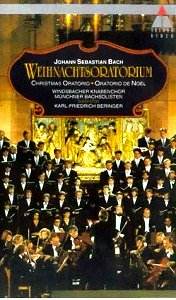
J.S. Bach. Christmas Oratorio.
Juliane Banse (soprano), Cornelia Kallisch (alto), Markus Schäfer (tenor), Robert Swensen (tenor), Thomas Quasthoff (bass). Windsbacher Knabenchor, Münchener Bachsolisten. Karl-Friedrich Beringer, director.
You can almost hear the rosin dust settling on the strings.
Recorded live at Heilsbronn Münster, July 1991. Label: Teldec video 4509-91124-3. Duration: 158 minutes. Bach’s Christmas Oratorio stands as a towering colossus in sacred music, a sprawling; tapestry woven from six cantatas that chronicle the Nativity story with theological depth and — well — festive exuberance.
Composed for Leipzig’s Christmas season of 1734, it reflects a Germany in flux—Lutheran tradition; meeting the ornate influences of French and Italian styles, liturgical rigidity loosening its grip. This Teldec video, produced under the baton of Karl-Friedrich Beringer with the Windsbacher Knabenchor and Münchener Bachsolisten, offers a window into a performance steeped in earnest precision but occasionally caught in stylistic rigidity. One must confess at the outset: the absence of female voices in the choir does impose a certain monotony on the vocal palette.
The Windsbacher Knabenchor, celebrated for their crystalline purity, deliver with technical finesse, yet the homogeneity of timbre — all boy trebles and young men — grows wearisome over the nearly three-hour span. Without the warm, rounded hues of women sopranos and altos, the choruses lose some of their tonal variety and emotional immediacy. After an initial glow, the sound can feel a touch monochrome, lacking the subtle color shifts Bach himself so often exploited.
Beringer’s conducting is a study in Germanic discipline—metronomic, exact, almost clinical. The tempos are steadfast, the articulation clean. Yet, this very precision borders on the antiseptic, draining some vital emotional juice from movements that cry out for more expressive shading.
Consider the opening chorus of Cantata I, “Jauchzet, frohlocket”—the energy is there, but it feels as though it’s being funnelled through a narrow lens, the natural ebb and flow smoothed out in pursuit of structural clarity. It’s a “by-the-book” approach, admirable for its polish but occasionally too cold for the warmth this music demands. The soloists, by contrast, inject life where the choir and company at times hold back.
Juliane Banse’s soprano is a luminous beacon—her vocal line fluent, nuanced, effortlessly floating above the texture. In her arias, such as “Bereite dich, Zion,” she reveals a keen sensitivity to Bach’s rhetorical gestures, with shadings that invite genuine contemplation. Thomas Quasthoff, too, emerges as the true standout—his bass voice is rich, sonorous, and imbued with an unusual depth of character.
From his first note, he commands attention; his vocal presence is undeniable. The duet with the solo trumpet in Cantata IV is a particular highlight, their interplay crackling with vitality and subtle rhythmic interplay. On the other hand, the two tenors, Markus Schäfer and Robert Swensen, are serviceable but somewhat lacking in expressive warmth.
Their intonation is secure, yes, but the emotional engagement feels muted. Cornelia Kallisch’s alto is often poised and competent, though occasionally she drifts into a more mechanical delivery that leaves me wanting a deeper spiritual connection. Orchestral playing is generally polished, with solo oboists shimmering and the trumpet’s trills executed with admirable flair.
The timpani strikes, unfortunately, betray a lack of cohesion—the choice of sticks leads to somewhat harsh attacks that jar against the otherwise smooth texture. Dotted rhythms, too, lose their characteristic bite, rendered with too much uniformity. The momentary enjoyment of the music by tacet orchestral members, visible on video, is a charming glimpse of musicianship alive—yet it contrasts oddly with the sometimes rigid overall interpretation.
A curious dissonance emerges between the youthful purity of the boy trebles and the mature expressiveness of Banse or Quasthoff. In one instance, a boy treble echoes a solo soprano line note-for-note, and the vocal disparity feels jarring, even banal—perhaps not Bach’s intent. While the boys excel in moments such as Cantata IV’s “Ihr Gedanken und ihr Sinnen” (with Quasthoff’s commanding bass), their voices occasionally sound strained, reminding us of the physical limits of youth.
Happily, some chorales shine with genuine splendor—smooth, flowing and heartfelt. Yet others lack the mercurial fluidity that transforms a simple hymn into a moment of transcendence. The overall impression is of a execution caught between reverence and restraint, one that honors Bach’s score but doesn’t fully ignite its spiritual fire.
In the shadow of Messiah—undeniably the gold standard for oratorio spiritual thrill—this Christmas Oratorio feels, at times, more workmanlike than wondrous. Bach’s music here is not always the sublime, richly layered masterpiece we hope for; there are stretches that feel; pedestrian or overly repetitive, particularly with the strict observance of repeats that prolong arias and choruses beyond their emotional necessity. To conclude: the Teldec video is a handsome, meticulously prepared document, with moments of brilliance courtesy of Banse’s and especially Quasthoff’s vocal artistry.
Yet the rigid conducting, the limited vocal color from the all-male choir, and occasional lapses into uninspired performance practice prevent it from reaching the heights this monumental work deserves. For those who prize crystalline purity and technical exactitude, it will hold appeal. But those seeking the full spectrum of Bach’s passionate humanity and spiritual uplift might find themselves yearning for more—more warmth, more color, more breath.
A worthy, if somewhat restrained, encounter with Bach’s Christmas Oratorio—a performance that acknowledges the genius but stops just shy of fully embodying it.