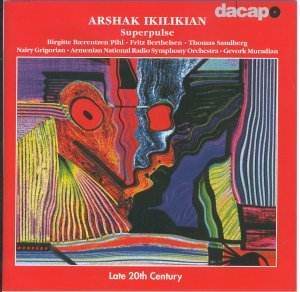
Arshak Ikilikian (b. 1948) The Courageous Nazar – ballet in one act (1981) Piano Concerto (1986) Superpulse for percussion and computer (1999) Success for violin and computer (1998) Crash for clarinet, bass clarinet and computer (1999) Nairy Grigorian (piano) Armenian National Radio Symphony Players /; Gevork Muradian Thomas Sandberg (percussion) Birgitte Bærentzen Pihl (violin) Fritz Berthelsen (clarinets) Recorded Yerevan 1987 (orchestral), Aarhus 1999 (computer works) DACAPO 8.224181 [70:26] — Ikilikian is one of those composers who quietly commands respect without ever loudly trumpeting his name in the West. Born in Armenia, now a Dane since the early ’90s, his output is prodigious—over 250 works including symphonies, ballets, and an intriguing range of electroacoustic pieces.
That the Danish label Dacapo has seen fit to issue this collection speaks volumes: a nod to a middle-ranker who nonetheless ventures far beyond the usual Nordic borders. The Courageous Nazar ballet, a one-act affair from 1981, nods unmistakably towards Prokofiev’s Love for Three Oranges (there’s an echo in the biting wit, the exoticism). But Ikilikian’s voice is far less whimsical—almost acrid in places, with gestures that spit and — well — slalom through the orchestral texture like shards of broken glass.
The Armenian National Radio Symphony, conducted by Gevork Muradian, delivers these moments with a certain — splendid dissolute flair: brass fanfares curl with a sharp edge; strings dart nervously, never settling. One might say the ballet’s musical drama unfolds like a vivid chiaroscuro—dark shadows punctuated by flashes of iridescent colour. The orchestration sparkles with a sly nervous energy, not unlike early Shostakovich but with an exoticism all its own.
That particular brightness of period instruments catches the ear.
Contrast that with the Piano Concerto, a compact, under-13-minute piece that feels—at first listen, anyway—like a distillation of late 20th-century musical currents. There’s a sternness here, a kind of austerity that recalls Schoenberg’s leaner moments, but the harmonic language also opens windows to more Romantic vistas—Rachmaninov’s warmth filters through, almost melted at the edges by the minimalist pulse of a Nyman-like stasis, especially evident in the slow movement. The piano writing is muscular but never showy; Nairy Grigorian plays with a crystalline precision that brings out both the concerto’s tension and its lyricism.
The "finale"—aptly dubbed the Golgotha ‘jester’ by Ikilikian—summons Shostakovich’s sardonic wit, a sly grin beneath the sombre mask. It’s a neat synthesis but also a work that perhaps demands more attention than a single hearing to fully appreciate its intricate architecture. Now, to the computer-enhanced works—these form a fascinating coda to the album, and perhaps the; most compelling draws for those steeped in the interface between acoustic and electronic sound worlds.
Superpulse follows a kind of sonic biography of life itself, beginning with a — distant heartbeat then layering a kaleidoscope of alarms, hisses, bells, rattles, and marimbas. Thomas Sandberg’s percussion here is a marvel of subtlety; each sound is clearly etched in the stereo field, yet the overall effect is seamless, almost organic. This is no mere gadgetry; rather, Ikilikian’s manipulation of the computer’s voice feels deeply human, an extension of percussion’s primal roots.
Success for violin and computer further explores this interplay. Birgitte Bærentzen Pihl’s violin begins solo—evoking a kind of Schelomo-like existential lament—but soon is enveloped in a digital tapestry that mimics the ‘oudh’ and North African percussion. The computer does not dominate but converses fluidly, a partner in an improvisatory dialogue rather than a mere backdrop.
The effect is rhapsodic, free-flowing, yet meticulously crafted. This piece alone justifies the disc’s existence for anyone interested in late-20th-century electroacoustic experimentation. Last, Crash for clarinet, bass clarinet, and computer, with Fritz Berthelsen’s expert clarinet duo, is a riotous, somewhat anarchic "finale".
Harpsichord-like plinks, synth drum rumbles, snarls of digitally processed sound collide and entwine with the clarinets’ rounded, lyrical lines. Towards the end, bird calls emerge—evoking Rautavaara’s Cantus Arcticus—a moment of fragile naturalism amid the electronic chaos. It hints at a potential series, solo instrument plus computer, akin to Malcolm Arnold’s solo works, but here with a postmodern twist.
There is a sense of narrative and drama, a restless energy that never quite settles into predictability. To be frank, this is not music that offers easy listening or immediate emotional gratification. Ikilikian’s work demands attention, patience, and an open ear—qualities increasingly rare in a world of streaming snippets and background noise.
Yet there is a rewarding depth here, a richly woven tapestry of influences and innovations. The Armenian National Radio Symphony and soloists—recorded with solid clarity—rise admirably to the challenge; while the computer works’ acoustic clarity and imaginative soundscapes place the composer firmly among late-20th-century modernists who truly understand technology’s musical possibilities. In the end, this compact survey of Ikilikian’s eclectic output is a valuable discovery.
Not a masterpiece disc in any absolute sense, but a collection that reveals a distinctive voice—one with a certain gnarl, a biting exoticism, and a restless, inquisitive mind. For anyone willing to engage with a repertoire less trodden, this is well worth the investment. Ikilikian may not yet claim a front-row seat in contemporary music’s pantheon, but he certainly deserves a wider hearing—and this release is a compelling argument why.