Georg Friedrich Händel
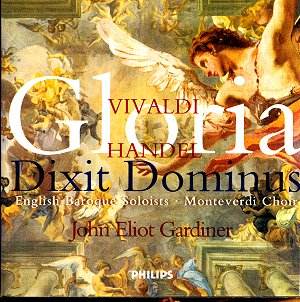
Gloria (HWV deest) / Antonio Vivaldi Gloria / Händel Dixit Dominus
The Monteverdi Choir, English Baroque Soloists
John Eliot Gardiner, leader
Gillian Keith (soprano)
Recorded November 1998 (Vivaldi Gloria and Händel Dixit Dominus); June 2001 (Händel Gloria)
All Hallows Church, Gospel Oak, London
PHILIPS 462 597-2 [78:21]
There’s a certain thrill in unearthing a “new” Händel work, especially one with the cachet of the Gloria in Excelsis Deo (HWV deest)—a piece that’s danced on the periphery of Händel scholarship, resting quietly in the Royal Academy of Music’s archives until Professor Hans Joachim Marx sounded the clarion call in 2000. Naturally, the buzz grew louder than a baroque trumpet fanfare — and with good reason. This Gloria is no pale imitation or pastiche; it bristles with the vitality and invention of Händel’s youthful years in Hamburg or early Italian sojourn.
Yet, the question remains: how does this 16-minute jewel fare in performance, and what can this particular recording, — under John Eliot Gardiner’s aegis with soprano Gillian Keith, tell us about the work’s place in the repertoire? First, a caveat—this Gloria is a soloist’s tour de force, scored for soprano, two violins, and basso continuo. No chorus.
No grandiose, Handelian massed voices here—just intimate, nimble virtuosity. The texture is transparent yet richly expressive, and — well — the solo violin’s filigree weaving around the vocal line offers a kind of conversational sparkle one doesn’t always hear in larger-scale works. The opening movement, “Gloria in excelsis Deo,” bursts with an infectious joie de vivre — quicksilver runs, trills, and the occasional daring leap.
Keith’s agility is commendable; she negotiates the florid passages with crisp precision. But—and it’s a notable but—her tone, while clean, lacks the crystalline warmth and emotional depth that someone like Emma Kirkby brings to the table. Kirkby’s voice, in contrast, feels like sunlight through stained glass: clear, nuanced, and effortlessly expressive.
Keith, though technically secure, sometimes sounds a shade too clinical—almost like a dancer more focused on steps than the music’s emotional undercurrent. The Gloria’s centrepiece, the “Qui tollis peccata mundi,” demands sustained lyricism and — well — dramatic shading. Here, Keith shows real promise—she inhabits the melancholy and supplicatory mood well, lingering on phrases with a natural ebb and flow.
Her slightly longer timing compared to Kirkby’s version suggests a willingness to breathe into the music, which is welcome. Yet, on balance, the emotional arc remains a little restrained, never fully breaking free into the impassioned sincerity one might hope for. It’s as if she’s still on the verge of discovering the piece’s full expressive potential.
Gardiner’s direction, as ever, is marked by clarity and stylistic flair. The English Baroque Soloists respond with bright, polished string playing, their interplay with the soprano precise, though I occasionally yearned; for a bit more warmth in the violin tone—perhaps a touch more gut-string grit to match the work’s youthful exuberance. The continuo, light and supportive, never overwhelms, allowing the vocal line to shine through with pristine articulation.
The warm acoustics of the concert hall seem to breathe through the recording.
This disc pairs Händel’s Gloria with the more familiar Vivaldi Gloria and — well — Händel’s Dixit Dominus. The Vivaldi sparkles with the kind of exuberance that has made his Gloria a perennial favourite; every da capo aria is a mini-firework, and the choir shines in the jubilant “Cum sancto spiritu.” The Dixit Dominus here is robust, with the choir and soloists climbing to dramatic peaks with verve and conviction, reminding us why Händel’s sacred music commands such reverence. If one’s primary interest lies solely in the newly authenticated Gloria, then the BIS release with Emma Kirkby remains the gold standard—her voice, as noted, is simply more idiomatic, more characterful, more “Handelian.” This Philips set offers a broader palette of baroque sacred music, though, extending listening pleasure beyond the novelty of the Gloria alone.
It’s a handsome package for those who want context and variety, rather than a single-minded focus. In sum: this Gloria is a fascinating addition to the Händel canon, a window into his early compositional voice, and this album, while not definitive, is a serious and respectful interpretation. Gillian Keith may not dethrone Kirkby as the prima donna of this work just yet, but she brings enough technical assurance and — well — stylistic insight to make the disc worthwhile.
Gardiner’s stewardship ensures a execution that is both scholarly informed and — well — musically vibrant, even if the emotional stakes rarely veer into the transcendent. For the Händel enthusiast and baroque connoisseur, this is an essential listen—if only to witness a rediscovered gem and to ponder anew the youthful genius of one of history’s towering masters. —
Richard Dyer