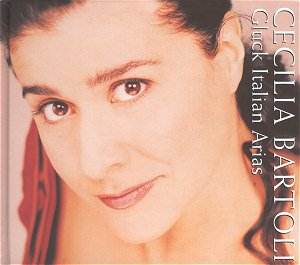
Christoph Willibald Gluck (1714–1787) Italian Arias Cecilia Bartoli (mezzo soprano) Akademie für Alte Musik Berlin, Bernhard Forck (leader) Recorded January 8 & 11–16, 2001,; Deutsches Filmorchester Babelsberg Studios, Berlin DECCA 467 248-2 [67:34] ___ Gluck’s pre-reform Italian arias, as laid out in this release, are a curious creature indeed. Not the stern “reformist” Gluck of Alceste or Orfeo ed Euridice—no, these are the operatic juvenilia, the strings-strewn, Metastasian-drenched canvases where the composer’s voice is at once tentative and intriguingly pliant. And what a vehicle Cecilia Bartoli is for this repertory.
Bartoli, with those famously arresting eyes fixed from the cover (a classically draped, rather than leather-clad, siren this time), brings to Italian Arias not just her signature coloratura fireworks but a deepened understanding of Gluck’s melodic rhetoric. It’s as if she’s peeling back layers of vocal excess to reveal a raw, almost conversational intimacy beneath the florid surface. The program is a bold gesture, if you like: six out of eight; arias newly recorded, excavated from operas that have long remained in the shadows.
It’s an act of devotion, one suspects, as much as it is a savvy bid for market distinction. Yet the real triumph here is the palpable collaboration between Bartoli and the Akademie für Alte Musik Berlin. This is not your typical “early music” group busily erasing any hint that their instruments are historical replicas.
Instead, under Bernhard Forck’s sensitive leadership, the ensemble conjures a vivid palette of sonorities—the gut strings hum with a woody warmth, the baroque oboes and natural horns breathe with a rustic charm, and the harpsichord’s nuanced continuo weaving is never intrusive but always subtly propulsive. The balance is exquisite: intimate without becoming insipid. Bartoli’s skill deserves special mention.
There has been much chatter about her vibrato—sometimes accused of being over-indulgent, other times a calculated expressive device. Here, it is both. She wields it like a secret weapon: at times the voice rings out with a pure, almost soprano clarity—those soaring top Bs in “Ah, taci, barbaro,” from La Clemenza di Tito are spun with an effortless sheen—yet, then she plunges into a rich, contralto-like middle register, lending a velvety shadow that refuses easy classification.
Is she mezzo or soprano? The question eerily misses the point; Bartoli inhabits a vocal realm all her own, shifting tessitura like a landscape painter modulating light and shadow. Her breath control is impeccable.
Passages sparkle with crystalline articulation, the notorious “h” that once peppered her rapid runs is nowhere to be found, replaced instead by precise, nimble execution. The famous trill—an often overlooked barometer of Baroque and Classical style—is on glorious display, particularly in the La Semiramide riconosciuta aria “Ciascun siegua il suo stile maggior follia.” Bartoli’s trills sparkle with elegant flexibility, oscillating cleanly between intervals, while her vibrato vibrates subtly beneath, never threatening clarity. The recital is not without its moments of strain, however.
The Semiramide aria struck me as somewhat banal, a relic of a fashion for ironic banality that perhaps hasn’t aged well. Yet, this does not damn the disc; rather, it places it in context—Gluck was still finding his way. The emotional range Bartoli traverses—from the trembling doubts of La Clemenza’s “Tremo fra’ dubbi miei” to the sardonic wit of La; Semiramide—is broad and well-contoured, even if no single phrase lingers in the memory quite like the great arias of Gluck’s reform period.
One must also admire the production values. Christopher Raeburn’s name inspires confidence, and rightly so. The sound is warm, immediate, and remarkably transparent—this is a production that invites close listening; micro-details emerge with satisfying clarity: the slight rubato in the continuo line, the ensemble’s subtle dynamic shifts, Bartoli’s nuanced phrasing.
That particular brightness of period instruments catches the ear.
There is a sense that this project was undertaken with genuine affection and patience, not just commercial expediency. To the question of live performance versus studio magic: yes, Bartoli’s voice can appear smaller in the hall—those who have heard her live report a certain intimacy that may not fill a grand opera house. But on disc, this vulnerability becomes a strength.
The voice floats and — well — shimmers in the controlled acoustic of the studio, each phrase captured with forensic attention to detail. The recitative preluding the Ezio aria “Misera, dove son!” feels almost whispered—this is microphone singing in the best sense, a candid moment of dramatic confession that might well be lost in a larger space. Ultimately, this disc is a fascinating contribution to Gluck’s discography and a testament to Bartoli’s artistic courage and charisma.
The music may not yet possess the monumental sweep of the reform operas, but it reveals a composer of melodic grace and dramatic subtlety—qualities that Bartoli and the Akademie bring vividly to life. If you are new to Gluck beyond Orfeo and Alceste, this album is more than an introduction; it’s a revelation. It whets the appetite for full stagings of these long-neglected operas, and in the meantime, it offers a rich, involving journey through the prelude to Gluck’s revolution in opera.
Bartoli remains — undeniably — one of the most compelling singing artists of our time — a phenomenon not easily pinned down or boxed in. Here, she inhabits Gluck’s Italian world with a mixture of intelligence, technical mastery, and sheer musical joie de vivre: a captivating interpretation that will linger well beyond the final note. — Richard Dyer