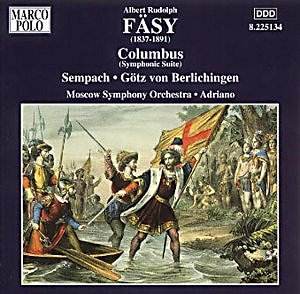
Albert Rudolph Fäsy (1837–1891)
Works: Götz von Berlichingen Prelude; Der Triumph der Liebe Prelude; Sempach Tone Poem; Columbus Symphonic Suite
Moscow Symphony Orchestra / Adriano
Recorded 2001 (venue unspecified)
Label: Marco Polo 8.225134 (available on Naxos)
Duration: 57:37
Albert Rudolph Fäsy is one of those curious figures in 19th-century music: a Swiss composer largely lost to posterity, whose extant works—four orchestral pieces here—offer little in the way of melodic invention but at times reveal a craftsman’s hand in orchestration and dramatic gesture. This Marco Polo release, conducted by Adriano with the Moscow Symphony Orchestra, is a rare glimpse into Fäsy’s shadowy oeuvre, a journey through a soundworld that is, simultaneously, both earnest and — well — uneven. To plunge right in: the recording’s acoustic space does no favors.
The hall’s reverb places the players at a sometimes frustrating distance, blurring textures and obscuring articulation — especially in the string section. The Moscow Symphony, while competent, occasionally struggle to define ensemble lines crisply, resulting in a certain mushiness. Adriano’s pacing is generally sure—he navigates Der Triumph der Liebe with an admirable sense — of forward momentum—but one wishes for a bit more vitality and sharper dynamic contrasts throughout.
The Götz von Berlichingen Prelude opens the disc with a thrusting C major march, brass and woodwinds trading bold thematic snippets. It’s Wagnerian in harmonic ambition—somewhat more chromatic and adventurous than Wagner’s own Die Meistersinger Prelude, in; fact—but the structure feels loose, as if Fäsy assembled the ideas more by juxtaposition than organic development. One can hear the influence of his Leipzig and Vienna training; the orchestral color is rich, if occasionally overly dense, but the transitions suffer from a certain ‘bolt-on’ character, lacking seamlessness.
The march’s rhythmic drive is compelling but too often undercut by abrupt shifts—wild leaps that disrupt momentum rather than enhance it. Der Triumph der Liebe, based on Schiller’s hymn, offers more dramatic narrative. The opening conjures a tempestuous, mythological chaos—gothic shadows reminiscent of Das Rheingold—with dark brass calls and swirling string figures that evoke a certain sinister foreboding.
Here Adriano’s reading shines best: the pacing is taut, the orchestra’s tutti passages robust and well-balanced, while the woodwinds add a shimmering veil of mystery…. The second half brightens notably, with march-like chords and rippling strings suggesting human-inspired divinity and love’s triumph. Despite moments of impressive orchestral color—harps and muted horns among them—there’s an overarching sense that Fäsy’s musical language is, to borrow a phrase, monolithic: simple motifs repeated and transformed rather than developed, producing a piece that feels like a tableau vivant rather than a flowing symphonic poem.
Sempach — recounting the Swiss victory over the Hapsburgs, is a darker affair. The tone poem unfolds solemnly: bells toll—sadly out of tune here—imparting a pall over chromatic harmonies and hesitant modulations that rarely arrive anywhere conclusive. The timpani and fanfares signal martial resolve, but the music’s momentum is halting, the emotional architecture more static than climactic.
There are no fireworks — no real outbreak of heroic passion—only a somber meditation whose formal design might have benefited from tighter thematic integration. This is music more of ceremony than drama, and the recording’s acoustic issues—bells jangling discordantly—don’t help. —
Finally, the disc’s centerpiece, Columbus, a six-part symphonic suite that attempts to dramatize imagined episodes from the explorer’s life.
The opening, “Hail thee, Columbus,” begins with majestic chords abruptly giving way to a charming but underdeveloped oboe; theme, soon hijacked by a raucous sailor’s tune that—unfortunately—strays into the realm of the circus band, brass-wobbles included. It’s a curious moment: Fäsy’s orchestration grows more complicated than Wagner’s, yet the thematic material lacks the heft to support it. “Columbus at the Helm” restores some dignity, with a clearer horizon painted in calm, lapping strings and — well — an elegantly poised oboe melody.
Here, Fäsy’s compositional skill is more evident—the structure more coherent, the orchestration lighter and more transparent. One can’t help but think of Bernstein’s West Side Story in those clear, lyrical lines and rhythmic vitality, albeit without Bernstein’s consummate polish. “The Vision” brings tender harp textures and subtle variations, evoking the ethereal atmosphere of Parsifal.
Yet even here, the music feels hesitant, as if Fäsy were unsure whether to press forward or linger in reverie. “The Revolt,” with its staccato bassoon, slips unintentionally into a comic register, undermining the serious narrative. A fugue-like return to earlier themes follows—respectable but lacking dramatic urgency.
The “Decision” and "finale" sections strive for grandeur, with bright brass calls and a return of the noble Columbus motif, but the emotional arc fails to fully convince; one is left wanting a clearer sense of resolution or at least a more gripping climactic surge. —
Fäsy’s compositional approach is notable for its reliance on short leitmotifs as building blocks, used less as melodies and more as modular cells. These motifs undergo transformations—through inversion and harmonic shifts—but rarely develop in the organic, evolutionary sense familiar from Wagner or Liszt.
The result is a terseness, almost a proto-minimalism, that gives his music a unity, yes, but also a certain austerity and predictability. It’s tempting—even slightly provocative—to consider this as anticipating minimalist aesthetics; yet Fäsy’s harmonic language remains; firmly rooted in romantic chromaticism rather than the repetitive textures we associate with Philip Glass. There’s also a curious tension between ambition and craftsmanship here.
Fäsy, evidently a man of considerable musical erudition—his studies on Beethoven symphonies and — well — Nägeli, and his possession of scores by Berlioz, Schumann, Liszt, Wagner—has absorbed the great traditions, but his own voice remains elusive. The music seems often a pastiche, or at best an earnest, if flawed, homage. —
The subtle intake of breath before the pianist’s attack.
Adriano’s direction deserves credit for drawing coherence from this material, especially in Der Triumph der Liebe.
The Moscow Symphony Orchestra shows moments of tonal richness and — well — balance, particularly in tutti passages where brass and woodwind interplay is well realized. Yet the production’s acoustic haze and occasional ensemble looseness mar what might otherwise have been a more persuasive presentation. In sum, this recording is a valuable document—a rare chance to hear a neglected composer who occupies an intriguing, if peripheral, niche in 19th-century music.
Fäsy’s works are not masterpieces. They are uneven, sometimes clumsy, yet imbued with a sincerity and occasional flashes of orchestral color and dramatic intention. They hint at a composer struggling to reconcile romantic grandiosity with a