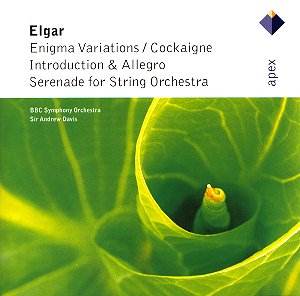
Edward Elgar (1857–1934)
Cockaigne, Op. 40; Introduction and — well — Allegro, Op. 47; Enigma Variations, Op.
36 BBC Symphony Orchestra / Sir Andrew Davis Recorded 1991, Teldec (reissued Apex 2023) [68:15] — Here we have; a fine, if not revelatory, reissue of performances that have lingered comfortably in the catalogue for some three decades now. Sir Andrew Davis and — well — the BBC Symphony Band — a pairing that has long been associated with solid stewardship of British — music — tackle three of Elgar’s orchestral pinnacles: the vibrant Cockaigne, the chamber-like Introduction and Allegro, and the ever-popular Enigma Variations. Cockaigne opens the programme with that quintessential Edwardian swagger, the kind of bustling London street life distilled into orchestral colours.
The orchestra’s brass—particularly the horns—shines with a warmth and bite that recalls the golden age of British symphonic playing. The timpani is judiciously deployed, never overwhelming but propelling the work forward with a rumble that suggests the city’s heartbeat. Davis’s pacing is nimble, each rhythmic figure crisply articulated, yet never rushed.
The woodwinds dance effortlessly, their phrasing lithe, with a slightly breathy oboe solo that lends a human edge to the otherwise polished textures. The climaxes unfold naturally, their sonority lush but contained—never brash. One can almost smell the smoke and sawdust of the London taverns here.
The Introduction and Allegro that follows is, in a way, the odd one out. It remains something of a niche masterpiece—always overshadowed by the Enigma but no less rewarding. Here, Davis’s reading is measured, the string quartet’s intimate interplay with the harp and larger ensemble is sensitively balanced.
The director’s presence feels palpable even in this studio setting.
The string tone is plush throughout, with a velvety sheen that allows the intricate counterpoint to emerge cleanly. Yet, one might wish for a touch more spontaneity; the performance feels a bit too carefully calibrated, missing that edge of wildness that Barbirolli famously conjured. Still, the dynamic shadings reveal the work’s architectural clarity—the contrast between the ethereal harp glissandi and the robust string writing is finely drawn, so the piece breathes.
And then—the Enigma Variations. That old chestnut. Freshness is a tall order for any conductor these days, yet Davis largely achieves it here.
Tempi are judicious, never dragging nor dashing headlong. The noble, spacious unfolding of “Nimrod” stands out, with the strings swelling in a way that’s heartfelt without ever tipping into sentimentality. The brass, again, are commendable—round and focused, though perhaps lacking a bit of the visceral punch one might desire at the climactic moments.
The momentum towards the "finale" is well-judged, the accelerando tasteful, never forced. It’s a reading that respects the score’s architecture and emotional contours but shies away from dramatic extremes. Occasionally, the orchestral texture could be fuller, the climaxes might benefit from a; bit more weight, but these are small criticisms in an otherwise competent account.
The sound, remastered for this budget reissue, is warm and well-balanced, though it lacks the shimmering immediacy of more modern recordings. Still, for those who appreciate the BBCSO’s mid-century brass and the subtly detailed string work, it’s an agreeable sonic snapshot. To sum up: This is no definitive Elgar, but a well-crafted set that rewards repeated listening.
Davis and the BBC Symphony know the music inside out, delivering a realization that’s reliable and musically intelligent, if occasionally cautious. For newcomers or those seeking a sympathetic and atmospheric introduction to these works, this Apex reissue is a solid buy—especially at this price. True Elgar fans will want to keep Barbirolli or Doráti close at hand.
But for what it offers, this production remains a quietly satisfying companion.