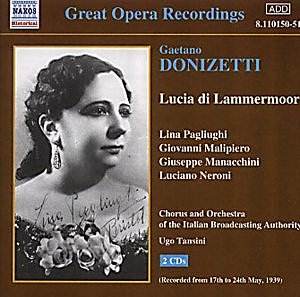
Gaetano Donizetti Lucia di Lammermoor Lina Pagliughi (soprano), Giovanni Malipiero (tenor), Giuseppe Manacchini (baritone), Luciano Neroni (bass) Orchestra and Chorus of the Italian Broadcasting Authority Director: Ugo Tansini Recorded Rome, 17–24 May 1939 Naxos Historical 8.110150–51 [2 CDs, 134:24] Reviewed from the Ward — Marston remastering — To stumble upon a performance of Lucia di Lammermoor from 1939 is to open a window onto a vanished world—one that predates modern hyperbole, the age of arena-sized voices, and a certain brand of theatrical grandstanding that has become de rigueur. Ugo Tansini’s conducting here is notable for its clarity and restraint, qualities that have become something of an endangered species in bel canto opera. Lina Pagliughi’s Lucia is a revelation not just for the historical curiosity it presents but for the exquisite musicality it embodies.
Her soprano is light—limpid, even—without the robust, fiery thrust demanded by later, more bombastic interpretations. This is a voice that seems to float in the air, silkily navigating the coloratura with an ease bordering on casual, but never at the expense of precision. It’s not just technical agility, though that is there in abundance; it’s a sense of grace and — well — elegance — that feels more authentic to Donizetti’s era than the heavyweight showpieces we’re used to from Callas or Sutherland.
You can almost hear the rosin dust settling on the strings.
The opening “Regnava nel silenzio” is an exemplary case in point. Pagliughi’s phrasing eschews excess—there’s a subtle shaping of the line, subtle dynamic shading,; and a purity of tone that reveals the aria’s melancholy without forcing it. You can almost smell the cold Scottish moors in the orchestral interlude, rendered here with a transparency that’s a rarity in recordings of Lucia.
Giovanni Malipiero’s Edgardo is an illuminating partner—his tenor is clear, balanced, and free from the forced brilliance that sometimes mars this role. His “Tombe degli avi miei” unfolds with a plaintive lyricism, and the timbral glow he brings complements Pagliughi’s soprano beautifully. The duet “Verranno a te sull’aure” betrays a shared stylistic ethos, a mutual commitment to textual clarity and — well — emotional subtlety.
Giuseppe Manacchini’s Lord Enrico Ashton fills out the baritone part with solid, if somewhat conventional; gravitas; he doesn’t quite push the dramatic envelope but serves the score’s demands with dependable authority. Luciano Neroni’s Raimondo Bidebent offers a robust bass foundation, his voice resonant without overpowering—judiciously measured. But the real star here is the vanished performance practice itself.
This is not a Lucia for those addicted to the adrenaline rush of vocal pyrotechnics or the siren calls of extreme emotionalism. It’s an artifact of a time when bel canto was still living breathing speech, a style wherein elegance; trumped excess, and the orchestra never drowned out the drama but rather wove itself delicately into the narrative fabric. Of course, the album is heavily cut—typical of the period and format constraints.
It runs considerably shorter than the more lavish, uncut versions that became standard postwar. But the flipside is that the discs include 37 minutes of additional arias by Pagliughi—from Rossini to Verdi to Giordano—that showcase her remarkable versatility and stylistic finesse. Her rendition of “Convien partir” from La Figlia del Reggimento sparkles with effervescence; her “Caro nome” from Rigoletto is tender and understated rather than showy.
A surprise is the Giordano aria “O colombello sposarti” from Il Re, which she treats with unexpected warmth and richness, a fitting coda to this nostalgic journey. The sound quality—thanks to Ward Marston’s meticulous remastering—is surprisingly fresh and clean. One hears the distinctive timbre of the Italian Broadcasting Authority band and chorus with a clarity that renders the 1939 vintage less of a hurdle and more of a charm.
The absence of a libretto is a minor inconvenience — offset by well-written notes and succinct plot summaries. In sum, this Lucia stands as a vivid reminder of a vanished interpretative world—one where vocal finesse married to musical intelligence produced a markedly different kind of bel canto experience. It’s a interpretation that will unsettle those accustomed to the Sutherland-Callas template but will enrich anyone eager to hear Donizetti’s masterpiece through a less familiar lens.
For all its historical quirks and cuts, it remains an arresting, high-standard musical — document—one that deserves a place on the shelf of any serious opera lover. A true rediscovery, then, as vital for what it reveals about performance practice — as for the sheer pleasure of hearing Lina Pagliughi’s radiant artistry once more.